 Ban dino nga? Kiis
 Xeexu dino
 Rawante dino
 Fo yu ndaw yu dino
 Albomu sitikeer
 Limu TOP yu dino
 Bett ma!
Arthropterygius
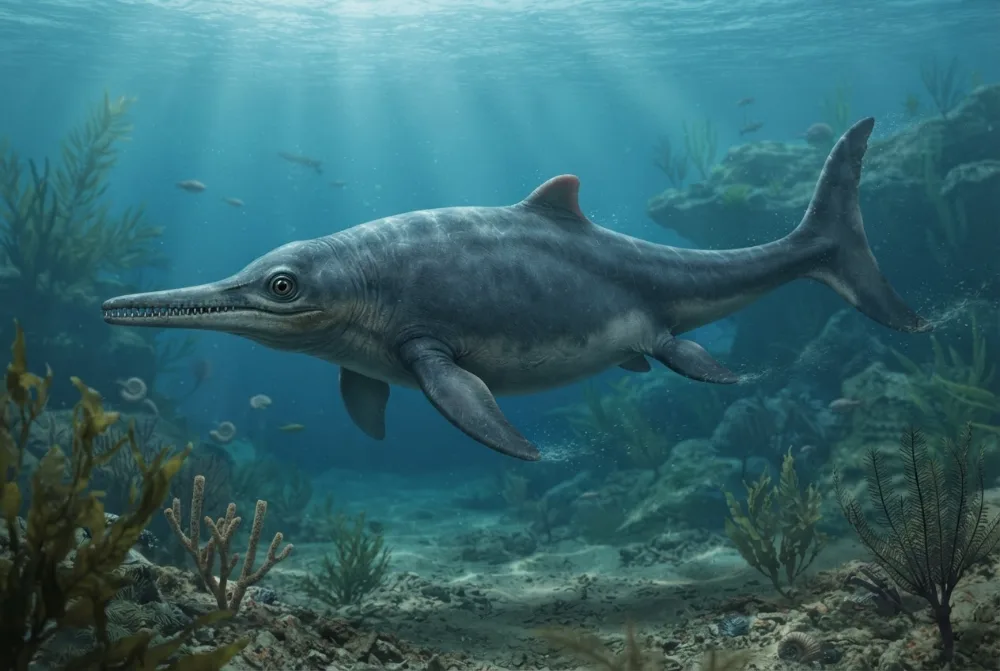
Arthropterygius was a large, fish-shaped marine reptile that swam in the oceans during the late Jurassic period. It had a long snout and strong flippers, and it was a fast hunter of fish and squid.13
Kañ la dundoon?
Naka la réyoon?
Naka la guddoon?
 gudd ni 5 xaj, bakkan ba geen🍌gudd ni 28 banaana yu ñu topp-toppale🏊mënoon na féey guddaayu pisin bu mag (50 m) ci 3,9 segond
Naka la Arthropterygius réyoon, bu ñu ko méngalee ak YAW?
Ay kalkil rekk ci sa navigatëer. Dara du ñu denc, dara du ñu yónne fenn.
Naka la gaawoon?


Xibaar yu neex
Arthropterygius had a special opening for the internal carotid artery on the back of its braincase, a feature unique among ichthyosaurs.2
Fossils of Arthropterygius have been found in both the Northern and Southern Hemispheres, showing it lived in warm and cold seas.12
One specimen from Svalbard, Norway, was about 3.8 to 4.3 metres (12 to 14 feet) long and was probably an adult.1
The name Arthropterygius means 'wing fin', referring to the shape of its flippers.1
Arthropterygius lived in shallow seas with methane seeps, where the seafloor was about 150 metres (490 feet) deep and had little oxygen.1
It belonged to a group called ophthalmosaurids, which were the last surviving ichthyosaurs before they went extinct.1
Laaj yi ñu gën a laaj ci Arthropterygius
?How big was Arthropterygius?
Arthropterygius was a relatively large ichthyosaur, with all species measuring between 3 and 5 metres (9.8 to 16.4 feet) long.1
?What did Arthropterygius eat?
It was a fast hunter of fish and squid, using its long snout and strong flippers to catch prey.1
?Was Arthropterygius a dinosaur?
No, Arthropterygius was an ichthyosaur, a type of marine reptile that lived in the oceans, not a dinosaur.1
?Where did Arthropterygius live?
Fossils of Arthropterygius have been found in Canada, Norway, Russia, and Argentina, showing it lived in both warm and cold seas across the Northern and Southern Hemispheres.1
Ngir ñi xam dino lool
- Turu xam-xam
- Arthropterygius
- Ku ko tudde
- Maxwell 20103
- Kurél
- Iktiyosoor yi
- Njaboot / klad
- Ophthalmosauridae3
- Klasifikasiyoŋ
- Ichthyosauria > Ichthyosauromorpha3
- Màggaayu doj yi
- 162 ba 143 milyoŋ at (Oxfordian / Tithonian)3
- Formasiyoŋi doj
- Ringnes, Agardhfjellet, Vaca Muerta3
- Réew yi
- Kanadaa, Norwees, Arsantin, Riisi3
- Fosil yu ñu gis
- 8 ci The Paleobiology Database3
- Gisees
- The first fossils of Arthropterygius were found on Melville Island, Canada, and were originally named Ophthalmosaurus chrisorum in 1993. In 2010, scientist Erin Maxwell gave them a new genus name, Arthropterygius.13
- Ñu ngi koy werante ba tey
- Scientists are not sure if Arthropterygius lived into the earliest Cretaceous period, or if it went extinct at the end of the Jurassic.1
Fa xibaar yi jóge
- Arthropterygius (en.wikipedia.org)
- Original article The genus Arthropterygius Maxwell (Ichthyosauria: Ophthalmosauridae) in the Late Jurassic of the Neuquén Basin, Argentina ☆ (sciencedirect.com)
- Arthropterygius in The Paleobiology Database (CC BY 4.0): at, béréb yi, formasiyoŋi doj, klasifikasiyoŋ.
Bépp xibaar ci xët wii am na lim bu wone fa mu jóge. Su nu juumee, baal nu, nun ñu bëgg dino lanu, du ab sërnaalu xam-xam. Wax nu ko ci [email protected] nu defar ko.
 Rex xiif na! Dino Wiki, mbiru ab baay la ngir doomam ju góor ju bëgg dinosoor, ci neen te amul kaamuñaate, amul tracker. Mag ñi mën nañu jox Rex tuuti ñam ngir dimbali ko mu des ci internet.Dundal Rex
 Ichthyosaurus
 Platypterygius
 Stenopterygius
 Khudiakovia
 Ophthalmosaurus
 Chonespondylus
 Brachiosaurus
 Diplodocus
 Allosaurus
 Brontosaurus
 Compsognathus
 Camarasaurus