 Ban dino nga? Kiis
 Xeexu dino
 Rawante dino
 Fo yu ndaw yu dino
 Albomu sitikeer
 Limu TOP yu dino
 Bett ma!
Kañ la dundoon?

Naka la réyoon?
Naka la guddoon?
Naka la kawewoon?
jortu
Naka la diisoon?
 gudd ni 2 muusu kër, bakkan ba geen🍌gudd ni 6 banaana yu ñu topp-toppalelu tollu ci diisaayu muusu kër🍌diis ni 42 banaana🪑tuuti ba mën a dox ci suufu siis🏃mënoon na daw 100 meetar ci 14 segond (nit ki gën a gaaw dafay soxla 9,6)
Naka la Caudipteryx réyoon, bu ñu ko méngalee ak YAW?
Ay kalkil rekk ci sa navigatëer. Dara du ñu denc, dara du ñu yónne fenn.
Naka la gaawoon?


Xibaar yu neex
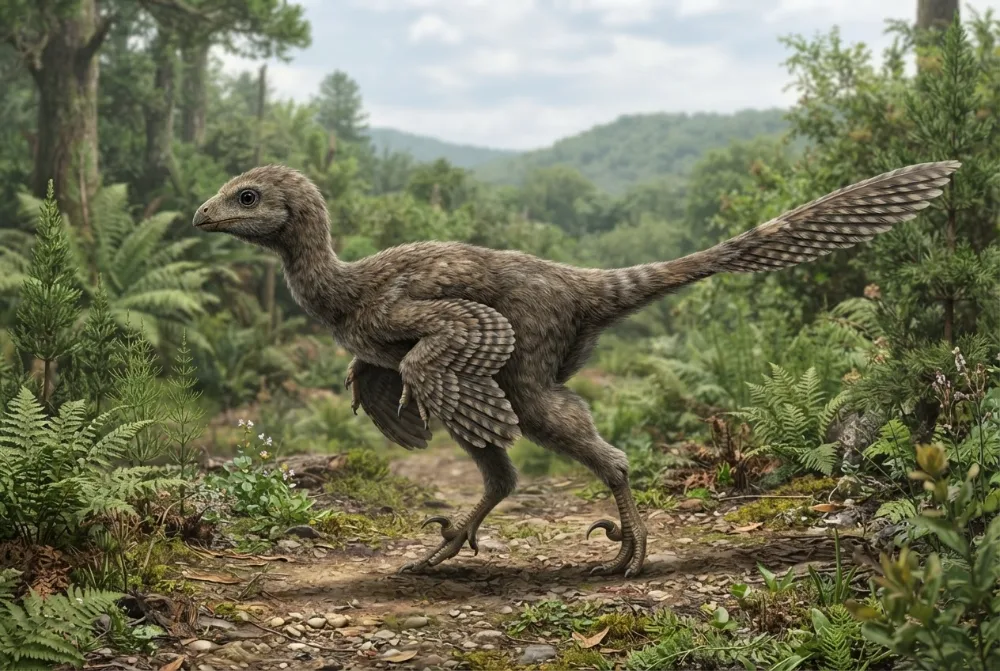
Caudipteryx had long, symmetrical feathers on its hands and tail, measuring 15 to 20 centimetres (5.9 to 7.9 inches) long. These feathers were black with a banded pattern on the tail.1
Its discovery in 1998 helped prove that birds evolved from dinosaurs, because it had clear feathers but was not a bird.1
Caudipteryx had a short, boxy skull with a beak-like snout and only a few teeth in the front of its upper jaw.1
Scientists think Caudipteryx was secondarily flightless, meaning its ancestors could fly but it lost that ability.1
Fossils of Caudipteryx have been found with gizzard stones in the place where its stomach would have been, just like in some plant-eating dinosaurs and modern birds.1
Laaj yi ñu gën a laaj ci Caudipteryx
?How big was Caudipteryx?
About 72.5 to 89 centimetres (2 feet 4.5 inches to 2 feet 11 inches) long and weighed around 5 kilograms (11 pounds). It was about the size of a peacock.14
?What did Caudipteryx eat?
It was an omnivore. It probably ate insects and maybe plants, and it swallowed small stones called gastroliths to help digest its food.12
?Could Caudipteryx fly?
No, it could not fly. Its arms were too short to work as wings, and scientists think it was secondarily flightless, meaning its ancestors could fly but it lost that ability.14
?When did Caudipteryx live?
It lived during the Early Cretaceous period, about 124 to 122 million years ago.12
?Where was Caudipteryx found?
All Caudipteryx fossils have been found in the Yixian Formation in Liaoning, China.14
?Is Caudipteryx a bird?
Most scientists say it is a non-avian dinosaur, but a few think it might be a flightless bird. The debate helped prove that birds evolved from dinosaurs.1
Ku tas léeb yu dul dëgg
Léeb: Caudipteryx was a bird because it had feathers.
Dëgg: Caudipteryx was a non-avian dinosaur, not a bird. It belongs to a group called oviraptorosaurs, which are dinosaurs closely related to birds.1
Ngir ñi xam dino lool
- Turu xam-xam
- Caudipteryx
- Ku ko tudde
- Ji et al. 19985
- Kurél
- Dino yu am dun yu doy waar
- Njaboot / klad
- Oviraptorosauria5
- Klasifikasiyoŋ
- Theropoda > Oviraptorosauria5
- Màggaayu doj yi
- 126 ba 120 milyoŋ at (Barremian / Aptian)5
- Formasiyoŋi doj
- Yixian5
- Réew yi
- Siin5
- Fosil yu ñu gis
- 2 ci The Paleobiology Database5
- Gisees
- Caudipteryx was named in 1998 by Ji and colleagues based on two nearly complete skeletons found in Liaoning, China. The name honors Zou Jiahua, a Chinese vice premier.1
- Ñu ngi koy werante ba tey
- Scientists still debate whether Caudipteryx was a bird or a non-avian dinosaur, though most now agree it is a non-avian oviraptorosaur.1
Fa xibaar yi jóge
- Caudipteryx (en.wikipedia.org)
- Caudipteryx | Natural History Museum (nhm.ac.uk)
- PBDB Taxon (paleobiodb.org)
- Caudipteryx | Size, Habitat, & Facts | Britannica (britannica.com)
- Caudipteryx in The Paleobiology Database (CC BY 4.0): at, béréb yi, formasiyoŋi doj, klasifikasiyoŋ.
Bépp xibaar ci xët wii am na lim bu wone fa mu jóge. Su nu juumee, baal nu, nun ñu bëgg dino lanu, du ab sërnaalu xam-xam. Wax nu ko ci [email protected] nu defar ko.
 Rex xiif na! Dino Wiki, mbiru ab baay la ngir doomam ju góor ju bëgg dinosoor, ci neen te amul kaamuñaate, amul tracker. Mag ñi mën nañu jox Rex tuuti ñam ngir dimbali ko mu des ci internet.Dundal Rex
 Therizinosaurus
 Oviraptor
 Chirostenotes
 Citipes
 Leptorhynchos
 Avimimus
 Stegosaurus
 Iguanodon
 Archaeopteryx
 Giganotosaurus
 Microraptor
 Deinonychus