 Ban dino nga? Kiis
 Xeexu dino
 Rawante dino
 Fo yu ndaw yu dino
 Albomu sitikeer
 Limu TOP yu dino
 Bett ma!
Changzhousaurus
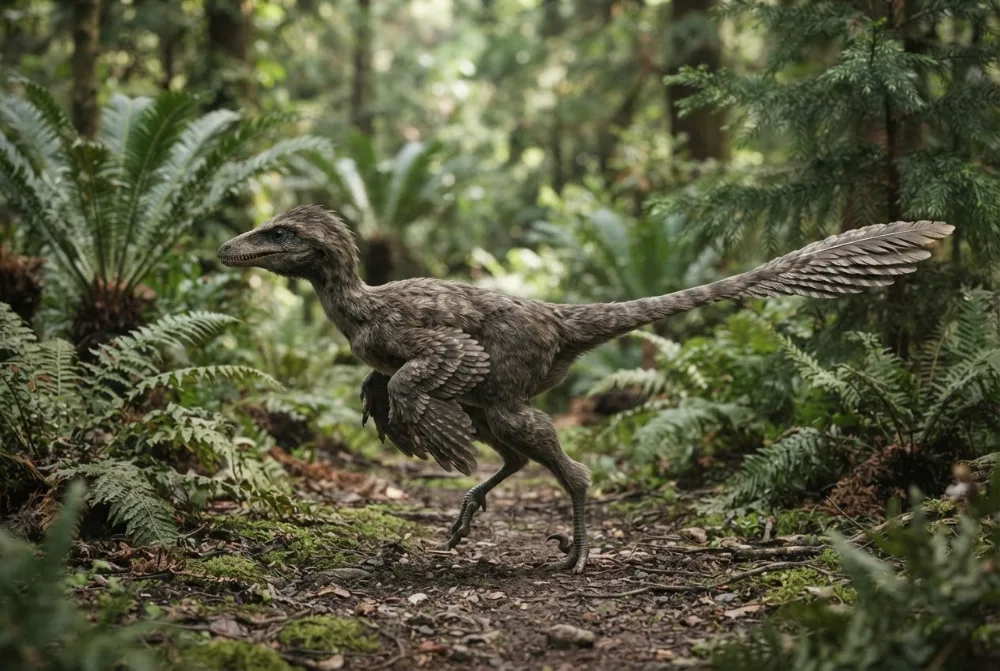
Changzhousaurus was a tiny, feathered dinosaur that lived about 120 million years ago in what is now China. It had big wings on its arms, smaller wings on its legs, and a fan of long tail feathers, kind of like a peacock. This little hunter is a close cousin of Velociraptor and Microraptor.12
Kañ la dundoon?
Naka la réyoon?
Naka la guddoon?
Naka la kawewoon?
jortu
Naka la Changzhousaurus réyoon, bu ñu ko méngalee ak YAW?
Ay kalkil rekk ci sa navigatëer. Dara du ñu denc, dara du ñu yónne fenn.
Naka la gaawoon?


Xibaar yu neex
Changzhousaurus is the only known early bird relative that had both large foot feathers and very long tail feathers at the same time.32
It had about 16 long tail feathers, which were about four times as long as its thigh bone, and they fanned out like a peacock's tail.32
Even though its arm bones were short, its wing feathers were the largest ever seen on a dinosaur that wasn't a bird, compared to its body size.3
The fossil is so well preserved that you can see clear imprints of feathers all around its skeleton.2
Laaj yi ñu gën a laaj ci Changzhousaurus
?How big was Changzhousaurus?
It was very small, about 34 centimeters (13 inches) long from snout to tail tip. That is about the size of a crow.1
?Did Changzhousaurus have feathers?
Yes, it had feathers all over its body. It had large wing feathers on its arms, smaller wing feathers on its legs, and a fan of long tail feathers similar to a peacock.1
?What did Changzhousaurus eat?
It was a meat-eating theropod dinosaur. It had sharp, curved claws and teeth with serrations on some of them to help catch and eat small prey.1
?Could Changzhousaurus fly?
Scientists are not sure. It had large feathered wings, but its arm bones were short, so it may have glided or used its wings for other purposes like display.4
?When did Changzhousaurus live?
It lived about 120 million years ago during the Early Cretaceous period. Its fossils were found in the Jiufotang Formation in China.1
Ku tas léeb yu dul dëgg
Léeb: Some people think Changzhousaurus could fly like a modern bird because of its big wings.
Dëgg: Scientists think it was a four-winged dinosaur that likely glided or parachuted from trees, not a true flier. Its exact flying ability is still being studied.3
Ngir ñi xam dino lool
- Turu xam-xam
- Changzhousaurus
- Ku ko tudde
- Xu 20265
- Kurél
- Dino yuy lekk yàpp
- Njaboot / klad
- Paraves5
- Klasifikasiyoŋ
- Theropoda5
- Màggaayu doj yi
- 121 ba 113 milyoŋ at (Aptian)5
- Formasiyoŋi doj
- Jiufotang5
- Réew yi
- Siin5
- Fosil yu ñu gis
- 1 ci The Paleobiology Database5
- Gisees
- The fossil was found in the Jiufotang Formation in Liaoning, China, and was named by Xu Xing in 2026. The name honors the city of Changzhou and China, where it was found.12
- Ñu ngi koy werante ba tey
- Scientists are still debating exactly where Changzhousaurus fits in the dinosaur family tree, because it has features of several different groups like troodontids, dromaeosaurids, and early birds.1
Fa xibaar yi jóge
- Changzhousaurus (en.wikipedia.org)
- Chinese Scientists Discover New Feathered Dinosaur Species----Chinese Academy of Sciences (english.cas.cn)
- Advanced online publication (dinosaurier-info.de)
- Advanced online publication - Dinodata.de (dinodata.de)
- Changzhousaurus in The Paleobiology Database (CC BY 4.0): at, béréb yi, formasiyoŋi doj, klasifikasiyoŋ.
Bépp xibaar ci xët wii am na lim bu wone fa mu jóge. Su nu juumee, baal nu, nun ñu bëgg dino lanu, du ab sërnaalu xam-xam. Wax nu ko ci [email protected] nu defar ko.
 Rex xiif na! Dino Wiki, mbiru ab baay la ngir doomam ju góor ju bëgg dinosoor, ci neen te amul kaamuñaate, amul tracker. Mag ñi mën nañu jox Rex tuuti ñam ngir dimbali ko mu des ci internet.Dundal Rex
 Allosaurus
 Carnotaurus
 Dilophosaurus
 Giganotosaurus
 Compsognathus
 Paronychodon
 Stegosaurus
 Iguanodon
 Archaeopteryx
 Microraptor
 Deinonychus
 Baryonyx