 Ban dino nga? Kiis
 Xeexu dino
 Rawante dino
 Fo yu ndaw yu dino
 Albomu sitikeer
 Limu TOP yu dino
 Bett ma!
Kañ la dundoon?

Naka la réyoon?
Naka la guddoon?
Naka la kawewoon?
jortu
Naka la diisoon?
 gudd ni 6 xaj, bakkan ba geen🍌gudd ni 33 banaana yu ñu topp-toppale🍉diis ni 80 xaal🧸diis ni 21 xale yu maternel🎒diis ni 12 xale yu lekkool🏃mënoon na daw 100 meetar ci 8 segond (nit ki gën a gaaw dafay soxla 9,6)
Naka la Concavenator réyoon, bu ñu ko méngalee ak YAW?
Ay kalkil rekk ci sa navigatëer. Dara du ñu denc, dara du ñu yónne fenn.
Naka la gaawoon?


Xibaar yu neex
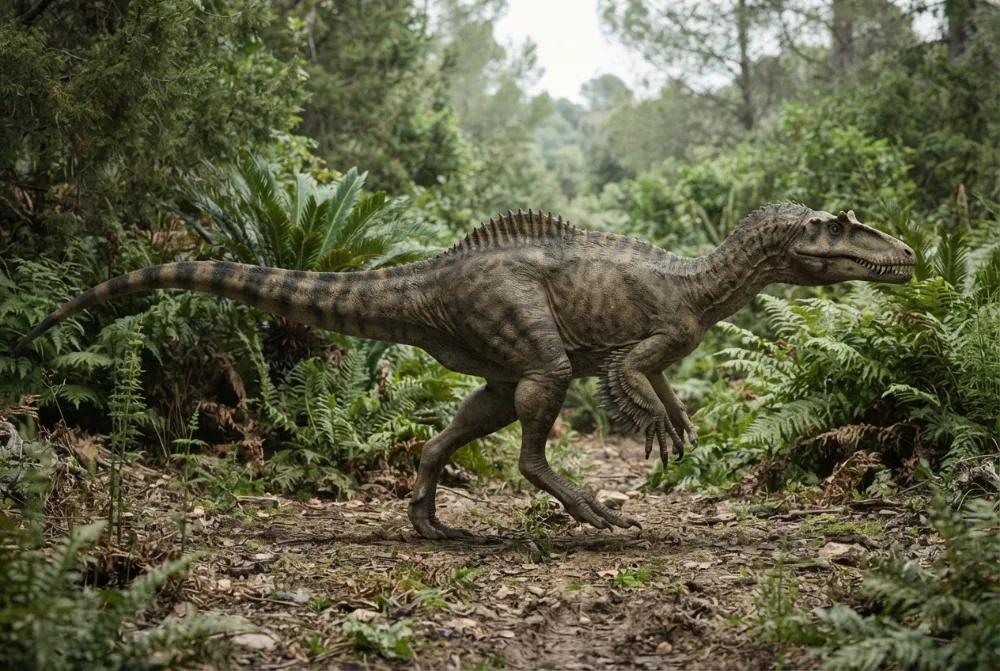
Concavenator had a hump on its back made from two tall bones in its spine.1
Scientists found small bumps on its arm bone that might be quill knobs, places where feathers attach.12
It lived about 130 to 125 million years ago during the Early Cretaceous Period.1
Its fossils were found at Las Hoyas in Spain, which was once an inland lake.1
Concavenator belongs to the carcharodontosaur group, which means 'shark-toothed lizards'.1
The hump on Concavenator's back might have been used for display or to store fat, but scientists are not sure.2
Laaj yi ñu gën a laaj ci Concavenator
?How big was Concavenator?
Concavenator was a medium sized dinosaur, about 5 to 6 metres long and weighed around 320 to 400 kilograms.31
?What did Concavenator eat?
Concavenator was a carnivore, meaning it ate meat. It likely hunted other animals that lived in its environment.1
?Did Concavenator have feathers?
Scientists disagree. Some think small bumps on its arm bone were quill knobs where feathers attached, but others think they were muscle scars. Scaly skin was found on its feet and tail.132
?Why did Concavenator have a hump?
Nobody knows for sure. It might have been used for display to recognise each other, or for temperature control like a camel's hump.13
?When did Concavenator live?
Concavenator lived about 130 to 125 million years ago, during the Early Cretaceous Period.13
?Where was Concavenator found?
Its fossils were found at the Las Hoyas site in Cuenca, Spain. That area was once an inland lake.13
?Was Concavenator a dinosaur?
Yes, Concavenator was a theropod dinosaur. It belongs to the carcharodontosaur group, which means 'shark-toothed lizards'.13
?Is Concavenator related to Spinosaurus?
No, Concavenator is not a spinosaur. It is a carcharodontosaur, a different group of meat-eating dinosaurs.1
Ku tas léeb yu dul dëgg
Léeb: Some people think Concavenator was a spinosaur because of its hump.
Dëgg: Concavenator was not a spinosaur. It was a carcharodontosaur, a different group of meat-eating dinosaurs.1
Ngir ñi xam dino lool
- Turu xam-xam
- Concavenator
- Ku ko tudde
- Ortega et al. 20104
- Kurél
- Dino yuy lekk yàpp
- Njaboot / klad
- Carcharodontosauridae4
- Klasifikasiyoŋ
- Theropoda > Allosauroidea > Carcharodontosauridae4
- Màggaayu doj yi
- 126 ba 121 milyoŋ at (Barremian)4
- Formasiyoŋi doj
- La Huérguina4
- Réew yi
- Españ4
- Fosil yu ñu gis
- 1 ci The Paleobiology Database4
- Gisees
- Concavenator was named by Ortega, Escaso and Sanz in 2010. The type specimen is MCCM-LH 6666, a nearly complete skeleton found at Las Hoyas, Spain.14
- Ñu ngi koy werante ba tey
- Scientists still debate whether the bumps on Concavenator's arm bone are really quill knobs for feathers or something else.2
Fa xibaar yi jóge
- Concavenator | Natural History Museum (nhm.ac.uk)
- A bizarre, humped Carcharodontosauria (Theropoda) from the Lower Cretaceous of Spain | Nature (nature.com)
- Concavenator (en.wikipedia.org)
- Concavenator in The Paleobiology Database (CC BY 4.0): at, béréb yi, formasiyoŋi doj, klasifikasiyoŋ.
Bépp xibaar ci xët wii am na lim bu wone fa mu jóge. Su nu juumee, baal nu, nun ñu bëgg dino lanu, du ab sërnaalu xam-xam. Wax nu ko ci [email protected] nu defar ko.
 Rex xiif na! Dino Wiki, mbiru ab baay la ngir doomam ju góor ju bëgg dinosoor, ci neen te amul kaamuñaate, amul tracker. Mag ñi mën nañu jox Rex tuuti ñam ngir dimbali ko mu des ci internet.Dundal Rex
 Allosaurus
 Carnotaurus
 Dilophosaurus
 Giganotosaurus
 Compsognathus
 Paronychodon
 Stegosaurus
 Iguanodon
 Archaeopteryx
 Microraptor
 Deinonychus
 Baryonyx