 Ban dino nga? Kiis
 Xeexu dino
 Rawante dino
 Fo yu ndaw yu dino
 Albomu sitikeer
 Limu TOP yu dino
 Bett ma!
Dearcmhara
Dearcmhara was a marine reptile that lived in the warm seas around Scotland during the Jurassic Period. It looked a bit like a dolphin with a long snout and flippers, and it was a fast swimmer that hunted fish and squid.21
Kañ la dundoon?
Naka la réyoon?
Naka la guddoon?
 gudd ni 4 xaj, bakkan ba geen🍌gudd ni 24 banaana yu ñu topp-toppale🏊mënoon na féey guddaayu pisin bu mag (50 m) ci 3,8 segond
Naka la Dearcmhara réyoon, bu ñu ko méngalee ak YAW?
Ay kalkil rekk ci sa navigatëer. Dara du ñu denc, dara du ñu yónne fenn.
Naka la gaawoon?


Xibaar yu neex
Dearcmhara is known from only a few bones: a humerus (upper arm bone) and three vertebrae (back bones).1
Its name comes from Scottish Gaelic and means 'marine lizard'.1
Dearcmhara lived about 184 to 169 million years ago, during the Early to Middle Jurassic.2
It was a basal neoichthyosaurian, meaning it was an early relative of later ichthyosaurs like Ophthalmosaurus.1
The fossils were collected by a man named Brian Shawcross in 1959, and he donated them to a museum instead of keeping them.1
Dearcmhara is one of the first ichthyosaurs from Scotland to be described in detail by scientists.1
Its humerus has a unique deep concavity and a large triangular process that help scientists tell it apart from other ichthyosaurs.1
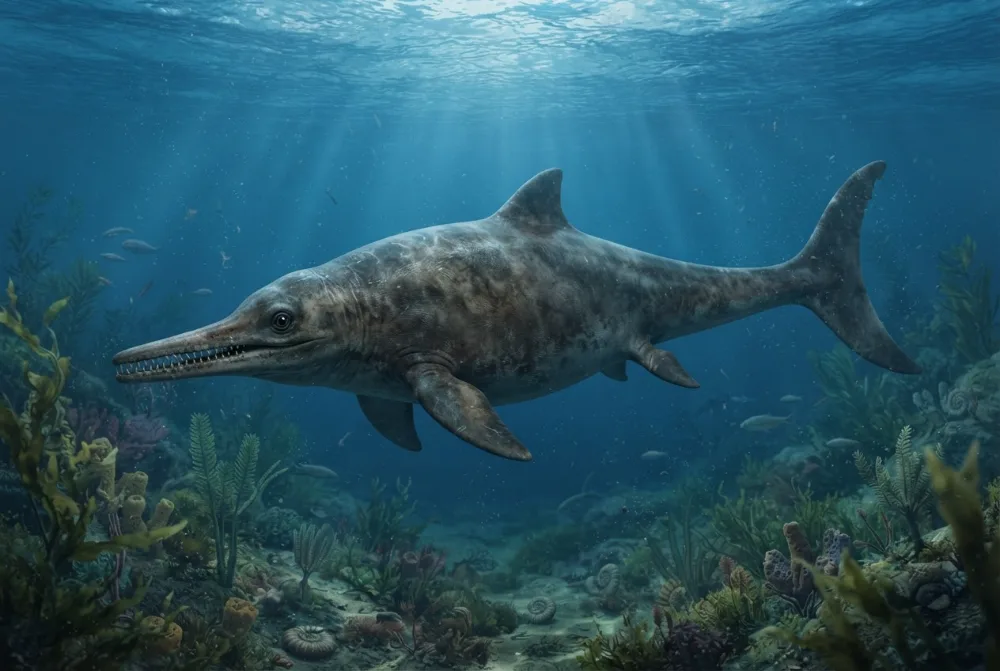
Ngir ñi xam dino lool
- Turu xam-xam
- Dearcmhara
- Ku ko tudde
- Brusatte et al. 20155
- Kurél
- Iktiyosoor yi
- Njaboot / klad
- Neoichthyosauria5
- Klasifikasiyoŋ
- Ichthyosauria > Ichthyosauromorpha5
- Màggaayu doj yi
- 184 ba 169 milyoŋ at (Toarcian / Bajocian)5
- Formasiyoŋi doj
- Bearreraig Sandstone5
- Réew yi
- Angalteer5
- Fosil yu ñu gis
- 1 ci The Paleobiology Database5
- Gisees
- Dearcmhara was named in 2015 by a team led by Stephen Brusatte. The fossils were found by Brian Shawcross in 1959 on the Isle of Skye, Scotland, and later donated to the Hunterian Museum in Glasgow.1
- Ñu ngi koy werante ba tey
- Scientists are not sure exactly how big Dearcmhara was, because only a few bones have been found.1
Fa xibaar yi jóge
- Ichthyosaurs from the Jurassic of Skye, Scotland (orbi.uliege.be)
- PBDB Taxon (paleobiodb.org)
- Dearcmhara (en.wikipedia.org)
- Motorboat-Size Sea Monster Found, Sheds Insight on Evolution | National Geographic (nationalgeographic.com)
- Dearcmhara in The Paleobiology Database (CC BY 4.0): at, béréb yi, formasiyoŋi doj, klasifikasiyoŋ.
Bépp xibaar ci xët wii am na lim bu wone fa mu jóge. Su nu juumee, baal nu, nun ñu bëgg dino lanu, du ab sërnaalu xam-xam. Wax nu ko ci [email protected] nu defar ko.
 Rex xiif na! Dino Wiki, mbiru ab baay la ngir doomam ju góor ju bëgg dinosoor, ci neen te amul kaamuñaate, amul tracker. Mag ñi mën nañu jox Rex tuuti ñam ngir dimbali ko mu des ci internet.Dundal Rex
 Ichthyosaurus
 Platypterygius
 Stenopterygius
 Khudiakovia
 Ophthalmosaurus
 Chonespondylus
 Dilophosaurus
 Dorygnathus
 Lufengosaurus
 Scutellosaurus
 Yunnanosaurus
 Sinosaurus