 Ban dino nga? Kiis
 Xeexu dino
 Rawante dino
 Fo yu ndaw yu dino
 Albomu sitikeer
 Limu TOP yu dino
 Bett ma!
Djupedalia
Djupedalia was a long-necked marine reptile that swam in the warm, shallow seas near Svalbard, Norway, about 150 million years ago. It was not a dinosaur, but a plesiosaur, a type of ocean predator. With its small head and long neck, it likely snapped up fish and squid while paddling through the water.42
Kañ la dundoon?
Naka la réyoon?
Naka la guddoon?
 gudd ni 6 xaj, bakkan ba geen🍌gudd ni 33 banaana yu ñu topp-toppale🏊mënoon na féey guddaayu pisin bu mag (50 m) ci 6,7 segond
Naka la Djupedalia réyoon, bu ñu ko méngalee ak YAW?
Ay kalkil rekk ci sa navigatëer. Dara du ñu denc, dara du ñu yónne fenn.
Naka la gaawoon?


Xibaar yu neex
Djupedalia is known from a single juvenile skeleton that is one of the most complete marine reptile fossils ever found in Spitsbergen.2
Its neck bones were special: the neural spines (the parts that stick up from the vertebrae) were shifted far back, and the postzygapophyses (the joints that connect vertebrae) were very long.2
Djupedalia had femora (thigh bones) that were longer than its humeri (upper arm bones), which is unusual for plesiosaurs.2
The fossil was found about 20 metres below a rock layer called the Dorsoplanites bed, which is full of ammonite shells.2
Djupedalia lived during the Tithonian age, about 150 to 145 million years ago, in the Late Jurassic period.1
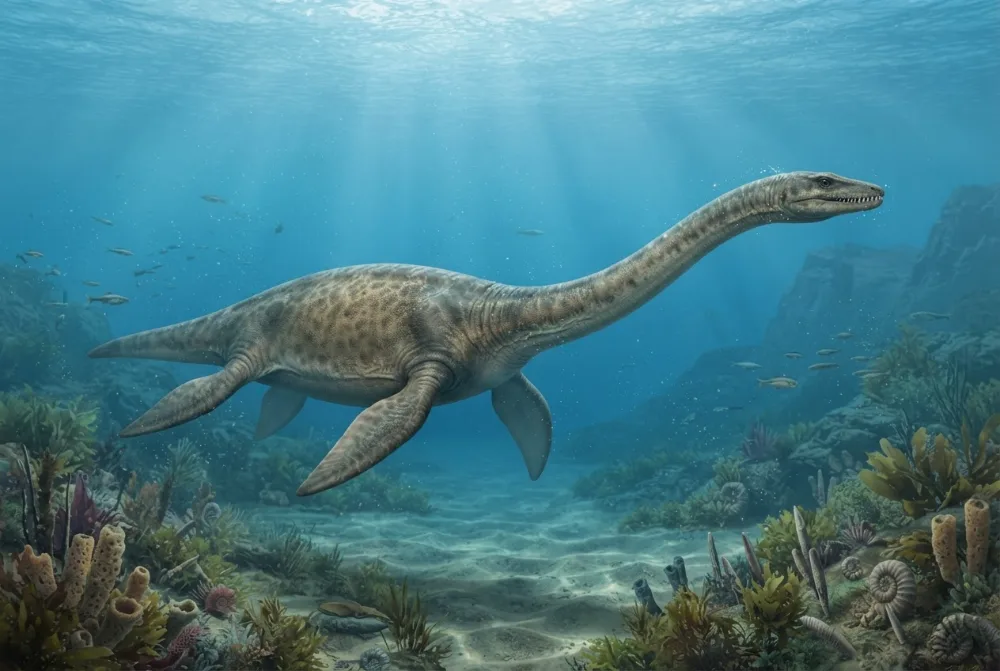
Ku tas léeb yu dul dëgg
Léeb: Some people might think Djupedalia was a dinosaur because it lived in the sea and had a long neck.
Dëgg: Djupedalia was a plesiosaur, a marine reptile, not a dinosaur. Dinosaurs lived on land, while plesiosaurs swam in the ocean.4
Ngir ñi xam dino lool
- Turu xam-xam
- Djupedalia
- Ku ko tudde
- Knutsen et al. 20124
- Kurél
- Plesiyosoor yi
- Njaboot / klad
- Cryptoclididae4
- Klasifikasiyoŋ
- Plesiosauria > Sauropterygia4
- Màggaayu doj yi
- 149 ba 143 milyoŋ at (Tithonian)4
- Formasiyoŋi doj
- Agardhfjellet4
- Réew yi
- Norwees4
- Fosil yu ñu gis
- 1 ci The Paleobiology Database4
- Gisees
- Djupedalia was named in 2012 by Espen M. Knutsen, Patrick S. Druckenmiller, and Jørn H. Hurum. The fossil was excavated in the summer of 2009 by the University of Oslo Natural History Museum from the Slottsmøya Member near Janusfjellet mountain.2
- Ñu ngi koy werante ba tey
- Scientists are still debating exactly how Djupedalia is related to other plesiosaurs, since it shares features with several different groups from England and other places.2
Fa xibaar yi jóge
- Djupedalia (en.wikipedia.org)
- A new plesiosauroid (Reptilia: Sauropterygia) from the Agardhfjellet Formation (Middle Volgian) of central Spitsbergen, Norway (foreninger.uio.no)
- PaleoCodex :: Djupedalia (paleocodex.com)
- Djupedalia in The Paleobiology Database (CC BY 4.0): at, béréb yi, formasiyoŋi doj, klasifikasiyoŋ.
Bépp xibaar ci xët wii am na lim bu wone fa mu jóge. Su nu juumee, baal nu, nun ñu bëgg dino lanu, du ab sërnaalu xam-xam. Wax nu ko ci [email protected] nu defar ko.
 Rex xiif na! Dino Wiki, mbiru ab baay la ngir doomam ju góor ju bëgg dinosoor, ci neen te amul kaamuñaate, amul tracker. Mag ñi mën nañu jox Rex tuuti ñam ngir dimbali ko mu des ci internet.Dundal Rex
 Elasmosaurus
 Pliosaurus
 Plesiosaurus
 Cimoliasaurus
 Colymbosaurus
 Trinacromerum
 Brachiosaurus
 Diplodocus
 Allosaurus
 Brontosaurus
 Compsognathus
 Camarasaurus