 Ban dino nga? Kiis
 Xeexu dino
 Rawante dino
 Fo yu ndaw yu dino
 Albomu sitikeer
 Limu TOP yu dino
 Bett ma!
Falcarius
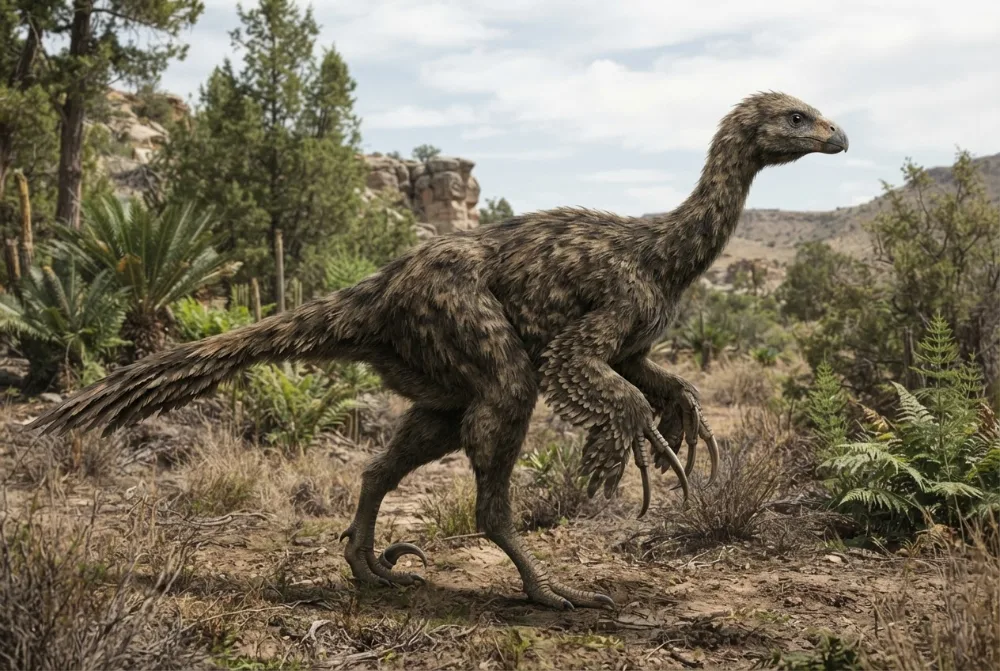
Falcarius was a strange dinosaur that looked like a mix between an ostrich, a gorilla, and Edward Scissorhands! It had a small head, a long neck, and huge curved claws on its hands. This dinosaur lived in what is now Utah, USA, about 139 to 134 million years ago.1
Kañ la dundoon?
Naka la réyoon?
Naka la guddoon?
Naka la kawewoon?
Naka la diisoon?
 gudd ni 5 xaj, bakkan ba geen🍌gudd ni 28 banaana yu ñu topp-toppale🍉diis ni 20 xaal🧸diis ni 5 xale yu maternel🎒diis ni 3 xale yu lekkool🏃mënoon na daw 100 meetar ci 12 segond (nit ki gën a gaaw dafay soxla 9,6)
Naka la Falcarius réyoon, bu ñu ko méngalee ak YAW?
Ay kalkil rekk ci sa navigatëer. Dara du ñu denc, dara du ñu yónne fenn.
Naka la gaawoon?


Xibaar yu neex
Falcarius is one of the most primitive therizinosaurs ever found. It helps scientists understand how meat-eating dinosaurs turned into plant-eaters.2
Over 3,000 bones of Falcarius have been dug up from a single quarry in Utah. That's a lot of fossils!1
Falcarius had a long neck that let it reach leaves about 1.5 metres (5 feet) off the ground.1
Its hand claws were huge and curved, like sickles. That's how it got its name, which means 'sickle cutter'.1
Falcarius probably had feathers, like its close relatives from Asia.1
The smallest Falcarius was less than 1 metre (3.3 feet) long, but adults grew to about 4 to 5 metres (13 to 16 feet).1
Laaj yi ñu gën a laaj ci Falcarius
?How big was Falcarius?
About 4 metres (13 feet) long and about 1.4 metres (4.5 feet) tall at the hip, weighing around 100 kilograms (220 pounds). The smallest known individual was less than 1 metre (3.3 feet) long.14
?What did Falcarius eat?
Mostly plants. Its leaf-shaped, serrated teeth were good for shredding leaves, but the pointed front teeth suggest it might have also eaten small animals like lizards sometimes.1
?Did Falcarius have feathers?
Scientists think yes. No feathers were found with its fossils, but its close feathered relatives from China make it very likely Falcarius had shaggy, hair-like proto-feathers.4
?How fast could Falcarius run?
Probably not very fast. Its lower legs were stubby, which suggests it no longer needed to run after prey like its meat-eating relatives did.4
Ngir ñi xam dino lool
- Turu xam-xam
- Falcarius
- Ku ko tudde
- Kirkland et al. 20055
- Kurél
- Dino yu am dun yu doy waar
- Njaboot / klad
- Therizinosauria5
- Klasifikasiyoŋ
- Theropoda > Therizinosauria5
- Màggaayu doj yi
- 143 ba 133 milyoŋ at (Berriasian / Valanginian)5
- Formasiyoŋi doj
- Cedar Mountain5
- Réew yi
- Amerig5
- Fosil yu ñu gis
- 2 ci The Paleobiology Database5
- Gisees
- Falcarius was discovered in 1999 by fossil collector Lawrence Walker in Utah. Scientists named it in 2005.1
- Ñu ngi koy werante ba tey
- Scientists are not sure if Falcarius was a pure plant-eater or if it also ate meat. Its front teeth are sharp and pointed, which might mean it ate small animals too.1
Fa xibaar yi jóge
- Falcarius (en.wikipedia.org)
- A primitive therizinosauroid dinosaur from the Early Cretaceous of Utah | Nature (nature.com)
- A Primitive Therizinosauroid Dinosaur from the Early Cretaceous of Utah - DocsLib (docslib.org)
- Falcarius Utahensis - Utah Geological Survey (geology.utah.gov)
- Falcarius in The Paleobiology Database (CC BY 4.0): at, béréb yi, formasiyoŋi doj, klasifikasiyoŋ.
Bépp xibaar ci xët wii am na lim bu wone fa mu jóge. Su nu juumee, baal nu, nun ñu bëgg dino lanu, du ab sërnaalu xam-xam. Wax nu ko ci [email protected] nu defar ko.
 Rex xiif na! Dino Wiki, mbiru ab baay la ngir doomam ju góor ju bëgg dinosoor, ci neen te amul kaamuñaate, amul tracker. Mag ñi mën nañu jox Rex tuuti ñam ngir dimbali ko mu des ci internet.Dundal Rex
 Therizinosaurus
 Oviraptor
 Chirostenotes
 Citipes
 Leptorhynchos
 Avimimus
 Stegosaurus
 Iguanodon
 Archaeopteryx
 Giganotosaurus
 Microraptor
 Deinonychus