 Ban dino nga? Kiis
 Xeexu dino
 Rawante dino
 Fo yu ndaw yu dino
 Albomu sitikeer
 Limu TOP yu dino
 Bett ma!
Gallardosaurus
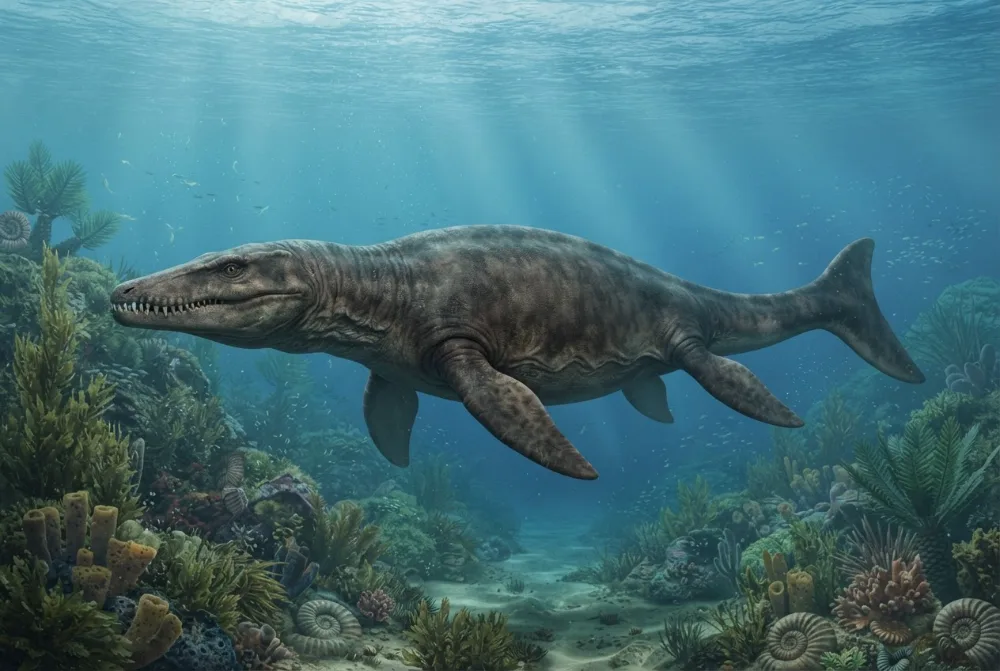
Gallardosaurus was a short-necked, big-headed marine reptile that swam in warm seas near Cuba 160 million years ago. It was a pliosaur, a type of plesiosaur with a huge skull and strong jaws for catching fish.12
Kañ la dundoon?
Naka la gaawoon?


Xibaar yu neex
Gallardosaurus is known from only one partial skull and a few neck bones. The tip of the snout and the back of the lower jaw are missing.1
The bones were found inside a hard rock called a concretion, which helped preserve them in three dimensions.1
The individual was probably not fully grown when it died, because some of its vertebrae were not fused together.1
Gallardosaurus lived in a shallow sea only about 10 to 12 metres (33 to 39 feet) deep. Oysters and algae grew on the seafloor.1
It shared its home with ichthyosaurs, a marine turtle called Notoemys oxfordiensis, and another plesiosaur named Vinialesaurus caroli.1
Scientists think Gallardosaurus may have migrated across the Caribbean Seaway each season, following the fish it hunted.1
The first fossil was discovered in 1946 by a Cuban farmer named Juan Gallardo. It was not fully studied until many years later.1
Laaj yi ñu gën a laaj ci Gallardosaurus
?How big was Gallardosaurus?
No complete skeleton has been found, so its exact size is unknown. Based on the partial skull and neck bones, it was probably a medium-sized pliosaur, but scientists do not have enough fossils to give a reliable length or weight.12
?What did Gallardosaurus eat?
It was a carnivore that likely ate fish. Scientists think it was an active predator that hunted nectonic (swimming) fish in the warm Caribbean Seaway.12
Ngir ñi xam dino lool
- Turu xam-xam
- Gallardosaurus
- Ku ko tudde
- Gasparini 20093
- Kurél
- Plesiyosoor yi
- Njaboot / klad
- Pliosauridae3
- Klasifikasiyoŋ
- Plesiosauria > Pliosauridae > Sauropterygia3
- Màggaayu doj yi
- 159 ba 155 milyoŋ at (Oxfordian)3
- Formasiyoŋi doj
- Jagua3
- Réew yi
- Kuba3
- Fosil yu ñu gis
- 1 ci The Paleobiology Database3
- Gisees
- The only known fossil was found in 1946 by Cuban farmer Juan Gallardo near Viñales, Cuba. It was first thought to be a species of Pliosaurus or Peloneustes, but in 2009 paleontologist Zulma Gasparini named it a new genus, Gallardosaurus.12
- Ñu ngi koy werante ba tey
- Scientists are not sure exactly how big Gallardosaurus grew, because only a partial skull and a few vertebrae have been found.1
Fa xibaar yi jóge
- Gallardosaurus (en.wikipedia.org)
- A new Oxfordian pliosaurid (Plesiosauria, Pliosauridae) in the Caribbean Seaway | The Palaeontological Association (palass.org)
- Gallardosaurus in The Paleobiology Database (CC BY 4.0): at, béréb yi, formasiyoŋi doj, klasifikasiyoŋ.
Bépp xibaar ci xët wii am na lim bu wone fa mu jóge. Su nu juumee, baal nu, nun ñu bëgg dino lanu, du ab sërnaalu xam-xam. Wax nu ko ci [email protected] nu defar ko.
 Rex xiif na! Dino Wiki, mbiru ab baay la ngir doomam ju góor ju bëgg dinosoor, ci neen te amul kaamuñaate, amul tracker. Mag ñi mën nañu jox Rex tuuti ñam ngir dimbali ko mu des ci internet.Dundal Rex
 Elasmosaurus
 Pliosaurus
 Plesiosaurus
 Cimoliasaurus
 Colymbosaurus
 Trinacromerum
 Brachiosaurus
 Diplodocus
 Allosaurus
 Brontosaurus
 Compsognathus
 Camarasaurus