 Ban dino nga? Kiis
 Xeexu dino
 Rawante dino
 Fo yu ndaw yu dino
 Albomu sitikeer
 Limu TOP yu dino
 Bett ma!
Gondwananectes
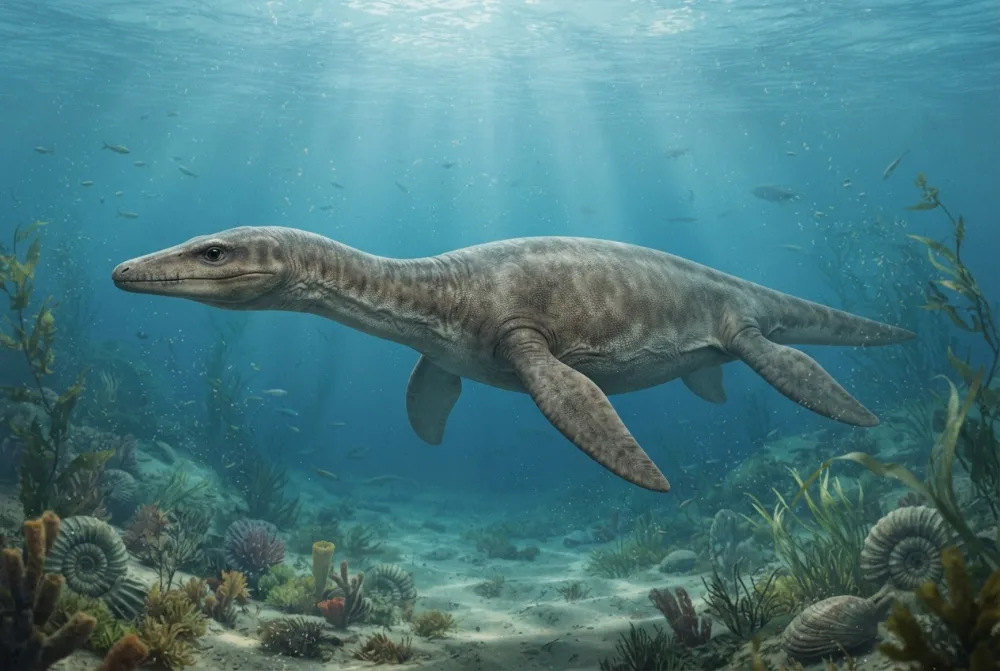
Gondwananectes was a medium-sized plesiosaur that swam in the warm seas of the Jurassic period. It had a long neck, a short tail, and four flippers that helped it glide through the water like a sea turtle. This marine reptile lived about 170 million years ago in what is now Chile.13
Kañ la dundoon?
Naka la réyoon?
Naka la guddoon?
 gudd ni 4 muusu kër, bakkan ba geen🍌gudd ni 11 banaana yu ñu topp-toppale🏊mënoon na féey guddaayu pisin bu mag (50 m) ci 7,8 segond
Naka la Gondwananectes réyoon, bu ñu ko méngalee ak YAW?
Ay kalkil rekk ci sa navigatëer. Dara du ñu denc, dara du ñu yónne fenn.
Naka la gaawoon?


Xibaar yu neex
Gondwananectes is one of the oldest plesiosaurs ever found in the southern supercontinent Gondwana, which is why it got its name.1
The only known fossil of Gondwananectes was discovered in 2014 by Osvaldo Rojas, a museum director, and his team.1
Scientists originally thought some of its bones were part of the hips, but later preparation showed they were actually from the shoulder area.1
Gondwananectes had heart-shaped neck vertebrae, which is a unique feature not seen in other plesiosaurs.2
The fossil of Gondwananectes was found scattered in pieces, but scientists were able to put it back together to study it.1
Gondwananectes lived during the Bajocian age of the Middle Jurassic, about 170 to 168 million years ago.3
Laaj yi ñu gën a laaj ci Gondwananectes
?How big was Gondwananectes?
It was about 1.5 to 2 metres (4.9 to 6.6 feet) long, which is roughly the size of a small dolphin.1
?What did Gondwananectes eat?
It was a carnivore, meaning it ate meat, probably fish and other small sea creatures.3
?Is Gondwananectes a dinosaur?
No, it is not a dinosaur. It is a plesiosaur, a type of marine reptile that lived in the ocean.1
Ngir ñi xam dino lool
- Turu xam-xam
- Gondwananectes
- Ku ko tudde
- Otero et al. 20263
- Kurél
- Plesiyosoor yi
- Njaboot / klad
- Plesiosauroidea3
- Klasifikasiyoŋ
- Plesiosauria > Sauropterygia3
- Màggaayu doj yi
- 171 ba 168 milyoŋ at (Bajocian)3
- Formasiyoŋi doj
- Quehuita3
- Réew yi
- Sili3
- Fosil yu ñu gis
- 1 ci The Paleobiology Database3
- Gisees
- Gondwananectes was named in 2026 by Rodrigo Otero and colleagues. The fossil was found in 2014 by Osvaldo Rojas near Calama, Chile, and is now kept at the Museum of Natural and Cultural History of the Atacama Desert.1
- Ñu ngi koy werante ba tey
- Scientists are still unsure about the exact size of Gondwananectes because only a partial skeleton has been found. The total length is estimated between 1.5 and 2 metres.1
Fa xibaar yi jóge
- Gondwananectes (en.wikipedia.org)
- PBDB Taxon (paleobiodb.org)
- Gondwananectes in The Paleobiology Database (CC BY 4.0): at, béréb yi, formasiyoŋi doj, klasifikasiyoŋ.
Bépp xibaar ci xët wii am na lim bu wone fa mu jóge. Su nu juumee, baal nu, nun ñu bëgg dino lanu, du ab sërnaalu xam-xam. Wax nu ko ci [email protected] nu defar ko.
 Rex xiif na! Dino Wiki, mbiru ab baay la ngir doomam ju góor ju bëgg dinosoor, ci neen te amul kaamuñaate, amul tracker. Mag ñi mën nañu jox Rex tuuti ñam ngir dimbali ko mu des ci internet.Dundal Rex
 Elasmosaurus
 Pliosaurus
 Plesiosaurus
 Cimoliasaurus
 Colymbosaurus
 Trinacromerum
 Ichthyosaurus
 Khudiakovia
 Ophthalmosaurus
 Pterodactylus
 Rhamphocephalus
 Gongbusaurus