 Ban dino nga? Kiis
 Xeexu dino
 Rawante dino
 Fo yu ndaw yu dino
 Albomu sitikeer
 Limu TOP yu dino
 Bett ma!
Huayangosaurus
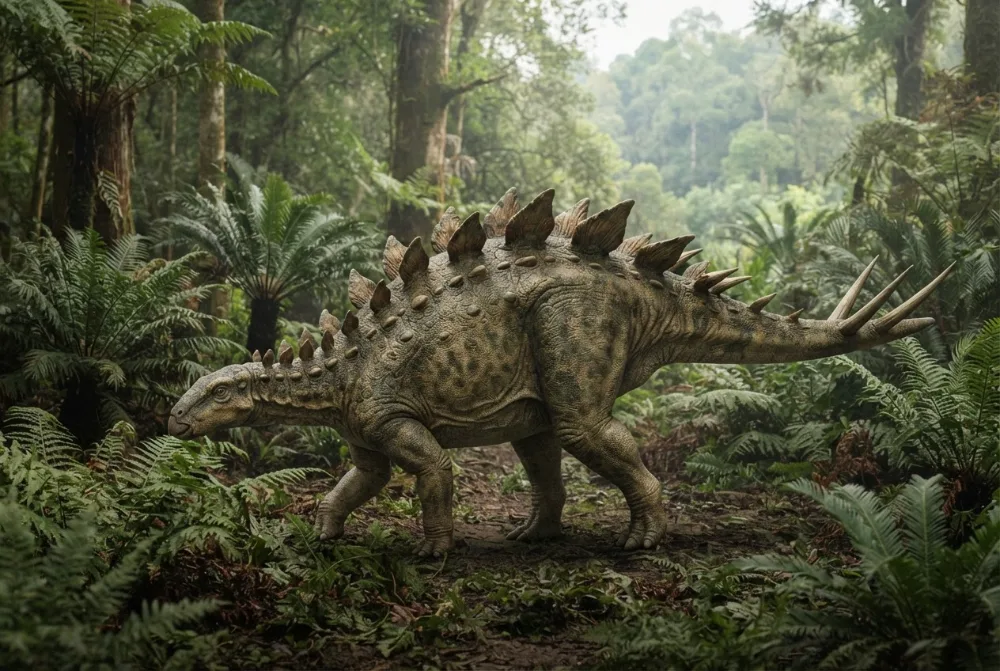
Huayangosaurus was a small, plant-eating dinosaur that lived about 165 million years ago in what is now China. It had a double row of bony plates and spikes along its back and tail, which it probably used for defense and showing off. This early stegosaur was much smaller than its famous relative Stegosaurus.1
Kañ la dundoon?
Naka la réyoon?
Naka la guddoon?
Naka la kawewoon?
Naka la diisoon?
 gudd ni 4 xaj, bakkan ba geen🍌gudd ni 22 banaana yu ñu topp-toppale🍉diis ni 100 xaal🧸diis ni 26 xale yu maternel🎒diis ni 16 xale yu lekkool🏃mënoon na daw 100 meetar ci 16 segond (nit ki gën a gaaw dafay soxla 9,6)
Naka la Huayangosaurus réyoon, bu ñu ko méngalee ak YAW?
Ay kalkil rekk ci sa navigatëer. Dara du ñu denc, dara du ñu yónne fenn.
Naka la gaawoon?


Xibaar yu neex
Huayangosaurus had a beak with teeth in the front of its mouth, a feature that later stegosaurs lost.2
Its bony plates had vein-like cavities that may have helped control body temperature or change color to scare off predators or attract mates.2
Huayangosaurus lived about 20 million years before Stegosaurus appeared in North America.1
It had two pairs of long spikes at the end of its tail, forming a weapon called a thagomizer.1
Fossils of at least twelve individual Huayangosaurus were found together in the Dashanpu Quarry.1
Its front legs were longer than those of later stegosaurs, and it had a broader skull.2
Laaj yi ñu gën a laaj ci Huayangosaurus
?How big was Huayangosaurus?
About 4 metres (13 ft) long and weighed around 500 kilograms (1,100 lb). It was one of the smallest known stegosaurians.1
?What did Huayangosaurus eat?
It was a plant-eater, or herbivore.2
?When did Huayangosaurus live?
It lived during the Middle Jurassic, about 165 million years ago.1
?Where was Huayangosaurus found?
Its fossils were discovered in the Dashanpu Quarry near Zigong in Sichuan Province, China.12
?Did Huayangosaurus have feathers?
No, the sources do not mention feathers. It had bony plates and spikes on its back and tail.1
?Was Huayangosaurus bigger than Stegosaurus?
No, it was much smaller. Stegosaurus was about 9 metres long, while Huayangosaurus was only about 4 metres long.1
Ngir ñi xam dino lool
- Turu xam-xam
- Huayangosaurus
- Ku ko tudde
- Dong et al. 19824
- Kurél
- Dino yu am ay plak
- Njaboot / klad
- Huayangosauridae4
- Klasifikasiyoŋ
- Ornithischia > Stegosauria > Thyreophora4
- Màggaayu doj yi
- 171 ba 155 milyoŋ at (Bajocian / Oxfordian)4
- Formasiyoŋi doj
- Shaximiao4
- Réew yi
- Siin4
- Fosil yu ñu gis
- 1 ci The Paleobiology Database4
- Gisees
- Huayangosaurus was named in 1982 by Chinese paleontologists Dong Zhiming, Tang Zilu, and Zhou Shiwu, based on fossils found in 1979 and 1980 at Dashanpu Quarry in Sichuan, China.1
- Ñu ngi koy werante ba tey
- Scientists are not sure whether the bony plates on Huayangosaurus were mainly used for defense, display, or regulating body temperature.2
Fa xibaar yi jóge
- Huayangosaurus (en.wikipedia.org)
- Dinosaurs - Huayangosaurus taibaii - The Australian Museum (australian.museum)
- science-resources.co.uk - Dinosaurs: Huayangosaurus (science-resources.co.uk)
- Huayangosaurus in The Paleobiology Database (CC BY 4.0): at, béréb yi, formasiyoŋi doj, klasifikasiyoŋ.
Bépp xibaar ci xët wii am na lim bu wone fa mu jóge. Su nu juumee, baal nu, nun ñu bëgg dino lanu, du ab sërnaalu xam-xam. Wax nu ko ci [email protected] nu defar ko.
 Rex xiif na! Dino Wiki, mbiru ab baay la ngir doomam ju góor ju bëgg dinosoor, ci neen te amul kaamuñaate, amul tracker. Mag ñi mën nañu jox Rex tuuti ñam ngir dimbali ko mu des ci internet.Dundal Rex
 Stegosaurus
 Diracodon
 Hypsirophus
 Dacentrurus
 Miragaia
 Kentrosaurus
 Ichthyosaurus
 Khudiakovia
 Ophthalmosaurus
 Pterodactylus
 Peloneustes
 Rhamphocephalus