 Ban dino nga? Kiis
 Xeexu dino
 Rawante dino
 Fo yu ndaw yu dino
 Albomu sitikeer
 Limu TOP yu dino
 Bett ma!
Peloneustes
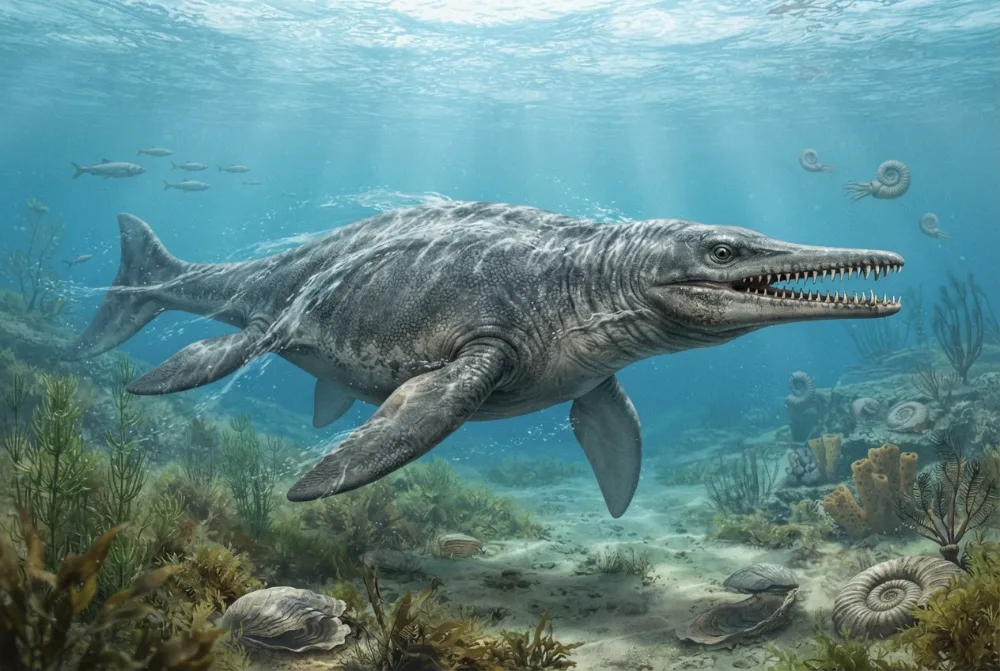
Peloneustes was a pliosaur, a kind of short-necked plesiosaur that lived in a shallow sea. It had a long, narrow snout like a dolphin and many sharp teeth for catching fish. This marine reptile was a fast and fierce hunter in the water.1
Kañ la dundoon?
Naka la réyoon?
Naka la guddoon?
Naka la diisoon?
 gudd ni 4 xaj, bakkan ba geen🍌gudd ni 24 banaana yu ñu topp-toppale🍉diis ni 200 xaal🧸diis ni 53 xale yu maternel🎒diis ni 31 xale yu lekkool🐻❄️diis ni 2 uurs yu weex🏊mënoon na féey guddaayu pisin bu mag (50 m) ci 6,7 segond
Naka la Peloneustes réyoon, bu ñu ko méngalee ak YAW?
Ay kalkil rekk ci sa navigatëer. Dara du ñu denc, dara du ñu yónne fenn.
Naka la gaawoon?


Xibaar yu neex
Peloneustes lived about 165 to 161 million years ago during the Middle Jurassic period.3
Its name means 'mud swimmer' because its fossils were found in mud from an ancient sea.1
Peloneustes had a long, narrow snout that was shaped like a dolphin's beak. This helped it move quickly through the water.1
It had 30 to 31 teeth in its upper jaw and 36 to 44 teeth in its lower jaw. The teeth were sharp and slightly curved for piercing fish.2
Peloneustes shared its sea home with other marine reptiles like ichthyosaurs and other plesiosaurs. At least five different pliosaurids lived in the same area.1
The sea where Peloneustes swam was only about 30 to 50 metres (100 to 160 feet) deep. It was a shallow inland sea.1
Laaj yi ñu gën a laaj ci Peloneustes
?How big was Peloneustes?
Peloneustes was about 3.5 to 4 metres (11 to 13 feet) long. This is small for a pliosaurid.1
?What did Peloneustes eat?
Peloneustes ate fish. It had a long, narrow snout and many sharp teeth for piercing fish, and it would swing its head quickly to catch them.1
?When did Peloneustes live?
Peloneustes lived during the Middle Jurassic period, about 165 to 161 million years ago. Its fossils are from the Oxford Clay Formation in England.1
?Was Peloneustes a dinosaur?
No, Peloneustes was a plesiosaur, a marine reptile, not a dinosaur. It lived in the sea and used its flippers to swim.1
Ngir ñi xam dino lool
- Turu xam-xam
- Peloneustes
- Ku ko tudde
- Lydekker 18893
- Kurél
- Plesiyosoor yi
- Njaboot / klad
- Pliosauridae3
- Klasifikasiyoŋ
- Plesiosauria > Pliosauridae > Sauropterygia3
- Màggaayu doj yi
- 165 ba 162 milyoŋ at (Callovian)3
- Formasiyoŋi doj
- Oxford Clay, Ornatenton, Argiles de Montaubert3
- Réew yi
- Angalteer, Faraas, Almaañ3
- Fosil yu ñu gis
- 12 ci The Paleobiology Database3
- Gisees
- Peloneustes was first described as a species of Plesiosaurus by Harry Govier Seeley in 1869. Richard Lydekker gave it its own genus name in 1889.1
- Ñu ngi koy werante ba tey
- Scientists are not sure if Peloneustes was a close relative of Pliosaurus or a more early-diverging pliosaurid. They are still studying its family tree.1
Fa xibaar yi jóge
- Peloneustes (en.wikipedia.org)
- The cranial anatomy and taxonomy of Peloneustes philarchus (Sauropterygia, Pliosauridae) from the Peterborough Member (Callovian, Middle Jurassic) of the United Kingdom (onlinelibrary.wiley.com)
- Peloneustes in The Paleobiology Database (CC BY 4.0): at, béréb yi, formasiyoŋi doj, klasifikasiyoŋ.
Bépp xibaar ci xët wii am na lim bu wone fa mu jóge. Su nu juumee, baal nu, nun ñu bëgg dino lanu, du ab sërnaalu xam-xam. Wax nu ko ci [email protected] nu defar ko.
 Rex xiif na! Dino Wiki, mbiru ab baay la ngir doomam ju góor ju bëgg dinosoor, ci neen te amul kaamuñaate, amul tracker. Mag ñi mën nañu jox Rex tuuti ñam ngir dimbali ko mu des ci internet.Dundal Rex
 Elasmosaurus
 Pliosaurus
 Plesiosaurus
 Cimoliasaurus
 Colymbosaurus
 Trinacromerum
 Ichthyosaurus
 Khudiakovia
 Ophthalmosaurus
 Pterodactylus
 Rhamphocephalus
 Gongbusaurus