 Ban dino nga? Kiis
 Xeexu dino
 Rawante dino
 Fo yu ndaw yu dino
 Albomu sitikeer
 Limu TOP yu dino
 Bett ma!
Iberospinus
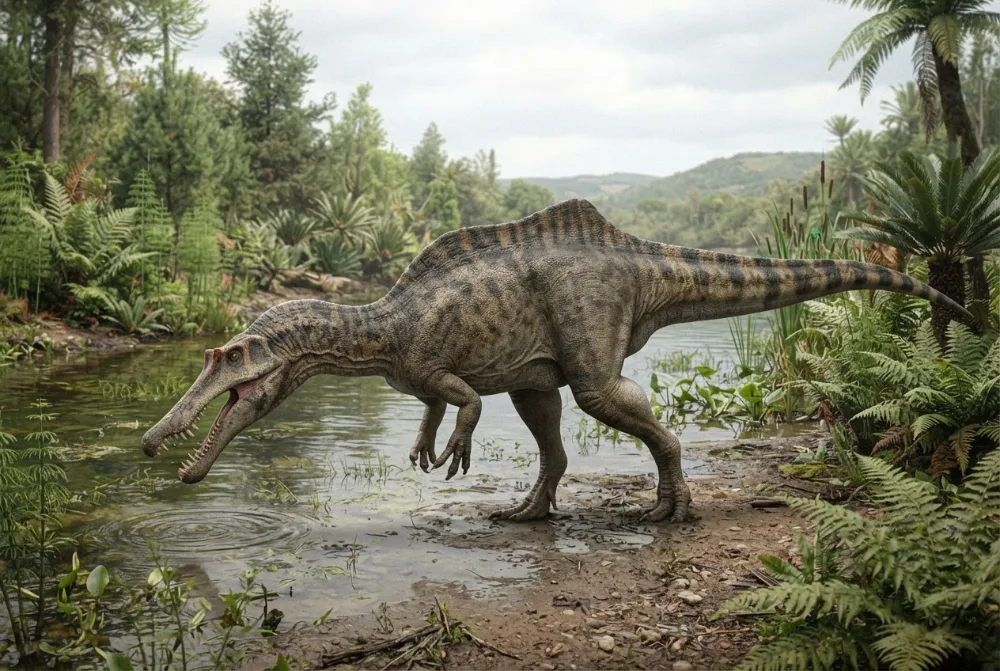
Iberospinus was a meat-eating dinosaur that lived about 125 million years ago. It had a long snout and sharp teeth, and it probably hunted near water. Scientists think it was a medium-sized spinosaur, a group known for eating fish.12
Kañ la dundoon?
Naka la gaawoon?


Xibaar yu neex
Iberospinus had a single hole in its lower jaw, which is unusual for spinosaurs. This helps scientists tell it apart from its relatives.2
Its lower jaw had a straight bottom edge, not upturned like some other spinosaurs. This is one of the features that makes it unique.2
Iberospinus lived in a lagoon environment with some freshwater and marine influences. Fish scales and teeth are common in the same rocks, so it probably hunted in the water.2
The fossils were first thought to belong to Baryonyx, but new bones found in 2020 showed they were a different dinosaur. That's when scientists named Iberospinus.12
Iberospinus is closely related to Baryonyx and Suchomimus, but it is not part of the same group. Scientists think it branched off earlier.12
The name Iberospinus means 'Iberian spine', referring to the Iberian Peninsula where it was found. The species name natarioi honors Carlos Natário, who discovered the fossil.2
Laaj yi ñu gën a laaj ci Iberospinus
?What did Iberospinus eat?
Iberospinus was a meat-eating dinosaur that probably hunted fish and other aquatic animals, using its crocodile-like jaws and constantly replacing teeth.3
?How big was Iberospinus?
Iberospinus was about 8 metres (26 feet) long, based on estimates from the fossil remains.3
?When did Iberospinus live?
Iberospinus lived about 125 million years ago, during the Early Cretaceous period (Barremian age).4
?Where was Iberospinus found?
Iberospinus was found in the Papo Seco Formation of Portugal, specifically at Praia de Aguncheiras (also known as Praia do Guincho) in the municipality of Sesimbra.5
?Could Iberospinus swim?
Scientists think Iberospinus had a possible semi-aquatic lifestyle, based on features in its tail and toe bones, though it lacked the extreme adaptations of some other spinosaurs.4
?Why is it called Iberospinus?
The name Iberospinus means 'Iberian spine', referring to the Iberian Peninsula where it was found and the long neural spines typical of spinosaurids.4
Ngir ñi xam dino lool
- Turu xam-xam
- Iberospinus
- Ku ko tudde
- Mateus and Estraviz-López 20226
- Kurél
- Spinosoor yi
- Njaboot / klad
- Spinosauridae6
- Klasifikasiyoŋ
- Theropoda > Spinosauridae6
- Màggaayu doj yi
- 126 ba 121 milyoŋ at (Barremian)6
- Formasiyoŋi doj
- Papo Seco6
- Réew yi
- Portigaal6
- Fosil yu ñu gis
- 1 ci The Paleobiology Database6
- Gisees
- The first fossils were found by Carlos Natário in Portugal, but they were originally thought to be Baryonyx. After new material was recovered in 2020, scientists Octávio Mateus and Darío Estraviz-López named it Iberospinus natarioi in 2022.26
- Ñu ngi koy werante ba tey
- Scientists are still debating exactly where Iberospinus fits in the spinosaur family tree. Some features suggest it is related to Baryonyx and Suchomimus, but other features point to a different position.12
Fa xibaar yi jóge
- A new theropod dinosaur from the early cretaceous (Barremian) of Cabo Espichel, Portugal: Implications for spinosaurid evolution. - Abstract - Europe PMC (europepmc.org)
- A new theropod dinosaur from the early cretaceous (Barremian) of Cabo Espichel, Portugal: Implications for spinosaurid evolution (journals.plos.org)
- New dinosaur: Species had teeth that were constantly replaced | New Scientist (newscientist.com)
- Iberospinus (en.wikipedia.org)
- A new theropod dinosaur from the early cretaceous (Barremian) of Cabo Espichel, Portugal: Implications for spinosaurid evolution | PLOS One (journals.plos.org)
- Iberospinus in The Paleobiology Database (CC BY 4.0): at, béréb yi, formasiyoŋi doj, klasifikasiyoŋ.
Bépp xibaar ci xët wii am na lim bu wone fa mu jóge. Su nu juumee, baal nu, nun ñu bëgg dino lanu, du ab sërnaalu xam-xam. Wax nu ko ci [email protected] nu defar ko.
 Rex xiif na! Dino Wiki, mbiru ab baay la ngir doomam ju góor ju bëgg dinosoor, ci neen te amul kaamuñaate, amul tracker. Mag ñi mën nañu jox Rex tuuti ñam ngir dimbali ko mu des ci internet.Dundal Rex
 Spinosaurus
 Baryonyx
 Suchomimus
 Angaturama
 Camarillasaurus
 Ceratosuchops
 Stegosaurus
 Iguanodon
 Archaeopteryx
 Giganotosaurus
 Microraptor
 Deinonychus