 Ban dino nga? Kiis
 Xeexu dino
 Rawante dino
 Fo yu ndaw yu dino
 Albomu sitikeer
 Limu TOP yu dino
 Bett ma!
Kañ la dundoon?

Naka la réyoon?
Naka la guddoon?
Naka la kawewoon?
Naka la diisoon?
 gudd ni 2,5 oto yu ñu taxawal ci benn rëdd🍌gudd ni 61 banaana yu ñu topp-toppale
 lu tollu ci diisaayu ñey🍉diis ni 1100 xaal🎒diis ni 7 klaas yu mat yu xale yu lekkool🐻❄️diis ni 12 uurs yu weex🏃mënoon na daw 100 meetar ci 18 segond (nit ki gën a gaaw dafay soxla 9,6)
Naka la Suchomimus réyoon, bu ñu ko méngalee ak YAW?
Ay kalkil rekk ci sa navigatëer. Dara du ñu denc, dara du ñu yónne fenn.
Naka la gaawoon?


Xibaar yu neex
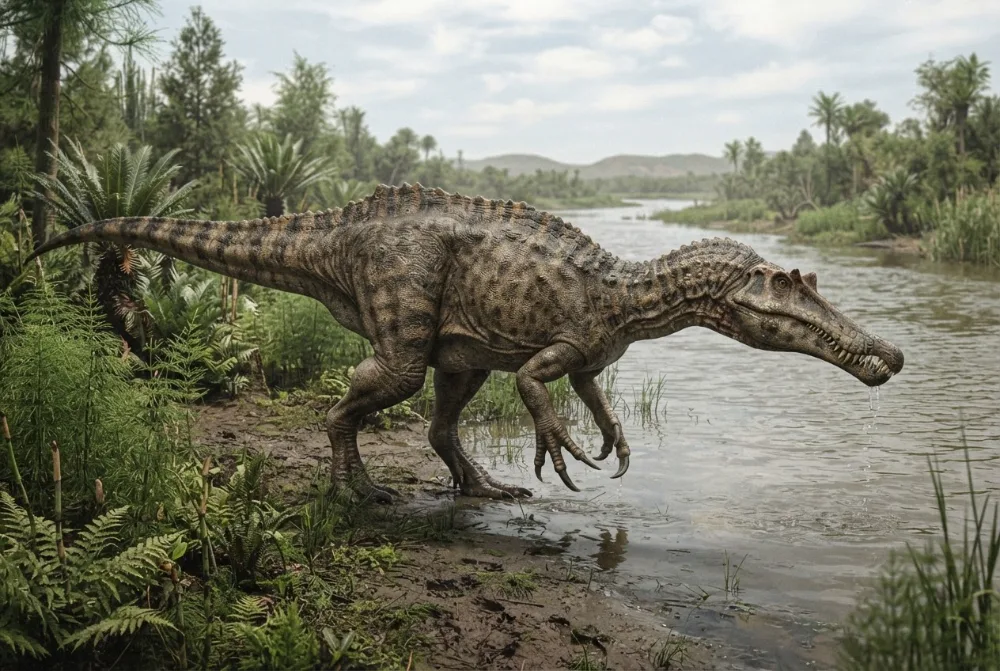
Suchomimus had a low sail on its back, made from long spines on its vertebrae.1
Its thumb claws were huge and curved, possibly used to hook fish or dig.1
The first fossils were found in 1997 by a team led by Paul Sereno, and the dinosaur was named in 1998.1
Some scientists think Suchomimus might be the same as another spinosaur called Baryonyx, but most now treat them as separate.1
Suchomimus had hollow bones, which helped it hunt in shallow water without sinking.1
Laaj yi ñu gën a laaj ci Suchomimus
?How big was Suchomimus?
Suchomimus was about 11 metres (36 feet) long and stood about 3.7 metres (12 feet) tall at the hip, which is smaller than the largest Tyrannosaurus rex.23
?What did Suchomimus eat?
Suchomimus was a fish-eater, or piscivore. It used its long, crocodile-like snout and cone-shaped teeth to catch fish in shallow water.13
?Did Suchomimus have feathers?
No one knows for sure. Suchomimus was a large theropod dinosaur, and while some related dinosaurs had feathers, no fossil feathers have been found with Suchomimus.1
?Could Suchomimus swim?
Suchomimus was adapted for hunting in shallow water, but its hollow bones suggest it could not fully submerge like some other spinosaurs. It likely waded and used its claws to catch fish.1
?Was Suchomimus bigger than T. rex?
Suchomimus was about the same length as Tyrannosaurus rex (about 11 to 12 metres), but T. rex was heavier and more powerfully built.3
?Why did Suchomimus have a sail?
Suchomimus had a low sail on its back made from long spines. Scientists think it was used for display, like to attract mates or signal to others.13
Ku tas léeb yu dul dëgg
Léeb: Some people think Suchomimus could swim underwater like Spinosaurus.
Dëgg: Science shows Suchomimus had hollow bones and was adapted for shallow water, not for diving deep like Spinosaurus or Baryonyx.1
Ngir ñi xam dino lool
- Turu xam-xam
- Suchomimus
- Ku ko tudde
- Sereno et al. 19984
- Kurél
- Spinosoor yi
- Njaboot / klad
- Spinosauridae4
- Klasifikasiyoŋ
- Theropoda > Spinosauridae4
- Màggaayu doj yi
- 121 ba 100 milyoŋ at (Aptian / Albian)4
- Formasiyoŋi doj
- Elrhaz4
- Réew yi
- Niseer4
- Fosil yu ñu gis
- 2 ci The Paleobiology Database4
- Gisees
- Suchomimus was discovered in 1997 by a team led by American paleontologist Paul Sereno in the Ténéré Desert of Niger. It was named and described in 1998.1
- Ñu ngi koy werante ba tey
- Scientists still debate whether Suchomimus is really a separate genus from Baryonyx or if it should be called Baryonyx tenerensis.1
Fa xibaar yi jóge
- Suchomimus (en.wikipedia.org)
- Suchomimus | Natural History Museum (nhm.ac.uk)
- Expedition unearths dinosaur fossil (chronicle.uchicago.edu)
- Suchomimus in The Paleobiology Database (CC BY 4.0): at, béréb yi, formasiyoŋi doj, klasifikasiyoŋ.
Bépp xibaar ci xët wii am na lim bu wone fa mu jóge. Su nu juumee, baal nu, nun ñu bëgg dino lanu, du ab sërnaalu xam-xam. Wax nu ko ci [email protected] nu defar ko.
 Rex xiif na! Dino Wiki, mbiru ab baay la ngir doomam ju góor ju bëgg dinosoor, ci neen te amul kaamuñaate, amul tracker. Mag ñi mën nañu jox Rex tuuti ñam ngir dimbali ko mu des ci internet.Dundal Rex
 Spinosaurus
 Baryonyx
 Angaturama
 Camarillasaurus
 Ceratosuchops
 Iberospinus
 Stegosaurus
 Iguanodon
 Archaeopteryx
 Giganotosaurus
 Microraptor
 Deinonychus