 Ban dino nga? Kiis
 Xeexu dino
 Rawante dino
 Fo yu ndaw yu dino
 Albomu sitikeer
 Limu TOP yu dino
 Bett ma!
Kañ la dundoon?

Naka la réyoon?
Naka la guddoon?
Naka la kawewoon?
Naka la diisoon?
 gudd ni 7 xaj, bakkan ba geen🍌gudd ni 39 banaana yu ñu topp-toppale🍉diis ni 180 xaal🧸diis ni 47 xale yu maternel🎒diis ni 28 xale yu lekkool🐻❄️diis ni 2 uurs yu weex🏃mënoon na daw 100 meetar ci 11 segond (nit ki gën a gaaw dafay soxla 9,6)
Naka la Tenontosaurus réyoon, bu ñu ko méngalee ak YAW?
Ay kalkil rekk ci sa navigatëer. Dara du ñu denc, dara du ñu yónne fenn.
Naka la gaawoon?


Xibaar yu neex
Tenontosaurus had an unusually long and broad tail, stiffened by a network of bony tendons, which is why it is called 'sinew lizard'.1
An adult Tenontosaurus could reach a browsing height of about 3 meters (10 feet) if it stood on its hind legs, but it usually walked on all fours.1
Its beak was U-shaped and thick, and its lower jaw had a special bone called a predentary that helped form the lower beak.1
Tenontosaurus lived alongside the predator Deinonychus, and fossils of both are common in the same rocks.1
The first Tenontosaurus fossil was found in 1903 in Montana, but it was not named until 1970.1
There are two species: Tenontosaurus tilletti and Tenontosaurus dossi. T. dossi is known from only a few specimens in Texas.1
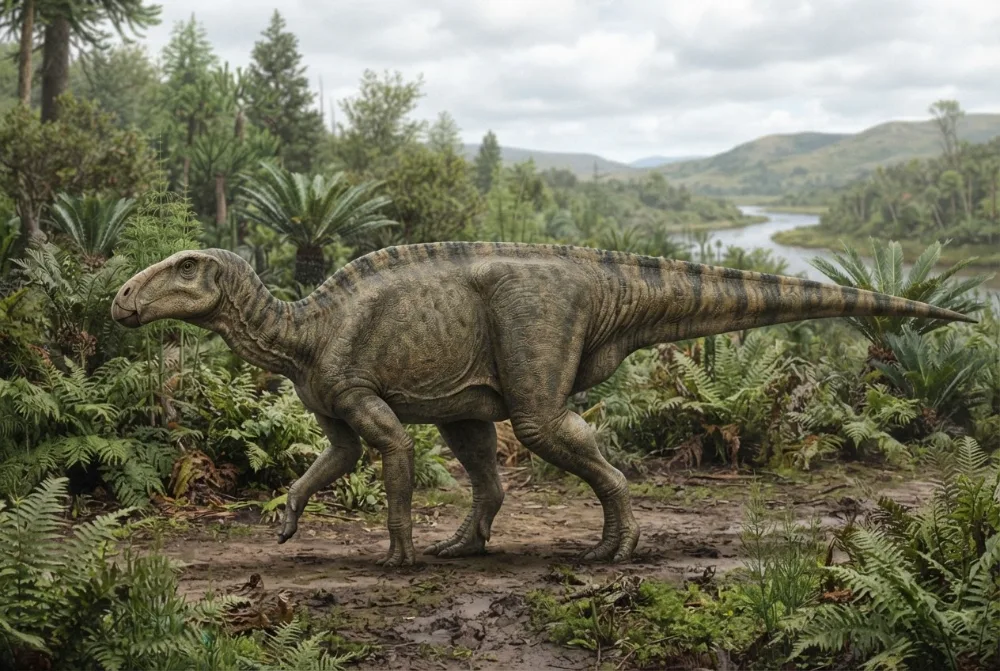
Laaj yi ñu gën a laaj ci Tenontosaurus
?How big was Tenontosaurus?
About 6 to 8 metres long and around 1,000 kilograms, though estimates vary by species and study.12
?What did Tenontosaurus eat?
It was a plant-eater. It used its U-shaped beak and chopping teeth to eat leaves, wood, fruit, and low-growing ferns and shrubs.12
?Did Tenontosaurus walk on two legs or four?
It usually walked on all four legs, but could stand on its hind legs to reach higher plants, up to about 3 metres.12
?Was Tenontosaurus bigger than Deinonychus?
Yes, adult Tenontosaurus were much larger than adult Deinonychus. Deinonychus probably hunted young or sick Tenontosaurus.1
?When did Tenontosaurus live?
It lived during the Early Cretaceous period, about 115 to 108 million years ago, in western North America.12
?Why did Tenontosaurus have a long tail?
Its tail was unusually long and broad, stiffened by bony tendons. This helped support the tail, but scientists aren't sure of its exact purpose.1
Ku tas léeb yu dul dëgg
Léeb: Some people think Tenontosaurus was a slow, clumsy dinosaur.
Dëgg: Scientists think it was a common and successful herbivore, and its stiff tail may have helped it balance.1
Ngir ñi xam dino lool
- Turu xam-xam
- Tenontosaurus
- Ku ko tudde
- Ostrom 19704
- Kurél
- Dino yu lekk gàncax te am gémmiñu picc
- Njaboot / klad
- Tenontosauridae4
- Klasifikasiyoŋ
- Ornithischia > Ornithopoda > Iguanodontia4
- Màggaayu doj yi
- 121 ba 94 milyoŋ at (Aptian / Cenomanian)4
- Formasiyoŋi doj
- Cloverly, Antlers, Cedar Mountain4
- Réew yi
- Amerig4
- Fosil yu ñu gis
- 83 ci The Paleobiology Database4
- Gisees
- The first fossil was found in 1903 by an American Museum of Natural History expedition in Montana. John Ostrom named it Tenontosaurus tilletti in 1970 after studying many specimens.1
- Ñu ngi koy werante ba tey
- Scientists still debate exactly how Tenontosaurus moved, whether it was mostly quadrupedal or could run on two legs.1
Fa xibaar yi jóge
- Tenontosaurus (en.wikipedia.org)
- Tenontosaurus | Natural History Museum (nhm.ac.uk)
- All about Tenontosaurus (animalia.bio)
- Tenontosaurus in The Paleobiology Database (CC BY 4.0): at, béréb yi, formasiyoŋi doj, klasifikasiyoŋ.
Bépp xibaar ci xët wii am na lim bu wone fa mu jóge. Su nu juumee, baal nu, nun ñu bëgg dino lanu, du ab sërnaalu xam-xam. Wax nu ko ci [email protected] nu defar ko.
 Rex xiif na! Dino Wiki, mbiru ab baay la ngir doomam ju góor ju bëgg dinosoor, ci neen te amul kaamuñaate, amul tracker. Mag ñi mën nañu jox Rex tuuti ñam ngir dimbali ko mu des ci internet.Dundal Rex
 Iguanodon
 Thescelosaurus
 Zalmoxes
 Camptosaurus
 Rhabdodon
 Nanosaurus
 Stegosaurus
 Archaeopteryx
 Giganotosaurus
 Microraptor
 Deinonychus
 Baryonyx