 Ban dino nga? Kiis
 Xeexu dino
 Rawante dino
 Fo yu ndaw yu dino
 Albomu sitikeer
 Limu TOP yu dino
 Bett ma!
Leninia
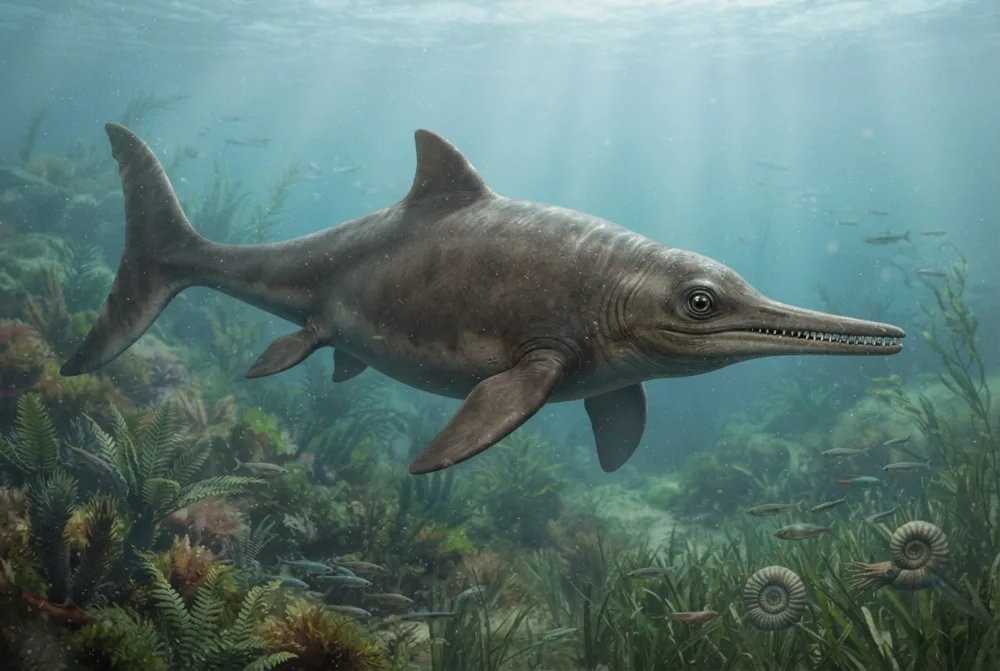
Leninia was a marine reptile that lived in the Early Cretaceous seas, not a dinosaur. It had huge eyes and probably dove deep to hunt for fish and squid.1
Kañ la dundoon?
Naka la gaawoon?


Xibaar yu neex
Only part of the skull was found, about 45 centimetres (18 inches) long. Scientists think the whole skull was between 65 and 90 centimetres (26 to 35 inches) long.1
Leninia had one of the largest scleral rings (the bony ring that supports the eye) of any ichthyosaur. Only Baptanodon and the giant Temnodontosaurus had bigger ones.1
Its skull bones form a star-shaped pattern, which is why its species name is stellans, meaning 'shining' or 'star-like'.1
Leninia lived about 119 to 113 million years ago, during the Early Cretaceous Period.1
It is one of the latest-living members of the ophthalmosaurine group, which were deep-diving ichthyosaurs with very large eyes.1
The fossil was discovered in 2012 in a limestone nodule on the banks of the Volga River, near the town of Kriushi.1
Ngir ñi xam dino lool
- Turu xam-xam
- Leninia
- Ku ko tudde
- Fischer et al. 20133
- Kurél
- Iktiyosoor yi
- Njaboot / klad
- Ophthalmosauridae3
- Klasifikasiyoŋ
- Ichthyosauria > Ichthyosauromorpha3
- Màggaayu doj yi
- 121 ba 120 milyoŋ at (Aptian)3
- Réew yi
- Riisi3
- Fosil yu ñu gis
- 1 ci The Paleobiology Database3
- Gisees
- Leninia was named in 2013 by Valentin Fischer and colleagues. The only known fossil is a partial skull found in 2012 on the Volga River banks in Russia.13
- Ñu ngi koy werante ba tey
- Scientists are not sure exactly how long the whole animal was, because only a piece of the skull has been found.1
Fa xibaar yi jóge
- Leninia (en.wikipedia.org)
- PBDB Taxon (paleobiodb.org)
- Leninia in The Paleobiology Database (CC BY 4.0): at, béréb yi, formasiyoŋi doj, klasifikasiyoŋ.
Bépp xibaar ci xët wii am na lim bu wone fa mu jóge. Su nu juumee, baal nu, nun ñu bëgg dino lanu, du ab sërnaalu xam-xam. Wax nu ko ci [email protected] nu defar ko.
 Rex xiif na! Dino Wiki, mbiru ab baay la ngir doomam ju góor ju bëgg dinosoor, ci neen te amul kaamuñaate, amul tracker. Mag ñi mën nañu jox Rex tuuti ñam ngir dimbali ko mu des ci internet.Dundal Rex
 Ichthyosaurus
 Platypterygius
 Stenopterygius
 Khudiakovia
 Ophthalmosaurus
 Chonespondylus
 Stegosaurus
 Iguanodon
 Archaeopteryx
 Giganotosaurus
 Microraptor
 Deinonychus