 Ban dino nga? Kiis
 Xeexu dino
 Rawante dino
 Fo yu ndaw yu dino
 Albomu sitikeer
 Limu TOP yu dino
 Bett ma!
Leptocleidus
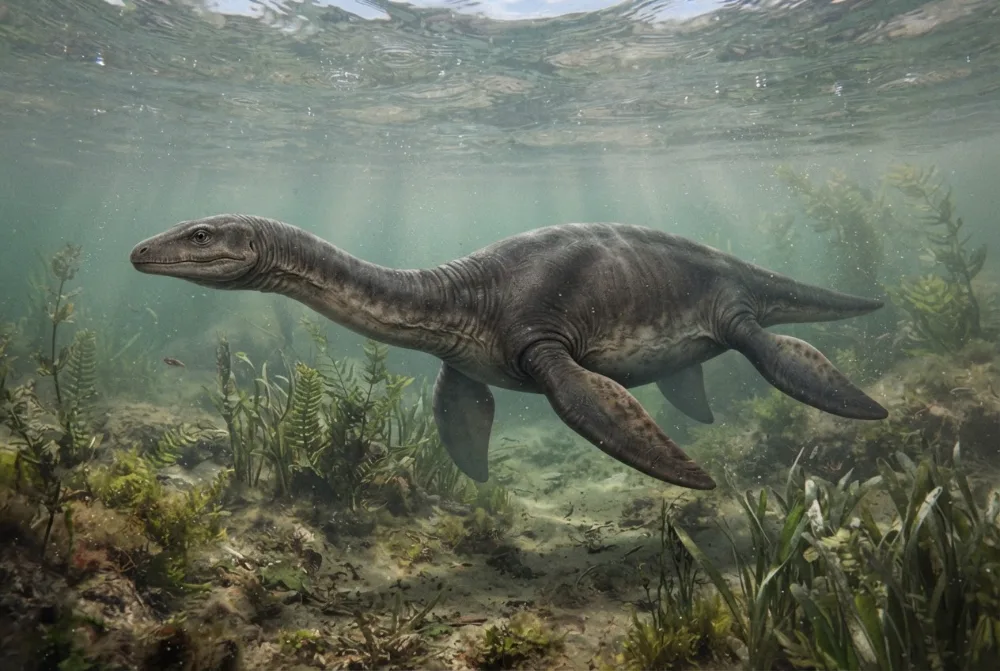
Leptocleidus was a small plesiosaur that swam in shallow seas and rivers during the Early Cretaceous. It had a long neck, a short body, and four flippers to paddle through the water. Unlike many other plesiosaurs, it lived in lagoons and even brackish or fresh water.1
Kañ la dundoon?
Naka la réyoon?
Naka la guddoon?
 gudd ni 3 xaj, bakkan ba geen🍌gudd ni 17 banaana yu ñu topp-toppale🏊mënoon na féey guddaayu pisin bu mag (50 m) ci 6,4 segond
Naka la Leptocleidus réyoon, bu ñu ko méngalee ak YAW?
Ay kalkil rekk ci sa navigatëer. Dara du ñu denc, dara du ñu yónne fenn.
Naka la gaawoon?


Xibaar yu neex
Leptocleidus had about 21 teeth on each side of its upper jaw and around 35 teeth on each side of its lower jaw.1
Its skull was triangle-shaped with a crest running from the tip of the nose to the nasal region.1
Unlike many plesiosaurs, Leptocleidus lived in shallow lagoons and may have entered brackish or fresh water, like river mouths.1
Scientists think Leptocleidus moved into fresh water to escape larger plesiosaurs and pliosaurs.1
The name Leptocleidus comes from Greek words meaning 'slender clavicle', referring to its thin collarbone.1
Leptocleidus had large clavicles and interclavicle bones but small shoulder blades, similar to the early Jurassic Rhomaleosaurus.1
A specimen from the Isle of Wight, once thought to be Leptocleidus, was later named a separate genus, Vectocleidus, in 2012.1
Laaj yi ñu gën a laaj ci Leptocleidus
?How big was Leptocleidus?
Leptocleidus was small for a plesiosaur, measuring up to 3 metres (9.8 feet) long. One species, Leptocleidus superstes, was even smaller at about 1.5 metres (5 feet).13
?Was Leptocleidus a dinosaur?
No, Leptocleidus was not a dinosaur. It was a plesiosaur, a type of extinct marine reptile that lived in the sea.13
Ngir ñi xam dino lool
- Turu xam-xam
- Leptocleidus
- Ku ko tudde
- Andrews 19224
- Kurél
- Plesiyosoor yi
- Njaboot / klad
- Leptocleididae4
- Klasifikasiyoŋ
- Plesiosauria > Sauropterygia4
- Màggaayu doj yi
- 143 ba 100 milyoŋ at (Berriasian / Albian)4
- Formasiyoŋi doj
- Murderong Shale, Bulldog Shale, Weald Clay4
- Réew yi
- Ostarali, Angalteer, Afrig di Sid4
- Fosil yu ñu gis
- 7 ci The Paleobiology Database4
- Ñu ngi koy wooye itam
- Peyerus (tur yu njëkk yi, léegi ñu ngi leen jàppe ni benn rab rekk)4
- Gisees
- Leptocleidus was named by Charles William Andrews in 1922 based on a partial skeleton and skull from the Weald Clay of Berwick, Sussex, England.41
- Ñu ngi koy werante ba tey
- Scientists debate whether Leptocleidus belongs within the group Rhomaleosauridae or in its own separate clade called Leptocleididae.2
Fa xibaar yi jóge
- Leptocleidus (en.wikipedia.org)
- Reassessment of the Lower Cretaceous (Barremian) pliosauroid Leptocleidus superstes Andrews, 1922 and other plesiosaur remains from the nonmarine Wealden succession of southern England | Zoological Journal of the Linnean Society | Oxford Academic (academic.oup.com)
- Leptocleidus Facts for Kids (kids.kiddle.co)
- Leptocleidus in The Paleobiology Database (CC BY 4.0): at, béréb yi, formasiyoŋi doj, klasifikasiyoŋ.
Bépp xibaar ci xët wii am na lim bu wone fa mu jóge. Su nu juumee, baal nu, nun ñu bëgg dino lanu, du ab sërnaalu xam-xam. Wax nu ko ci [email protected] nu defar ko.
 Rex xiif na! Dino Wiki, mbiru ab baay la ngir doomam ju góor ju bëgg dinosoor, ci neen te amul kaamuñaate, amul tracker. Mag ñi mën nañu jox Rex tuuti ñam ngir dimbali ko mu des ci internet.Dundal Rex
 Elasmosaurus
 Pliosaurus
 Plesiosaurus
 Cimoliasaurus
 Colymbosaurus
 Trinacromerum
 Stegosaurus
 Iguanodon
 Archaeopteryx
 Giganotosaurus
 Microraptor
 Deinonychus