 Ban dino nga? Kiis
 Xeexu dino
 Rawante dino
 Fo yu ndaw yu dino
 Albomu sitikeer
 Limu TOP yu dino
 Bett ma!
Leptonectes
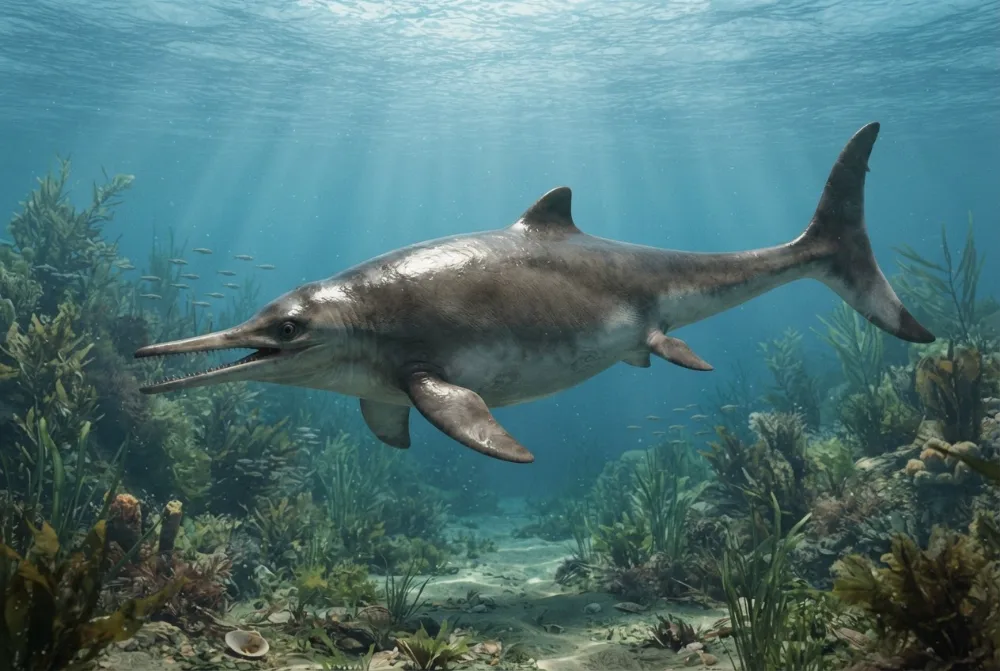
Leptonectes was a sleek, long-snouted marine reptile that swam in the seas during the time of the dinosaurs. It was not a dinosaur, but a type of ichthyosaur, with a body shaped like a fish and flippers for steering. It hunted small sea creatures with its slender jaws.12
Kañ la dundoon?
Naka la réyoon?
Naka la guddoon?
 gudd ni 6 xaj, bakkan ba geen🍌gudd ni 33 banaana yu ñu topp-toppale🏊mënoon na féey guddaayu pisin bu mag (50 m) ci 4,2 segond
Naka la Leptonectes réyoon, bu ñu ko méngalee ak YAW?
Ay kalkil rekk ci sa navigatëer. Dara du ñu denc, dara du ñu yónne fenn.
Naka la gaawoon?


Xibaar yu neex
Leptonectes had a very long and slender snout, which is why its name means 'slender swimmer'.1
The name Leptonectes was proposed in 1996 to replace the older name Leptopterygius, because that name was already used for another animal.1
Leptonectes lived from about 205.7 to 182.9 million years ago, during the Late Triassic and Early Jurassic periods.2
Its front flippers were longer than its back flippers, but not twice as long.2
Leptonectes had large eyes and a slightly raised area on its skull near the cheekbones.2
The bones in its flippers were rounded and spaced apart, which may have made its flippers flexible.2
Leptonectes gave birth to live young, just like other ichthyosaurs, instead of laying eggs.2
Laaj yi ñu gën a laaj ci Leptonectes
?How big was Leptonectes?
The biggest species, Leptonectes solei, was about 5 to 6 metres (16 to 20 ft) long. The type species, L. tenuirostris, reached 4 metres (13 ft), and L. moorei was about 3 metres (9.8 ft).3
?Was Leptonectes a dinosaur?
No, Leptonectes was not a dinosaur. It was an ichthyosaur, a marine reptile that lived in the sea at the same time as dinosaurs.3
?What did Leptonectes eat?
Leptonectes hunted small sea creatures with its long, slender jaws. Its sharp teeth helped it catch fish and other marine animals.3
Ku tas léeb yu dul dëgg
Léeb: Some people think Leptonectes was a dinosaur because it lived during the time of dinosaurs.
Dëgg: Leptonectes was not a dinosaur. It was a marine reptile called an ichthyosaur, which lived in the ocean.2
Ngir ñi xam dino lool
- Turu xam-xam
- Leptonectes
- Ku ko tudde
- McGowan 19964
- Kurél
- Iktiyosoor yi
- Njaboot / klad
- Neoichthyosauria4
- Klasifikasiyoŋ
- Ichthyosauria > Ichthyosauromorpha4
- Màggaayu doj yi
- 206 ba 183 milyoŋ at (Rhaetian / Toarcian)4
- Formasiyoŋi doj
- Charmouth Mudstone, Blue Lias, Posidonia Shale4
- Réew yi
- Angalteer, Suwis, Almaañ, Belsik, Otris4
- Fosil yu ñu gis
- 12 ci The Paleobiology Database4
- Ñu ngi koy wooye itam
- Leptopterygius (tur yu njëkk yi, léegi ñu ngi leen jàppe ni benn rab rekk)4
- Gisees
- The name Leptonectes was created by Chris McGowan in 1996 to replace the old name Leptopterygius. The first species, Leptonectes tenuirostris, was originally named by Conybeare in 1822.1
- Ñu ngi koy werante ba tey
- Scientists still debate exactly which species belong to Leptonectes and how they are related to other ichthyosaurs.1
Fa xibaar yi jóge
- The taxonomic status of Leptopterygius Huene, 1922 (Reptilia: Ichthyosauria) (cdnsciencepub.com)
- PBDB Taxon (paleobiodb.org)
- Leptonectes (en.wikipedia.org)
- Leptonectes in The Paleobiology Database (CC BY 4.0): at, béréb yi, formasiyoŋi doj, klasifikasiyoŋ.
Bépp xibaar ci xët wii am na lim bu wone fa mu jóge. Su nu juumee, baal nu, nun ñu bëgg dino lanu, du ab sërnaalu xam-xam. Wax nu ko ci [email protected] nu defar ko.
 Rex xiif na! Dino Wiki, mbiru ab baay la ngir doomam ju góor ju bëgg dinosoor, ci neen te amul kaamuñaate, amul tracker. Mag ñi mën nañu jox Rex tuuti ñam ngir dimbali ko mu des ci internet.Dundal Rex
 Ichthyosaurus
 Platypterygius
 Stenopterygius
 Khudiakovia
 Ophthalmosaurus
 Chonespondylus
 Dilophosaurus
 Dorygnathus
 Lufengosaurus
 Scutellosaurus
 Yunnanosaurus
 Sinosaurus