 Ban dino nga? Kiis
 Xeexu dino
 Rawante dino
 Fo yu ndaw yu dino
 Albomu sitikeer
 Limu TOP yu dino
 Bett ma!
Liliensternus
Liliensternus was a meat-eating dinosaur that lived in what is now Germany during the Late Triassic. It walked on two legs and was one of the largest predators of its time in Europe.1
Kañ la dundoon?
Naka la réyoon?
Naka la guddoon?
Naka la kawewoon?
Naka la diisoon?
 gudd ni 5 xaj, bakkan ba geen🍌gudd ni 29 banaana yu ñu topp-toppale🍉diis ni 40 xaal🧸diis ni 11 xale yu maternel🎒diis ni 6 xale yu lekkool🏃mënoon na daw 100 meetar ci 7,2 segond (nit ki gën a gaaw dafay soxla 9,6)
Naka la Liliensternus réyoon, bu ñu ko méngalee ak YAW?
Ay kalkil rekk ci sa navigatëer. Dara du ñu denc, dara du ñu yónne fenn.
Naka la gaawoon?


Xibaar yu neex
Liliensternus is the best-known Triassic theropod from Europe.1
The fossils were found by Count Hugo Rühle von Lilienstern in the winter of 1932/1933 near Großer Gleichberg in Germany.1
Liliensternus had a shorter shin bone (tibia) than thigh bone (femur), which is different from some other early theropods like Coelophysis.1
It lived about 210 million years ago, during the Late Triassic Period.1
The dinosaur's name honors Count Hugo Rühle von Lilienstern, who helped paleontology in Germany by starting a museum in his castle.1
Some scientists think Liliensternus could run fast to catch small ornithischian dinosaurs.1
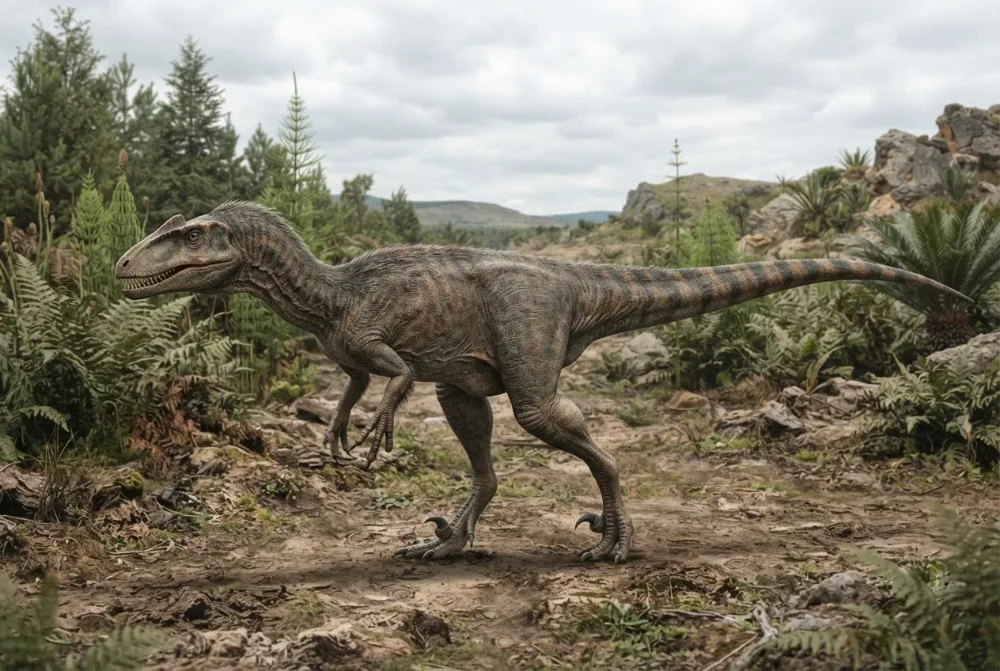
Laaj yi ñu gën a laaj ci Liliensternus
?How big was Liliensternus?
About 5.15 metres (16.9 feet) long and maybe 127 kilograms (280 pounds), but some fragmentary remains suggest adults could reach 7 to 9 metres.1
?What did Liliensternus eat?
It was a meat-eater that probably hunted large herbivores like Plateosaurus and also chased fast ornithischian dinosaurs.1
?Did Liliensternus have feathers?
Nobody knows for sure. The fossils don't show feathers, and most Triassic theropods are not known to have them.1
?When did Liliensternus live?
It lived about 210 million years ago, during the Late Triassic Period.12
?Could Liliensternus run fast?
Yes, it was a fast runner. Paul (1988) noted it used its speed to catch swift ornithischian dinosaurs.1
?Was Liliensternus bigger than T. rex?
No, T. rex was much bigger. Liliensternus was about 5 metres long, while T. rex was over 12 metres long.1
Ngir ñi xam dino lool
- Turu xam-xam
- Liliensternus
- Ku ko tudde
- Welles 19844
- Kurél
- Dino yuy lekk yàpp
- Njaboot / klad
- Neotheropoda4
- Klasifikasiyoŋ
- Theropoda4
- Màggaayu doj yi
- 227 ba 201 milyoŋ at (Norian / Rhaetian)4
- Formasiyoŋi doj
- Trossingen, Klettgau, Löwenstein4
- Réew yi
- Almaañ, Suwis4
- Fosil yu ñu gis
- 5 ci The Paleobiology Database4
- Gisees
- Liliensternus was first named Halticosaurus liliensternus by Friedrich von Huene in 1934, but in 1984 Samuel Paul Welles gave it its own genus name Liliensternus.1
- Ñu ngi koy werante ba tey
- Scientists are not sure if Liliensternus belongs to the group Coelophysoidea or is a more primitive neotheropod.1
Fa xibaar yi jóge
- Liliensternus (en.wikipedia.org)
- Liliensternus | Natural History Museum (nhm.ac.uk)
- Liliensternus | Earth and Atmospheric Sciences | Research Starters | EBSCOhost (ebsco.com)
- Liliensternus in The Paleobiology Database (CC BY 4.0): at, béréb yi, formasiyoŋi doj, klasifikasiyoŋ.
Bépp xibaar ci xët wii am na lim bu wone fa mu jóge. Su nu juumee, baal nu, nun ñu bëgg dino lanu, du ab sërnaalu xam-xam. Wax nu ko ci [email protected] nu defar ko.
 Rex xiif na! Dino Wiki, mbiru ab baay la ngir doomam ju góor ju bëgg dinosoor, ci neen te amul kaamuñaate, amul tracker. Mag ñi mën nañu jox Rex tuuti ñam ngir dimbali ko mu des ci internet.Dundal Rex
 Allosaurus
 Carnotaurus
 Dilophosaurus
 Giganotosaurus
 Compsognathus
 Paronychodon
 Nothosaurus
 Massospondylus
 Plateosaurus
 Simosaurus
 Thecodontosaurus
 Eudimorphodon