 Ban dino nga? Kiis
 Xeexu dino
 Rawante dino
 Fo yu ndaw yu dino
 Albomu sitikeer
 Limu TOP yu dino
 Bett ma!
Luskhan
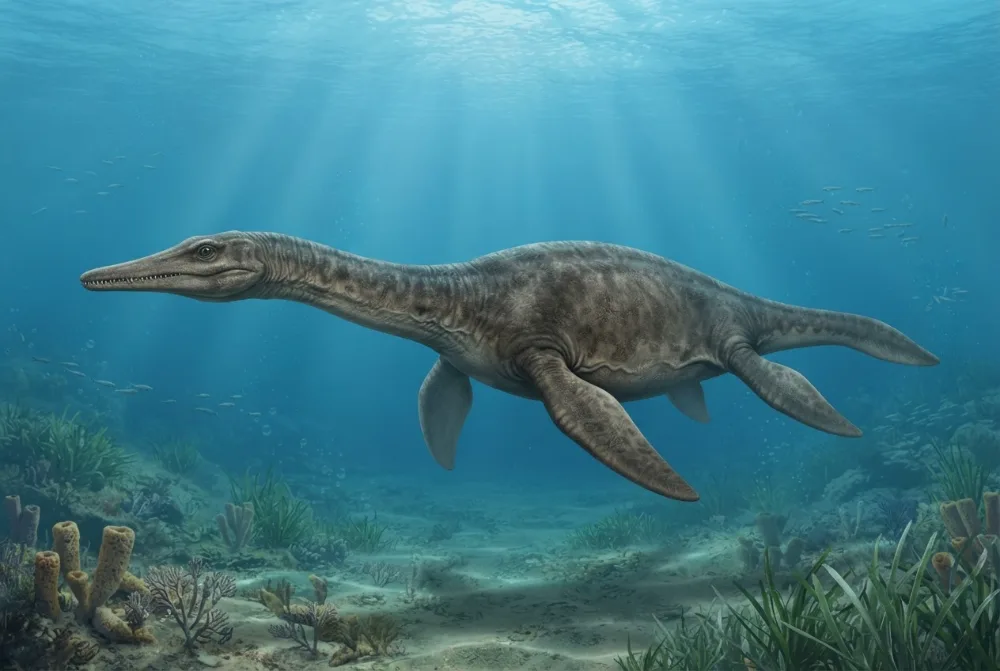
Luskhan was a plesiosaur, a marine reptile that lived in the ancient seas of what is now Russia. It had a long, slender snout and small teeth, perfect for catching soft, squishy prey like squid. Unlike many other pliosaurs, Luskhan was not a giant apex predator but a specialized hunter of small animals.12
Kañ la dundoon?
Naka la réyoon?
Naka la guddoon?
 gudd ni 6 xaj, bakkan ba geen🍌gudd ni 36 banaana yu ñu topp-toppale🏊mënoon na féey guddaayu pisin bu mag (50 m) ci 6,9 segond
Naka la Luskhan réyoon, bu ñu ko méngalee ak YAW?
Ay kalkil rekk ci sa navigatëer. Dara du ñu denc, dara du ñu yónne fenn.
Naka la gaawoon?


Xibaar yu neex
Luskhan is known from a nearly complete, three-dimensionally preserved skeleton, which is rare for pliosaurids.12
Its name comes from Mongolian and Turkic mythology: 'luus' means water spirit and 'khan' means chief.1
Luskhan lived about 128 million years ago, during the Hauterivian stage of the Early Cretaceous.1
Unlike most other pliosaurs, Luskhan had a long, slender snout and small teeth, similar to the distantly related polycotylid plesiosaurs.12
Luskhan evolved its fish-eating features independently from polycotylids, more than 10 million years later.1
The only known specimen was discovered in 2002 by Russian paleontologist Gleb N. Uspensky on the banks of the Volga River.1
Laaj yi ñu gën a laaj ci Luskhan
?How big was Luskhan?
Luskhan was about 6.5 metres (21 feet) long, which is roughly the length of a large boat.1
?What did Luskhan eat?
Luskhan ate small, soft prey like squid. Its slender snout and small teeth were perfect for catching soft animals, not large prey.13
?Was Luskhan a dinosaur?
No, Luskhan was a plesiosaur, a marine reptile that lived in the sea. It was not a dinosaur.1
Ngir ñi xam dino lool
- Turu xam-xam
- Luskhan
- Ku ko tudde
- Fischer et al. 20174
- Kurél
- Plesiyosoor yi
- Njaboot / klad
- Pliosauridae4
- Klasifikasiyoŋ
- Plesiosauria > Pliosauridae > Sauropterygia4
- Màggaayu doj yi
- 133 ba 126 milyoŋ at (Hauterivian)4
- Réew yi
- Riisi4
- Fosil yu ñu gis
- 1 ci The Paleobiology Database4
- Gisees
- Luskhan was named in 2017 by a team led by Valentin Fischer, based on a skeleton found in 2002 by Gleb N. Uspensky in western Russia.14
- Ñu ngi koy werante ba tey
- Scientists are not sure exactly how large Luskhan grew, because no complete length estimate has been published.1
Fa xibaar yi jóge
- Luskhan (en.wikipedia.org)
- Anatomy and relationships of the bizarre Early Cretaceous pliosaurid Luskhan itilensis | Zoological Journal of the Linnean Society | Oxford Academic (academic.oup.com)
- Plasticity and Convergence in the Evolution of Short-Necked Plesiosaurs: Current Biology (cell.com)
- Luskhan in The Paleobiology Database (CC BY 4.0): at, béréb yi, formasiyoŋi doj, klasifikasiyoŋ.
Bépp xibaar ci xët wii am na lim bu wone fa mu jóge. Su nu juumee, baal nu, nun ñu bëgg dino lanu, du ab sërnaalu xam-xam. Wax nu ko ci [email protected] nu defar ko.
 Rex xiif na! Dino Wiki, mbiru ab baay la ngir doomam ju góor ju bëgg dinosoor, ci neen te amul kaamuñaate, amul tracker. Mag ñi mën nañu jox Rex tuuti ñam ngir dimbali ko mu des ci internet.Dundal Rex
 Elasmosaurus
 Pliosaurus
 Plesiosaurus
 Cimoliasaurus
 Colymbosaurus
 Trinacromerum
 Stegosaurus
 Iguanodon
 Archaeopteryx
 Giganotosaurus
 Microraptor
 Deinonychus