 Ban dino nga? Kiis
 Xeexu dino
 Rawante dino
 Fo yu ndaw yu dino
 Albomu sitikeer
 Limu TOP yu dino
 Bett ma!
Kañ la dundoon?

Naka la réyoon?
Naka la kawewoon?
Naka la diisoon?
Naka la Mirarce réyoon, bu ñu ko méngalee ak YAW?
Ay kalkil rekk ci sa navigatëer. Dara du ñu denc, dara du ñu yónne fenn.
Naka la gaawoon?


Xibaar yu neex
Its fossil was discovered in 1992 but was not officially named until 2018.1
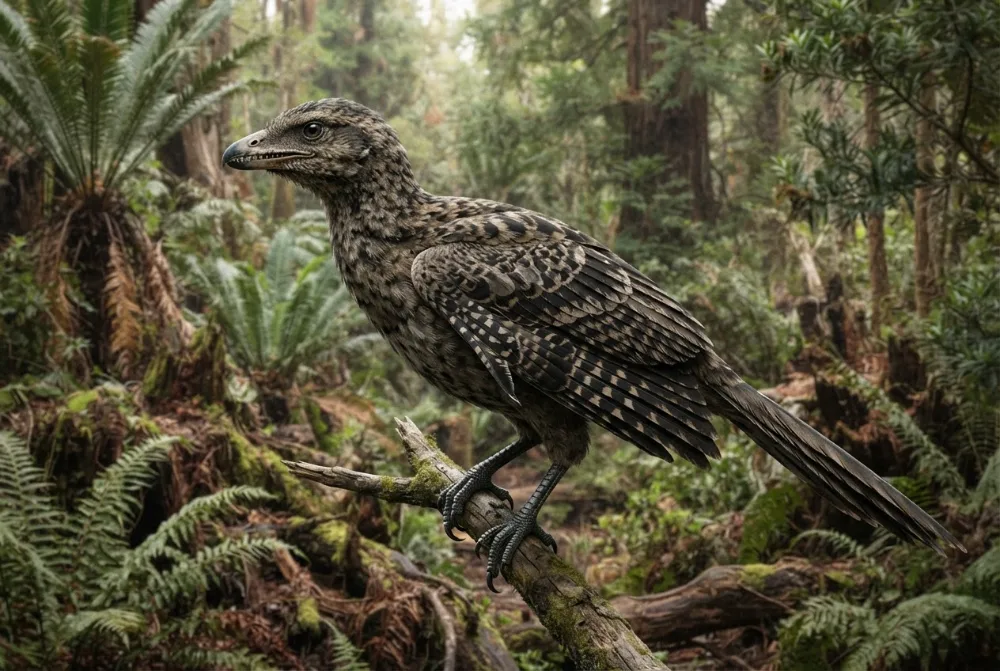
Mirarce had quill knobs on its ulna bone, which are bumps that help anchor flight feathers. This is the first time such knobs have been found in enantiornithine birds.21
It had a deeply keeled sternum (breastbone) and a narrow furcula (wishbone), features that improved its flight abilities.2
Mirarce lived during the Campanian age of the Late Cretaceous, about 76 to 74 million years ago.1
Its name combines Latin 'mirus' (wonderful) and the Greek messenger Arke, referring to its well-preserved flight-related features.1
Laaj yi ñu gën a laaj ci Mirarce
?Was Mirarce a dinosaur?
Yes, Mirarce was a bird, and birds are a type of dinosaur called avialan theropods. So it was a dinosaur, but not a non-avian dinosaur like T. rex.1
?How big was Mirarce?
Mirarce was about the size of a turkey vulture, growing to around 60 cm tall. It weighed about 0.45 kg.13
?What did Mirarce eat?
Mirarce was a raptorial predator, meaning it hunted and ate other animals. It had powerful talons and leg tendons, similar to modern birds of prey.1
?When did Mirarce live?
Mirarce lived during the Campanian age of the Late Cretaceous, about 76 to 74 million years ago.1
Ngir ñi xam dino lool
- Turu xam-xam
- Mirarce
- Ku ko tudde
- Atterholt et al. 20184
- Kurél
- Picc yu jëkk yi
- Njaboot / klad
- Avisauridae4
- Klasifikasiyoŋ
- Theropoda > Avialae4
- Màggaayu doj yi
- 84 ba 72 milyoŋ at (Campanian)4
- Formasiyoŋi doj
- Kaiparowits4
- Réew yi
- Amerig4
- Fosil yu ñu gis
- 1 ci The Paleobiology Database4
- Gisees
- The fossil was collected in 1992 by Howard Hutchison in Utah. It was studied and named by Jesse Atterholt and colleagues in 2018, who called it Mirarce eatoni in honor of paleontologist Jeffrey Eaton.1
- Ñu ngi koy werante ba tey
- Scientists are still debating how enantiornithine birds like Mirarce compare to modern birds in terms of flight abilities and evolutionary relationships.2
Fa xibaar yi jóge
- Mirarce (en.wikipedia.org)
- The most complete enantiornithine from North America and a phylogenetic analysis of the Avisauridae (pmc.ncbi.nlm.nih.gov)
- Rare fossil bird deepens mystery of avian extinctions (vcresearch.berkeley.edu)
- Mirarce in The Paleobiology Database (CC BY 4.0): at, béréb yi, formasiyoŋi doj, klasifikasiyoŋ.
Bépp xibaar ci xët wii am na lim bu wone fa mu jóge. Su nu juumee, baal nu, nun ñu bëgg dino lanu, du ab sërnaalu xam-xam. Wax nu ko ci [email protected] nu defar ko.
 Rex xiif na! Dino Wiki, mbiru ab baay la ngir doomam ju góor ju bëgg dinosoor, ci neen te amul kaamuñaate, amul tracker. Mag ñi mën nañu jox Rex tuuti ñam ngir dimbali ko mu des ci internet.Dundal Rex
 Archaeopteryx
 Hesperornis
 Ichthyornis
 Baptornis
 Jurapteryx
 Gobipteryx
 Tyrannosaurus
 Triceratops
 Velociraptor
 Spinosaurus
 Ankylosaurus
 Parasaurolophus