 Ban dino nga? Kiis
 Xeexu dino
 Rawante dino
 Fo yu ndaw yu dino
 Albomu sitikeer
 Limu TOP yu dino
 Bett ma!
Nichollssaura
Nichollssaura was a small, fast-swimming marine reptile that lived in the ancient seas of North America. It had a long neck, four flippers, and a mouth full of sharp teeth for catching fish.1
Kañ la dundoon?
Naka la réyoon?
Naka la guddoon?
Naka la diisoon?
 gudd ni 3 xaj, bakkan ba geen🍌gudd ni 16 banaana yu ñu topp-toppale🍉diis ni 27 xaal🧸diis ni 7 xale yu maternel🎒diis ni 4 xale yu lekkool🏊mënoon na féey guddaayu pisin bu mag (50 m) ci 6,4 segond
Naka la Nichollssaura réyoon, bu ñu ko méngalee ak YAW?
Ay kalkil rekk ci sa navigatëer. Dara du ñu denc, dara du ñu yónne fenn.
Naka la gaawoon?


Xibaar yu neex
Nichollssaura fills a 40-million-year gap in the fossil record of North American plesiosaurs, meaning no plesiosaur fossils from that time were known before its discovery.1
The only known skeleton was accidentally discovered by a 100-ton electric shovel operator in an oilsand mine near Fort McMurray, Alberta, in 1994.1
The fossil is almost complete, missing only a few bones like the left forelimb and some ribs, which were lost when the shovel hit the skeleton.1
Inside the stomach of the Nichollssaura fossil, scientists found 165 gastroliths (stomach stones) made of chert and quartzite, which may have helped it digest food.1
The gastroliths in Nichollssaura are similar to those found in another plesiosaur from the same area, Wapuskanectes, suggesting both animals collected stones from the same ancient beaches.1
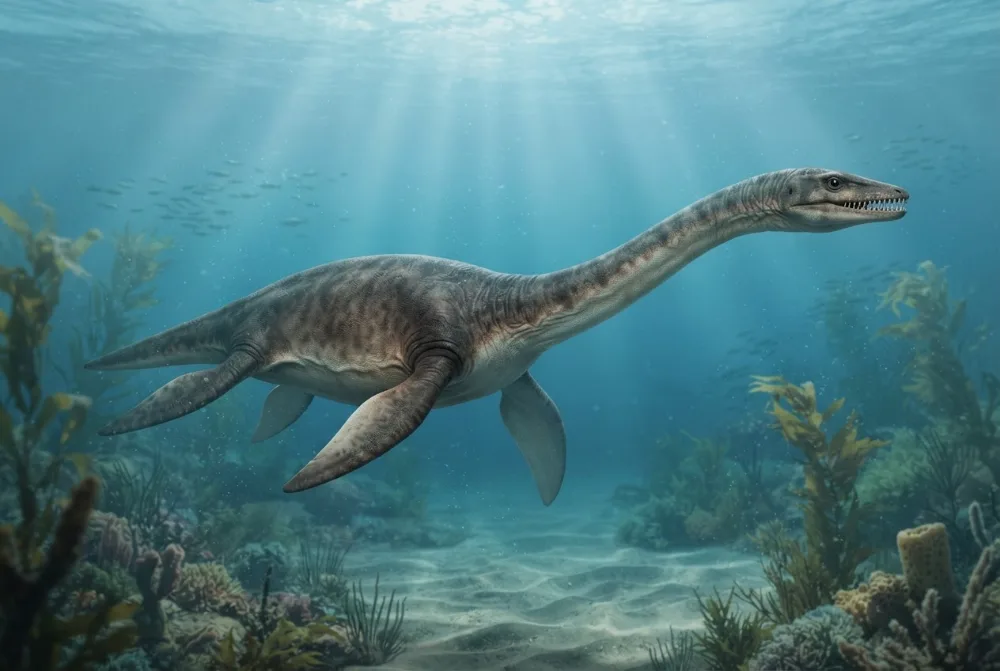
Ngir ñi xam dino lool
- Turu xam-xam
- Nichollssaura
- Ku ko tudde
- Druckenmiller and Russell 20092
- Kurél
- Plesiyosoor yi
- Njaboot / klad
- Leptocleididae2
- Klasifikasiyoŋ
- Plesiosauria > Sauropterygia2
- Màggaayu doj yi
- 113 ba 100 milyoŋ at (Albian)2
- Formasiyoŋi doj
- Clearwater2
- Réew yi
- Kanadaa2
- Fosil yu ñu gis
- 1 ci The Paleobiology Database2
- Gisees
- The fossil was discovered in 1994 by shovel operators Greg Fisher and Lorne Cundal in an oilsand mine near Fort McMurray, Alberta. It was named Nichollsia borealis in 2008 by Druckenmiller and Russell, but renamed Nichollssaura borealis in 2009 because the original name was already taken.12
- Ñu ngi koy werante ba tey
- Scientists are not sure exactly where Nichollssaura collected its stomach stones, but they think it may have swum westward to gather rocks from the Cadomin Formation, which is 8 to 10 million years older than the plesiosaur itself.1
Fa xibaar yi jóge
- Nichollssaura (en.wikipedia.org)
- Nichollssaura in The Paleobiology Database (CC BY 4.0): at, béréb yi, formasiyoŋi doj, klasifikasiyoŋ.
Bépp xibaar ci xët wii am na lim bu wone fa mu jóge. Su nu juumee, baal nu, nun ñu bëgg dino lanu, du ab sërnaalu xam-xam. Wax nu ko ci [email protected] nu defar ko.
 Rex xiif na! Dino Wiki, mbiru ab baay la ngir doomam ju góor ju bëgg dinosoor, ci neen te amul kaamuñaate, amul tracker. Mag ñi mën nañu jox Rex tuuti ñam ngir dimbali ko mu des ci internet.Dundal Rex
 Elasmosaurus
 Pliosaurus
 Plesiosaurus
 Cimoliasaurus
 Colymbosaurus
 Trinacromerum
 Stegosaurus
 Iguanodon
 Archaeopteryx
 Giganotosaurus
 Microraptor
 Deinonychus