 Ban dino nga? Kiis
 Xeexu dino
 Rawante dino
 Fo yu ndaw yu dino
 Albomu sitikeer
 Limu TOP yu dino
 Bett ma!
Kañ la dundoon?

Naka la réyoon?
Naka la ay laafam yaatuwoon?
Naka la Parvavis réyoon, bu ñu ko méngalee ak YAW?
Ay kalkil rekk ci sa navigatëer. Dara du ñu denc, dara du ñu yónne fenn.
Naka la gaawoon?


Xibaar yu neex
When Parvavis was discovered, it was the smallest known enantiornithine bird, even smaller than Iberomesornis.1
The fossil of Parvavis includes parts of the skull, spine, tail, and even impressions of its feathers in the rock.1
Scientists studied the bone structure and found that Parvavis was nearly full-grown when it died, but it was still surprisingly tiny.12
Parvavis had a special feature: the bottom joint of its second metatarsal (a foot bone) was wider than the joints of its other metatarsals.1
The claw on the fourth toe of Parvavis was reduced, meaning it was smaller than the other toe claws.1
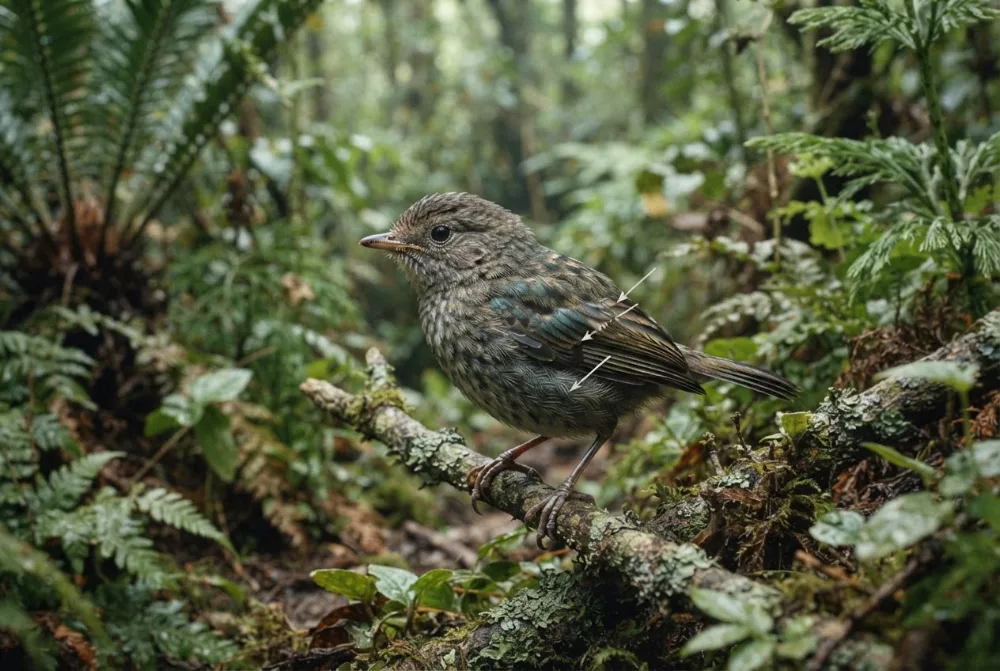
Ngir ñi xam dino lool
- Turu xam-xam
- Parvavis
- Ku ko tudde
- Wang et al. 20143
- Kurél
- Picc yu jëkk yi
- Njaboot / klad
- Enantiornithes3
- Klasifikasiyoŋ
- Theropoda > Avialae3
- Màggaayu doj yi
- 94 ba 84 milyoŋ at (Turonian / Santonian)3
- Formasiyoŋi doj
- Jiangdihe3
- Réew yi
- Siin3
- Fosil yu ñu gis
- 1 ci The Paleobiology Database3
- Gisees
- The skeleton of Parvavis was found in 2010 near Luojumei Village in Yunnan, China. It was named and described in 2014 by Wang Min, Zhou Zhonghe, and Xu Guanghui.1
- Ñu ngi koy werante ba tey
- Scientists are still debating exactly where Parvavis fits on the enantiornithine family tree. Some analyses place it in a relatively basal position, meaning it may have been an early branch of this group.1
Fa xibaar yi jóge
- Parvavis (en.wikipedia.org)
- The first enantiornithine bird from the Upper Cretaceous of China (tandfonline.com)
- Parvavis in The Paleobiology Database (CC BY 4.0): at, béréb yi, formasiyoŋi doj, klasifikasiyoŋ.
Bépp xibaar ci xët wii am na lim bu wone fa mu jóge. Su nu juumee, baal nu, nun ñu bëgg dino lanu, du ab sërnaalu xam-xam. Wax nu ko ci [email protected] nu defar ko.
 Rex xiif na! Dino Wiki, mbiru ab baay la ngir doomam ju góor ju bëgg dinosoor, ci neen te amul kaamuñaate, amul tracker. Mag ñi mën nañu jox Rex tuuti ñam ngir dimbali ko mu des ci internet.Dundal Rex
 Archaeopteryx
 Hesperornis
 Ichthyornis
 Baptornis
 Jurapteryx
 Gobipteryx
 Tyrannosaurus
 Triceratops
 Velociraptor
 Spinosaurus
 Ankylosaurus
 Parasaurolophus