 Ban dino nga? Kiis
 Xeexu dino
 Rawante dino
 Fo yu ndaw yu dino
 Albomu sitikeer
 Limu TOP yu dino
 Bett ma!
Kañ la dundoon?

Naka la réyoon?
Naka la guddoon?
Naka la kawewoon?
jortu
Naka la diisoon?

 gudd ni 5 xaj, bakkan ba geen🍌gudd ni 28 banaana yu ñu topp-toppalediis ni 100 xaj🍉diis ni 400 xaal🎒diis ni 2,5 klaas yu mat yu xale yu lekkool🐻❄️diis ni 4 uurs yu weex🏃mënoon na daw 100 meetar ci 18 segond (nit ki gën a gaaw dafay soxla 9,6)
Naka la Polacanthus réyoon, bu ñu ko méngalee ak YAW?
Ay kalkil rekk ci sa navigatëer. Dara du ñu denc, dara du ñu yónne fenn.
Naka la gaawoon?


Xibaar yu neex
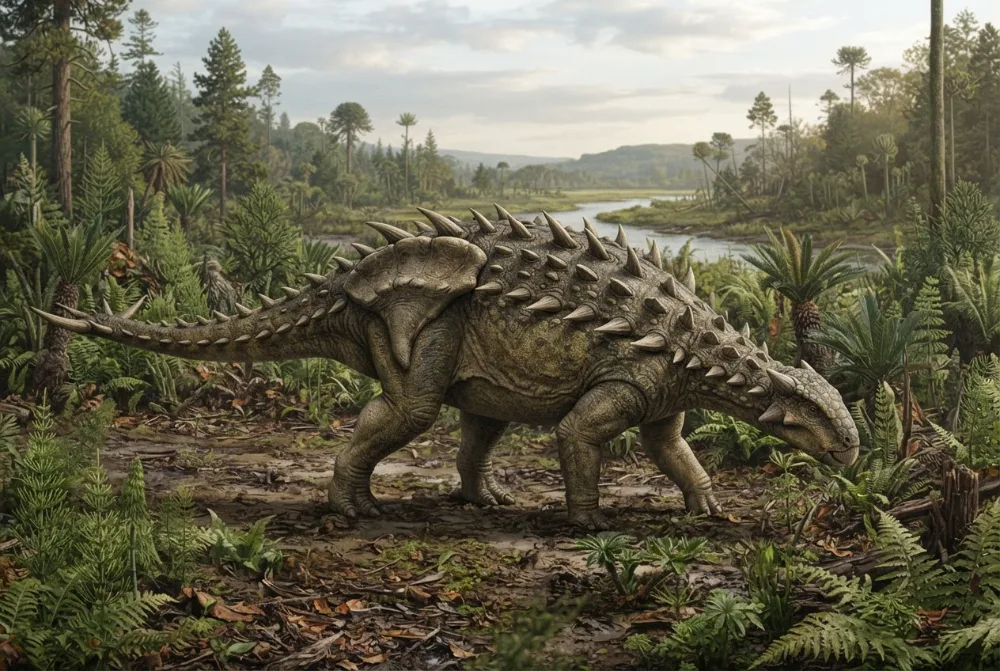
Polacanthus had a large fused plate of bone over its hips called a 'pelvic shield', which was about 108 centimetres wide and 90 centimetres long.1
Its body was covered with many spikes and small bony studs called ossicles.1
The first fossil of Polacanthus was discovered by the Reverend William Fox on the Isle of Wight in 1865.1
Polacanthus lived about 130 to 125 million years ago during the Early Cretaceous.1
Scientists are not sure if Polacanthus belongs to the Nodosauridae family or its own family, the Polacanthidae.1
A second species, Polacanthus rudgwickensis, was named in 1996 but later moved to its own genus Horshamosaurus in 2015.1
Laaj yi ñu gën a laaj ci Polacanthus
?How big was Polacanthus?
Polacanthus grew to about 4 to 5 metres (13 to 16 feet) long. Estimates of its weight vary significantly, with some scientists suggesting it weighed around 2 tonnes (4,400 pounds), while others estimate it was much lighter.1
?What did Polacanthus eat?
Polacanthus was a herbivore, meaning it ate plants. Its teeth and body were built for eating vegetation.1
?Did Polacanthus have a tail club?
No, Polacanthus did not have a tail club like Ankylosaurus. Instead, its tail had spikes and bony plates for protection.1
?Where was Polacanthus found?
Polacanthus fossils have been found in England, especially on the Isle of Wight. The first fossil was discovered there in 1865 by the Reverend William Fox.13
?When did Polacanthus live?
Polacanthus lived during the Early Cretaceous Period, about 130 to 125 million years ago.1
?How fast could Polacanthus run?
Nobody knows for sure how fast Polacanthus could run, but it walked on all fours and had relatively long hindlimbs for an ankylosaur, which might have allowed it to move fairly quickly.1
Ku tas léeb yu dul dëgg
Léeb: Polacanthus could swing its tail like a club.
Dëgg: Polacanthus did not have a tail club; its tail was covered in spikes but lacked the heavy bony club seen in some other ankylosaurs.1
Ngir ñi xam dino lool
- Turu xam-xam
- Polacanthus
- Ku ko tudde
- Fox 18664
- Kurél
- Dino yu am kiiraay
- Njaboot / klad
- Nodosauridae4
- Klasifikasiyoŋ
- Ornithischia > Ankylosauria > Nodosauridae > Thyreophora4
- Màggaayu doj yi
- 139 ba 100 milyoŋ at (Berriasian / Albian)4
- Formasiyoŋi doj
- Wessex, Vectis, Pinilla de los Moros4
- Réew yi
- Angalteer, Españ4
- Fosil yu ñu gis
- 16 ci The Paleobiology Database4
- Ñu ngi koy wooye itam
- Euacanthus, Vectensia (tur yu njëkk yi, léegi ñu ngi leen jàppe ni benn rab rekk)4
- Gisees
- Polacanthus was discovered by Reverend William Fox on the Isle of Wight in 1865. The name was first used by Richard Owen in a lecture later that year, and the full description was published by Fox in 1866.1
- Ñu ngi koy werante ba tey
- Scientists still debate whether Polacanthus was a nodosaurid or belonged to a separate family called Polacanthidae.1
Fa xibaar yi jóge
- Polacanthus (en.wikipedia.org)
- Polacanthus | Natural History Museum (nhm.ac.uk)
- Spotlight on Polacanthus - Horniman Museum and Gardens (horniman.ac.uk)
- Polacanthus in The Paleobiology Database (CC BY 4.0): at, béréb yi, formasiyoŋi doj, klasifikasiyoŋ.
Bépp xibaar ci xët wii am na lim bu wone fa mu jóge. Su nu juumee, baal nu, nun ñu bëgg dino lanu, du ab sërnaalu xam-xam. Wax nu ko ci [email protected] nu defar ko.
 Rex xiif na! Dino Wiki, mbiru ab baay la ngir doomam ju góor ju bëgg dinosoor, ci neen te amul kaamuñaate, amul tracker. Mag ñi mën nañu jox Rex tuuti ñam ngir dimbali ko mu des ci internet.Dundal Rex
 Ankylosaurus
 Sauropelta
 Pinacosaurus
 Scutellosaurus
 Struthiosaurus
 Euoplocephalus
 Stegosaurus
 Iguanodon
 Archaeopteryx
 Giganotosaurus
 Microraptor
 Deinonychus