 Ban dino nga? Kiis
 Xeexu dino
 Rawante dino
 Fo yu ndaw yu dino
 Albomu sitikeer
 Limu TOP yu dino
 Bett ma!
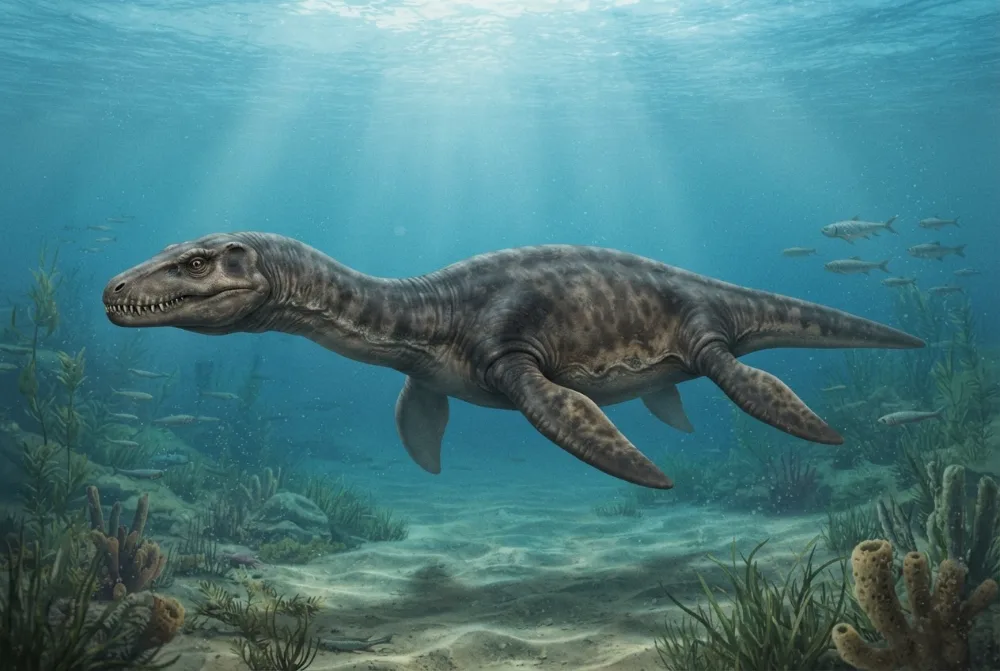
Polycotylus
Polycotylus was a short-necked plesiosaur that swam in the warm seas of North America and Europe during the Cretaceous. It had a big head, strong flippers, and gave birth to live babies in the water, just like whales do today.1
Kañ la dundoon?
Naka la réyoon?
Naka la guddoon?
Naka la diisoon?
 gudd ni 5 xaj, bakkan ba geen🍌gudd ni 30 banaana yu ñu topp-toppale🍉diis ni 200 xaal🧸diis ni 53 xale yu maternel🎒diis ni 31 xale yu lekkool🐻❄️diis ni 2 uurs yu weex🏊mënoon na féey guddaayu pisin bu mag (50 m) ci 6,7 segond
Naka la Polycotylus réyoon, bu ñu ko méngalee ak YAW?
Ay kalkil rekk ci sa navigatëer. Dara du ñu denc, dara du ñu yónne fenn.
Naka la gaawoon?


Xibaar yu neex
Polycotylus was named by famous paleontologist Edward Drinker Cope in 1869 from fossils found in Kansas.1
A fossil of Polycotylus found in Kansas contains a single large fetus inside the mother, proving that these plesiosaurs gave live birth.1
The baby Polycotylus was about 1.5 metres (4.9 feet) long, which is about 32 percent of the mother's length.1
Polycotylus had a short neck and a long head, making it look a bit like a pliosaur, but it is actually a type of plesiosaur called a polycotylid.1
Its name means 'much-cupped vertebrae' because the bones in its spine have deep cup-like hollows.1
Polycotylus lived in the Western Interior Seaway, a shallow sea that split North America in two during the Cretaceous.1
Scientists think Polycotylus gave birth to just one large baby at a time, a strategy called K-selection.1
Laaj yi ñu gën a laaj ci Polycotylus
?How big was Polycotylus?
Polycotylus was a medium-sized plesiosaur, measuring about 4.7 to 5.4 metres (15 to 18 feet) long and weighing over 1 metric ton (1.1 short tons).1
?Did Polycotylus have a short neck?
Yes, Polycotylus had a short neck and a long head, unlike the long-necked plesiosaurs like Elasmosaurus.1
?What did Polycotylus eat?
Polycotylus had thick teeth with striations on their surfaces, which suggests it ate fish and other marine animals, but the sources do not give a specific diet.1
?When did Polycotylus live?
Polycotylus lived toward the end of the Cretaceous period, about 84 to 66 million years ago.1
Ku tas léeb yu dul dëgg
Léeb: Many people think all plesiosaurs had long necks like the Loch Ness Monster.
Dëgg: Polycotylus had a short neck and a large head, very different from long-necked plesiosaurs like Elasmosaurus.1
Ngir ñi xam dino lool
- Turu xam-xam
- Polycotylus
- Ku ko tudde
- Cope 18693
- Kurél
- Plesiyosoor yi
- Njaboot / klad
- Polycotylidae3
- Klasifikasiyoŋ
- Plesiosauria > Sauropterygia3
- Màggaayu doj yi
- 152 ba 72 milyoŋ at (Kimmeridgian / Campanian)3
- Formasiyoŋi doj
- Niobrara, Frontier, Mooreville Chalk3
- Réew yi
- Amerig, Faraas, Riisi3
- Fosil yu ñu gis
- 10 ci The Paleobiology Database3
- Gisees
- Edward Drinker Cope named Polycotylus in 1869 from fragmentary bones found in the Niobrara Formation of Kansas. A nearly complete skeleton was later found in Alabama in 1949 but not described until 2002.1
- Ñu ngi koy werante ba tey
- Scientists are not sure exactly how many species of Polycotylus existed, and some species may be the same as others.1
Fa xibaar yi jóge
- Polycotylus (en.wikipedia.org)
- PBDB Taxon (paleobiodb.org)
- Polycotylus in The Paleobiology Database (CC BY 4.0): at, béréb yi, formasiyoŋi doj, klasifikasiyoŋ.
Bépp xibaar ci xët wii am na lim bu wone fa mu jóge. Su nu juumee, baal nu, nun ñu bëgg dino lanu, du ab sërnaalu xam-xam. Wax nu ko ci [email protected] nu defar ko.
 Rex xiif na! Dino Wiki, mbiru ab baay la ngir doomam ju góor ju bëgg dinosoor, ci neen te amul kaamuñaate, amul tracker. Mag ñi mën nañu jox Rex tuuti ñam ngir dimbali ko mu des ci internet.Dundal Rex
 Elasmosaurus
 Pliosaurus
 Plesiosaurus
 Cimoliasaurus
 Colymbosaurus
 Trinacromerum
 Stegosaurus
 Iguanodon
 Archaeopteryx
 Giganotosaurus
 Microraptor
 Deinonychus