 Ban dino nga? Kiis
 Xeexu dino
 Rawante dino
 Fo yu ndaw yu dino
 Albomu sitikeer
 Limu TOP yu dino
 Bett ma!
Kañ la dundoon?

Naka la réyoon?
Naka la guddoon?
Naka la kawewoon?
jortu
Naka la diisoon?
 gudd ni 3 muusu kër, bakkan ba geen🍌gudd ni 8 banaana yu ñu topp-toppalelu tollu ci diisaayu muusu kër🍌diis ni 42 banaana🏃mënoon na daw 100 meetar ci 12 segond (nit ki gën a gaaw dafay soxla 9,6)
Naka la Shanag réyoon, bu ñu ko méngalee ak YAW?
Ay kalkil rekk ci sa navigatëer. Dara du ñu denc, dara du ñu yónne fenn.
Naka la gaawoon?


Xibaar yu neex
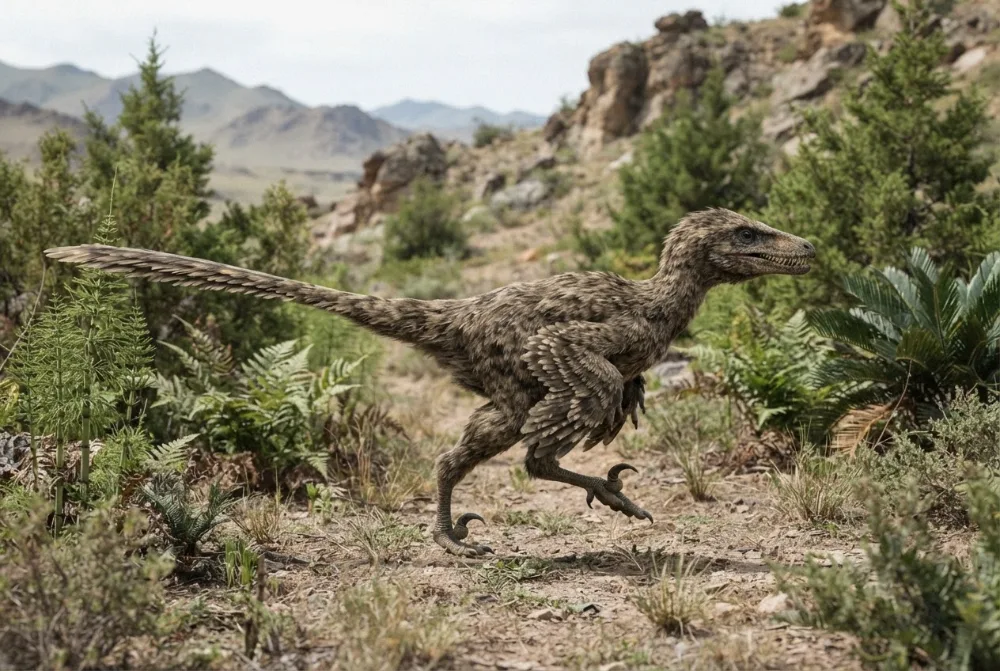
Shanag is known from only a partial skull: a right maxilla (upper jaw bone), dentary (lower jaw bone), and part of the splenial (a jaw bone).2
It was a dromaeosaurid, meaning it was a close relative of famous raptors like Velociraptor and Deinonychus.2
Shanag had special air pockets inside its jawbone between the tooth sockets, called interalveolar pneumatic cavities.2
Unlike many other theropods, Shanag lacked a promaxillary fenestra, a small opening in the front of the snout.2
Shanag lived alongside Psittacosaurus, a small horned dinosaur, and large sauropods in the Öösh region.1
The fossils of Shanag were found in rocks that are about 130 million years old, from the Early Cretaceous period.1
Laaj yi ñu gën a laaj ci Shanag
?How big was Shanag?
Shanag was a small predator, about 1.5 metres (4.9 feet) long and weighing around 5 kilograms (11 pounds).3
?Did Shanag have feathers?
Yes, as a theropod, Shanag had hollow bones and feathers. Its feathers helped with climbing, thermoregulation, and stabilizing while on prey.3
?What did Shanag eat?
Shanag was a meat-eating dinosaur with sharp teeth and claws. It likely used its claws to grip and pin down prey, similar to modern birds of prey.3
?Is Shanag a dromaeosaurid?
It may be a dromaeosaurid, but some researchers are skeptical. It shows a mix of dromaeosaurid, troodontid, and basal avialan traits, so its exact classification is debated.3
Ngir ñi xam dino lool
- Turu xam-xam
- Shanag
- Ku ko tudde
- Turner et al. 20074
- Kurél
- Raptor yi
- Njaboot / klad
- Dromaeosauridae4
- Klasifikasiyoŋ
- Theropoda > Dromaeosauridae4
- Màggaayu doj yi
- 143 ba 100 milyoŋ at (Berriasian / Albian)4
- Formasiyoŋi doj
- Öösh4
- Réew yi
- Mongoli4
- Fosil yu ñu gis
- 1 ci The Paleobiology Database4
- Gisees
- Shanag was named in 2007 by Alan H. Turner, Sunny H. Hwang, and Mark A. Norell. The only known fossil was found by a Mongolian Academy of Sciences,American Museum of Natural History expedition in 1999 at the Öösh locality in Mongolia.21
- Ñu ngi koy werante ba tey
- Scientists are unsure about the exact size of Shanag because only a partial skull has been found.2
Fa xibaar yi jóge
- digitallibrary.amnh.org (digitallibrary.amnh.org)
- A small derived theropod from Öösh, early Cretaceous, Baykhangor Mongolia ; American Museum novitates, no. 3557 (digitallibrary.amnh.org)
- Shanag (en.wikipedia.org)
- Shanag in The Paleobiology Database (CC BY 4.0): at, béréb yi, formasiyoŋi doj, klasifikasiyoŋ.
Bépp xibaar ci xët wii am na lim bu wone fa mu jóge. Su nu juumee, baal nu, nun ñu bëgg dino lanu, du ab sërnaalu xam-xam. Wax nu ko ci [email protected] nu defar ko.
 Rex xiif na! Dino Wiki, mbiru ab baay la ngir doomam ju góor ju bëgg dinosoor, ci neen te amul kaamuñaate, amul tracker. Mag ñi mën nañu jox Rex tuuti ñam ngir dimbali ko mu des ci internet.Dundal Rex
 Velociraptor
 Microraptor
 Deinonychus
 Asiamericana
 Richardoestesia
 Saurornitholestes
 Stegosaurus
 Iguanodon
 Archaeopteryx
 Giganotosaurus
 Baryonyx
 Paronychodon