 Ban dino nga? Kiis
 Xeexu dino
 Rawante dino
 Fo yu ndaw yu dino
 Albomu sitikeer
 Limu TOP yu dino
 Bett ma!
Kañ la dundoon?

Naka la réyoon?
Naka la guddoon?
Naka la kawewoon?
Naka la diisoon?
 gudd ni 2 oto yu ñu taxawal ci benn rëdd🍌gudd ni 56 banaana yu ñu topp-toppale
 diis ni 88 xaj🍉diis ni 350 xaal🧸diis ni 92 xale yu maternel🎒diis ni 55 xale yu lekkool🐻❄️diis ni 4 uurs yu weex🏃mënoon na daw 100 meetar ci 9,7 segond (nit ki gën a gaaw dafay soxla 9,6)
Naka la Siamotyrannus réyoon, bu ñu ko méngalee ak YAW?
Ay kalkil rekk ci sa navigatëer. Dara du ñu denc, dara du ñu yónne fenn.
Naka la gaawoon?


Xibaar yu neex
Its fossil includes part of the pelvis, back vertebrae, and tail vertebrae, but no skull has been found yet.1
Siamotyrannus had two vertical ridges on its hip bone, a feature that may be unique to this dinosaur.12
Even though its name means 'Siamese tyrant', scientists now think it might not be a true tyrannosaur. Some studies place it with allosaurs or other meat-eaters.1
The first fossil was found in 1993 by a man named Somchai Traimwichanon at a site in Thailand.1
Some scientists think Siamotyrannus was closely related to another dinosaur called Siamraptor, which also lived in Thailand.1
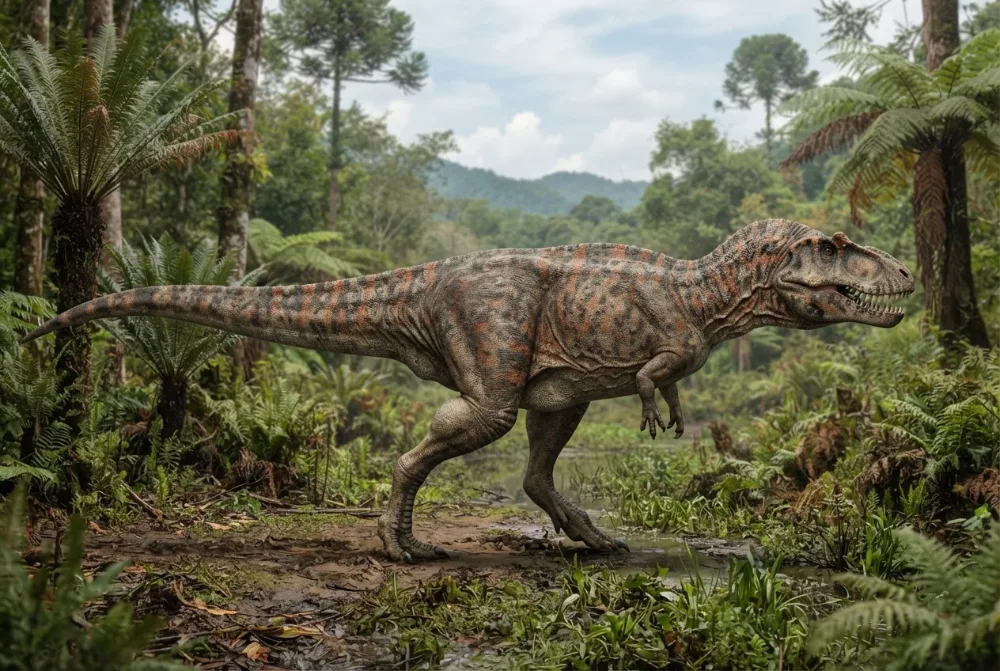
Laaj yi ñu gën a laaj ci Siamotyrannus
?How big was Siamotyrannus?
Scientists are not sure, but estimates range from about 6 meters (20 feet) to 10 meters (33 feet) long, and it may have weighed between 500 kg and 1.75 tonnes.1
?Was Siamotyrannus a tyrannosaur?
Probably not. Even though its name means 'Siamese tyrant', most scientists now think it was an allosauroid or a close relative of Siamraptor, not a true tyrannosaur.1
?What did Siamotyrannus eat?
It was a meat-eater. It had sharp teeth and strong legs to hunt other animals.4
?When did Siamotyrannus live?
It lived during the Early Cretaceous period, about 145 to 120 million years ago.1
?Where was Siamotyrannus found?
Its fossils were found in Thailand, at the Phu Wiang 9 site in Khon Kaen province.1
?Did Siamotyrannus have a skull?
No skull has been found yet. The only fossils discovered are part of the pelvis, back vertebrae, and tail vertebrae.1
Ku tas léeb yu dul dëgg
Léeb: Siamotyrannus was a true tyrannosaur, like T. rex.
Dëgg: Scientists now think it may not be a tyrannosaur at all. Many studies place it with allosauroids or other theropods, and its exact family is still debated.1
Ngir ñi xam dino lool
- Turu xam-xam
- Siamotyrannus
- Ku ko tudde
- Buffetaut et al. 19964
- Kurél
- Dino yuy lekk yàpp
- Njaboot / klad
- Metriacanthosauridae4
- Klasifikasiyoŋ
- Theropoda > Allosauroidea4
- Màggaayu doj yi
- 126 ba 121 milyoŋ at (Barremian)4
- Formasiyoŋi doj
- Sao Khua4
- Réew yi
- Taylaand4
- Fosil yu ñu gis
- 1 ci The Paleobiology Database4
- Gisees
- In 1993, Somchai Traimwichanon found a partial skeleton at Phu Wiang 9 in Thailand. In 1996, Eric Buffetaut, Varavudh Suteethorn, and Haiyan Tong named it Siamotyrannus isanensis.14
- Ñu ngi koy werante ba tey
- Scientists still debate what group Siamotyrannus belongs to. It might be an allosauroid, a primitive coelurosaur, or something else entirely.1
Fa xibaar yi jóge
- Siamotyrannus (en.wikipedia.org)
- PBDB Taxon (paleobiodb.org)
- Siamotyrannus — Grokipedia (grokipedia.com)
- Siamotyrannus in The Paleobiology Database (CC BY 4.0): at, béréb yi, formasiyoŋi doj, klasifikasiyoŋ.
Bépp xibaar ci xët wii am na lim bu wone fa mu jóge. Su nu juumee, baal nu, nun ñu bëgg dino lanu, du ab sërnaalu xam-xam. Wax nu ko ci [email protected] nu defar ko.
 Rex xiif na! Dino Wiki, mbiru ab baay la ngir doomam ju góor ju bëgg dinosoor, ci neen te amul kaamuñaate, amul tracker. Mag ñi mën nañu jox Rex tuuti ñam ngir dimbali ko mu des ci internet.Dundal Rex
 Allosaurus
 Carnotaurus
 Dilophosaurus
 Giganotosaurus
 Compsognathus
 Paronychodon
 Stegosaurus
 Iguanodon
 Archaeopteryx
 Microraptor
 Deinonychus
 Baryonyx