 Ban dino nga? Kiis
 Xeexu dino
 Rawante dino
 Fo yu ndaw yu dino
 Albomu sitikeer
 Limu TOP yu dino
 Bett ma!
Simolestes
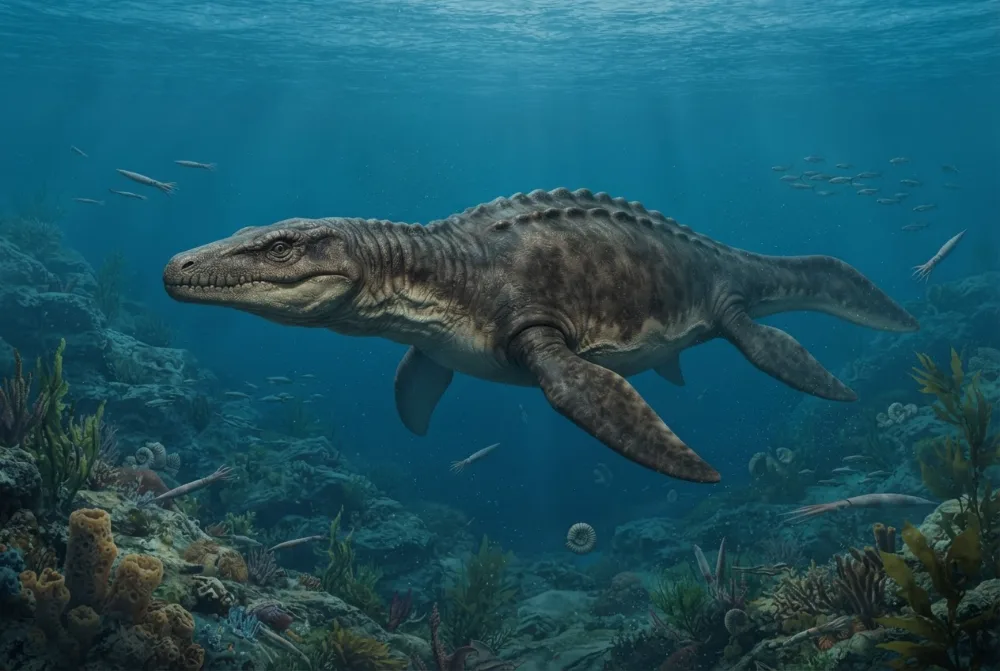
Simolestes was a pliosaur, a kind of short-necked plesiosaur that lived in the Jurassic seas. It had a short, high, and wide skull built to handle twisting forces when hunting. It probably ate squid-like animals and ammonites.1
Kañ la dundoon?
Naka la réyoon?
Naka la guddoon?
 gudd ni 5 xaj, bakkan ba geen🍌gudd ni 26 banaana yu ñu topp-toppale🏊mënoon na féey guddaayu pisin bu mag (50 m) ci 6,4 segond
Naka la Simolestes réyoon, bu ñu ko méngalee ak YAW?
Ay kalkil rekk ci sa navigatëer. Dara du ñu denc, dara du ñu yónne fenn.
Naka la gaawoon?


Xibaar yu neex
Simolestes had salt-secreting glands, which helped it drink seawater and keep its salt balance.1
The type specimen of Simolestes vorax is an almost complete but crushed skeleton found in the Oxford Clay of England.1
Simolestes lived from the Middle to Late Jurassic, about 171 to 145 million years ago.1
Scientists think Simolestes might have hunted in deeper waters or at night, because its prey (cephalopods) move up at night to feed.1
The species Simolestes keileni from France was moved to a new genus called Lorrainosaurus in 2023.1
Laaj yi ñu gën a laaj ci Simolestes
?How big was Simolestes?
The largest Simolestes vorax specimens reached about 4.6 metres (15 feet) long, based on a head to body ratio similar to Liopleurodon.1
?What did Simolestes eat?
Simolestes probably ate squid-like animals, belemnites, and ammonites. Its exact feeding habits are unclear, but it likely hunted in deeper waters or at night.1
?Was Simolestes a dinosaur?
No, Simolestes was a pliosaur, a type of short-necked plesiosaur, which is a marine reptile, not a dinosaur.1
?When did Simolestes live?
Simolestes lived during the Middle to Late Jurassic, about 171 to 145 million years ago.1
Ngir ñi xam dino lool
- Turu xam-xam
- Simolestes
- Ku ko tudde
- Andrews 19092
- Kurél
- Plesiyosoor yi
- Njaboot / klad
- Pliosauridae2
- Klasifikasiyoŋ
- Plesiosauria > Pliosauridae > Sauropterygia2
- Màggaayu doj yi
- 169 ba 143 milyoŋ at (Bajocian / Tithonian)2
- Formasiyoŋi doj
- Umia, Oxford Clay, Marnes de Gravelotte (=La Gravclotte Marls)2
- Réew yi
- End, Angalteer, Faraas2
- Fosil yu ñu gis
- 5 ci The Paleobiology Database2
- Gisees
- Simolestes was named by C. W. Andrews in 1909 based on a skeleton from the Oxford Clay of Peterborough, England.12
- Ñu ngi koy werante ba tey
- Scientists are unsure about the exact feeding habits of Simolestes, though the current consensus is that it ate cephalopods.1
Fa xibaar yi jóge
- Simolestes (en.wikipedia.org)
- Simolestes in The Paleobiology Database (CC BY 4.0): at, béréb yi, formasiyoŋi doj, klasifikasiyoŋ.
Bépp xibaar ci xët wii am na lim bu wone fa mu jóge. Su nu juumee, baal nu, nun ñu bëgg dino lanu, du ab sërnaalu xam-xam. Wax nu ko ci [email protected] nu defar ko.
 Rex xiif na! Dino Wiki, mbiru ab baay la ngir doomam ju góor ju bëgg dinosoor, ci neen te amul kaamuñaate, amul tracker. Mag ñi mën nañu jox Rex tuuti ñam ngir dimbali ko mu des ci internet.Dundal Rex
 Elasmosaurus
 Pliosaurus
 Plesiosaurus
 Cimoliasaurus
 Colymbosaurus
 Trinacromerum
 Brachiosaurus
 Diplodocus
 Allosaurus
 Brontosaurus
 Compsognathus
 Camarasaurus