 Ban dino nga? Kiis
 Xeexu dino
 Rawante dino
 Fo yu ndaw yu dino
 Albomu sitikeer
 Limu TOP yu dino
 Bett ma!
Kañ la dundoon?

Naka la réyoon?
Naka la guddoon?
Naka la kawewoon?
jortu
Naka la diisoon?
 gudd ni 2 muusu kër, bakkan ba geen🍌gudd ni 6 banaana yu ñu topp-toppale🪶gën a woyof muusu kër🍌diis ni 8 banaana🪑tuuti ba mën a dox ci suufu siis🏃mënoon na daw 100 meetar ci 19 segond (nit ki gën a gaaw dafay soxla 9,6)
Naka la Sinosauropteryx réyoon, bu ñu ko méngalee ak YAW?
Ay kalkil rekk ci sa navigatëer. Dara du ñu denc, dara du ñu yónne fenn.
Naka la gaawoon?


Xibaar yu neex
Sinosauropteryx was the first feathered dinosaur discovered that was not directly related to birds.1
Scientists used Sinosauropteryx to figure out a dinosaur's color pattern for the first time ever.1
A fossil of Sinosauropteryx has a tiny lizard preserved in its stomach, showing what it ate for its last meal.1
Sinosauropteryx had over 50 very long tail bones, which made up about 60% of its body length.2
Its feathers were short and simple, like down feathers, not like the flight feathers of modern birds.2
Sinosauropteryx could not fly, but it could run fast on two legs, like an ostrich.2
One of the small mammals Sinosauropteryx ate, called Zhangheotherium, may have been venomous, with spurs on its ankles like a platypus.1
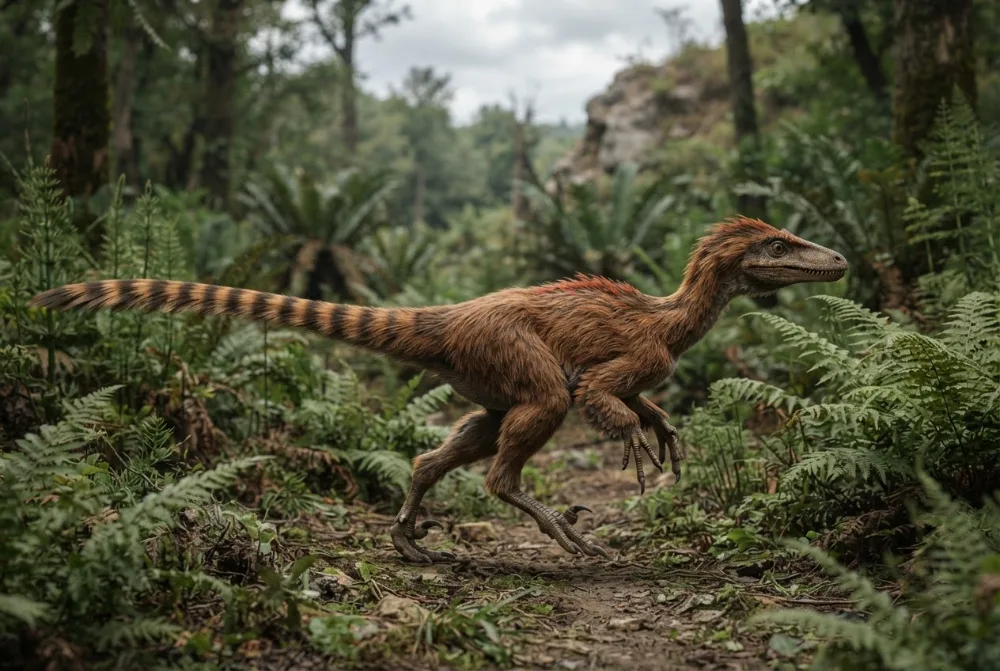
Laaj yi ñu gën a laaj ci Sinosauropteryx
?How big was Sinosauropteryx?
About 1.07 metres (3.5 feet) long and weighed around 0.55 kilograms (1.2 pounds). That is about as long as a skateboard but much lighter.31
?Did Sinosauropteryx have feathers?
Yes, it had a coat of thin, hair-like feathers. It was the first non-avian dinosaur discovered with evidence of feathers.13
?What did Sinosauropteryx eat?
It ate small animals like lizards, mammals, and insects. One fossil even has a tiny lizard preserved in its stomach.13
?When did Sinosauropteryx live?
It lived during the Early Cretaceous period, about 125 to 122 million years ago.13
?Where was Sinosauropteryx found?
Its fossils were found in Liaoning Province in northeastern China.13
?What color was Sinosauropteryx?
Scientists think it was reddish-brown with a light belly and dark and light bands on its tail, like a camouflage pattern.13
Ngir ñi xam dino lool
- Turu xam-xam
- Sinosauropteryx
- Ku ko tudde
- Ji and Ji 19965
- Kurél
- Dino yuy lekk yàpp
- Njaboot / klad
- Sinosauropterygidae5
- Klasifikasiyoŋ
- Theropoda5
- Màggaayu doj yi
- 126 ba 120 milyoŋ at (Barremian / Aptian)5
- Formasiyoŋi doj
- Yixian5
- Réew yi
- Siin5
- Fosil yu ñu gis
- 4 ci The Paleobiology Database5
- Gisees
- A fossil hunter named Li Yumin found the first Sinosauropteryx remains in 1996 in Liaoning, China. He sold the fossils to museums, and scientists Ji and Ji named the dinosaur in the same year.15
Fa xibaar yi jóge
- Sinosauropteryx | Natural History Museum (nhm.ac.uk)
- On the Discovery of the earliest fossil bird in China (Sinosauropteryx (naturalhistory.si.edu)
- Sinosauropteryx (en.wikipedia.org)
- Dinosaurs - Sinosauropteryx prima - The Australian Museum (australian.museum)
- Sinosauropteryx in The Paleobiology Database (CC BY 4.0): at, béréb yi, formasiyoŋi doj, klasifikasiyoŋ.
Bépp xibaar ci xët wii am na lim bu wone fa mu jóge. Su nu juumee, baal nu, nun ñu bëgg dino lanu, du ab sërnaalu xam-xam. Wax nu ko ci [email protected] nu defar ko.
 Rex xiif na! Dino Wiki, mbiru ab baay la ngir doomam ju góor ju bëgg dinosoor, ci neen te amul kaamuñaate, amul tracker. Mag ñi mën nañu jox Rex tuuti ñam ngir dimbali ko mu des ci internet.Dundal Rex
 Allosaurus
 Carnotaurus
 Dilophosaurus
 Giganotosaurus
 Compsognathus
 Paronychodon
 Stegosaurus
 Iguanodon
 Archaeopteryx
 Microraptor
 Deinonychus
 Baryonyx