 Ban dino nga? Kiis
 Xeexu dino
 Rawante dino
 Fo yu ndaw yu dino
 Albomu sitikeer
 Limu TOP yu dino
 Bett ma!
Sisteronia
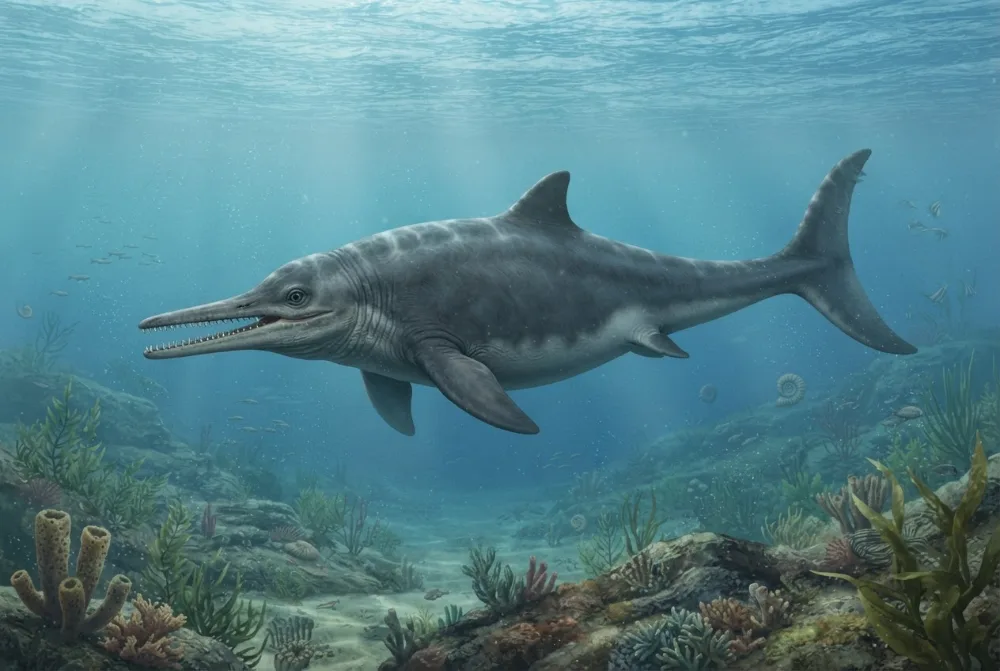
Sisteronia was a fast-swimming marine reptile that lived in the Cretaceous seas. It had sharp teeth for catching small fish and squid. Sisteronia was an ichthyosaur, not a dinosaur, and looked a bit like a modern dolphin.12
Kañ la dundoon?
Naka la gaawoon?


Xibaar yu neex
Sisteronia had teeth that were rectangular in cross-section, which is unusual among ichthyosaurs.2
It lived during the Albian and early Cenomanian stages of the Cretaceous, about 112 to 100 million years ago.2
Sisteronia is known from fossils found in England, France, and Russia, showing it lived in the seas of western Europe.3
This ichthyosaur belonged to the group Platypterygiinae, which were the last surviving ichthyosaurs before they went extinct.2
The name Sisteronia comes from the town of Sisteron in France, near where some of its fossils were found.1
Sisteronia had a raised process on the floor of the foramen magnum (the hole in the skull for the spinal cord), a unique feature not seen in other ichthyosaurs.2
Ngir ñi xam dino lool
- Turu xam-xam
- Sisteronia
- Ku ko tudde
- Fischer et al. 20143
- Kurél
- Iktiyosoor yi
- Njaboot / klad
- Ophthalmosauridae3
- Klasifikasiyoŋ
- Ichthyosauria > Ichthyosauromorpha3
- Màggaayu doj yi
- 113 ba 94 milyoŋ at (Albian / Cenomanian)3
- Formasiyoŋi doj
- Marnes bleues, West Melbury Marly Chalk, Gault3
- Réew yi
- Angalteer, Faraas, Riisi3
- Fosil yu ñu gis
- 6 ci The Paleobiology Database3
- Gisees
- Sisteronia was named by Fischer and colleagues in 2014, based on fossils from the Cambridge Greensand Member in England and the Vocontian Basin in France.31
- Ñu ngi koy werante ba tey
- Scientists are still debating exactly how diverse late Cretaceous ichthyosaurs were, and whether Sisteronia was part of a broader European hotspot of ichthyosaur diversity.1
Fa xibaar yi jóge
- High Diversity in Cretaceous Ichthyosaurs from Europe Prior to Their Extinction (pmc.ncbi.nlm.nih.gov)
- Sisteronia (en.wikipedia.org)
- Sisteronia in The Paleobiology Database (CC BY 4.0): at, béréb yi, formasiyoŋi doj, klasifikasiyoŋ.
Bépp xibaar ci xët wii am na lim bu wone fa mu jóge. Su nu juumee, baal nu, nun ñu bëgg dino lanu, du ab sërnaalu xam-xam. Wax nu ko ci [email protected] nu defar ko.
 Rex xiif na! Dino Wiki, mbiru ab baay la ngir doomam ju góor ju bëgg dinosoor, ci neen te amul kaamuñaate, amul tracker. Mag ñi mën nañu jox Rex tuuti ñam ngir dimbali ko mu des ci internet.Dundal Rex
 Ichthyosaurus
 Platypterygius
 Stenopterygius
 Khudiakovia
 Ophthalmosaurus
 Chonespondylus
 Stegosaurus
 Iguanodon
 Archaeopteryx
 Giganotosaurus
 Microraptor
 Deinonychus