 Ban dino nga? Kiis
 Xeexu dino
 Rawante dino
 Fo yu ndaw yu dino
 Albomu sitikeer
 Limu TOP yu dino
 Bett ma!
Tatenectes
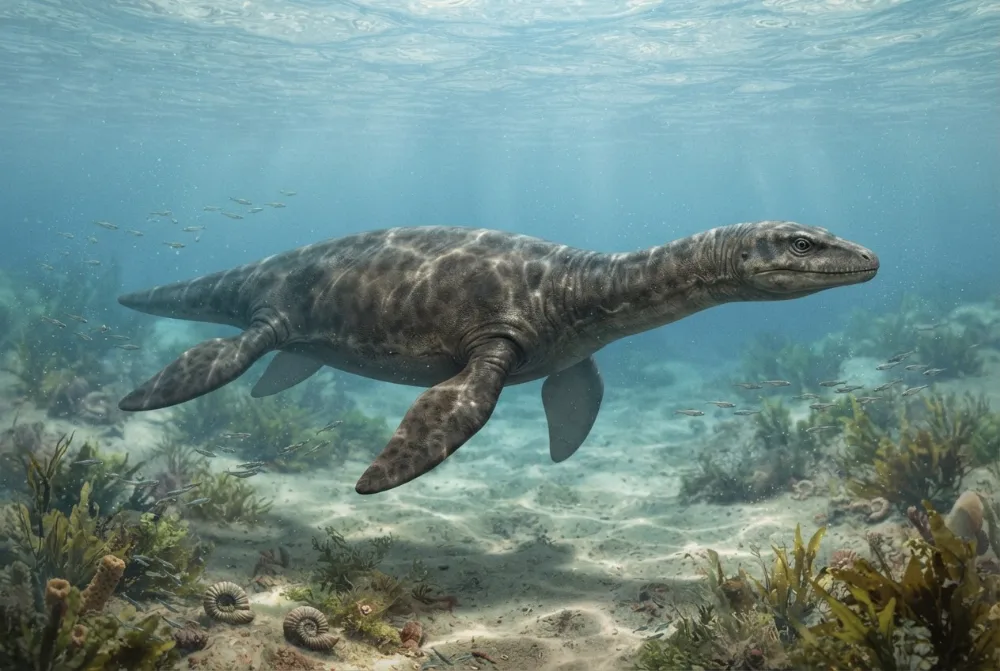
Tatenectes was a small plesiosaur that lived in a shallow sea that covered much of North America during the Jurassic Period. It had a flattened, boxy body and a long neck, and it swam using four flippers like paddles.1
Kañ la dundoon?
Naka la réyoon?
Naka la guddoon?
 gudd ni 3 xaj, bakkan ba geen🍌gudd ni 17 banaana yu ñu topp-toppale🏊mënoon na féey guddaayu pisin bu mag (50 m) ci 6,4 segond
Naka la Tatenectes réyoon, bu ñu ko méngalee ak YAW?
Ay kalkil rekk ci sa navigatëer. Dara du ñu denc, dara du ñu yónne fenn.
Naka la gaawoon?


Xibaar yu neex
Tatenectes had a very unusual body shape for a plesiosaur: its torso was flattened and boxy, and its belly ribs were thickened, which helped it stay stable in turbulent water.1
The first fossil of Tatenectes was described in 1900 by Wilbur Clinton Knight, who thought it was a species of Cimoliosaurus. That original specimen has since been lost.1
Tatenectes lived in the Sundance Sea, a shallow inland sea that was less than 40 meters (130 feet) deep and covered parts of western North America during the Jurassic.1
Its teeth were small and thin, with long roots and low enamel ridges, perfect for catching slippery prey like fish and squid.1
Tatenectes shared its sea home with other marine reptiles, including the plesiosaur Pantosaurus and the large pliosaur Megalneusaurus.1
Scientists think Tatenectes could have used lung deflation to help it dive, just like some modern sea turtles do.1
Ngir ñi xam dino lool
- Turu xam-xam
- Tatenectes
- Ku ko tudde
- O'Keefe and Wahl 20033
- Kurél
- Plesiyosoor yi
- Njaboot / klad
- Cryptoclididae3
- Klasifikasiyoŋ
- Plesiosauria > Sauropterygia3
- Màggaayu doj yi
- 162 ba 155 milyoŋ at (Oxfordian)3
- Formasiyoŋi doj
- Sundance3
- Réew yi
- Amerig3
- Fosil yu ñu gis
- 3 ci The Paleobiology Database3
- Gisees
- The first fossil was described by Wilbur Clinton Knight in 1900 as a new species of Cimoliosaurus. In 2003, F. Robin O'Keefe and William Wahl Jr. gave it its own genus, Tatenectes, based on a new specimen found in Wyoming.12
- Ñu ngi koy werante ba tey
- Scientists are still debating whether the gastroliths (stomach stones) found in plesiosaurs like Tatenectes were used for ballast, digestion, or something else.1
Fa xibaar yi jóge
- Tatenectes (en.wikipedia.org)
- "Preliminary Report on the Osteology and Relationships of a New Aberran" by F. Robin O’Keefe and William Wahl Jr. (mds.marshall.edu)
- Tatenectes in The Paleobiology Database (CC BY 4.0): at, béréb yi, formasiyoŋi doj, klasifikasiyoŋ.
Bépp xibaar ci xët wii am na lim bu wone fa mu jóge. Su nu juumee, baal nu, nun ñu bëgg dino lanu, du ab sërnaalu xam-xam. Wax nu ko ci [email protected] nu defar ko.
 Rex xiif na! Dino Wiki, mbiru ab baay la ngir doomam ju góor ju bëgg dinosoor, ci neen te amul kaamuñaate, amul tracker. Mag ñi mën nañu jox Rex tuuti ñam ngir dimbali ko mu des ci internet.Dundal Rex
 Elasmosaurus
 Pliosaurus
 Plesiosaurus
 Cimoliasaurus
 Colymbosaurus
 Trinacromerum
 Brachiosaurus
 Diplodocus
 Allosaurus
 Brontosaurus
 Compsognathus
 Camarasaurus