 Ban dino nga? Kiis
 Xeexu dino
 Rawante dino
 Fo yu ndaw yu dino
 Albomu sitikeer
 Limu TOP yu dino
 Bett ma!
Umoonasaurus
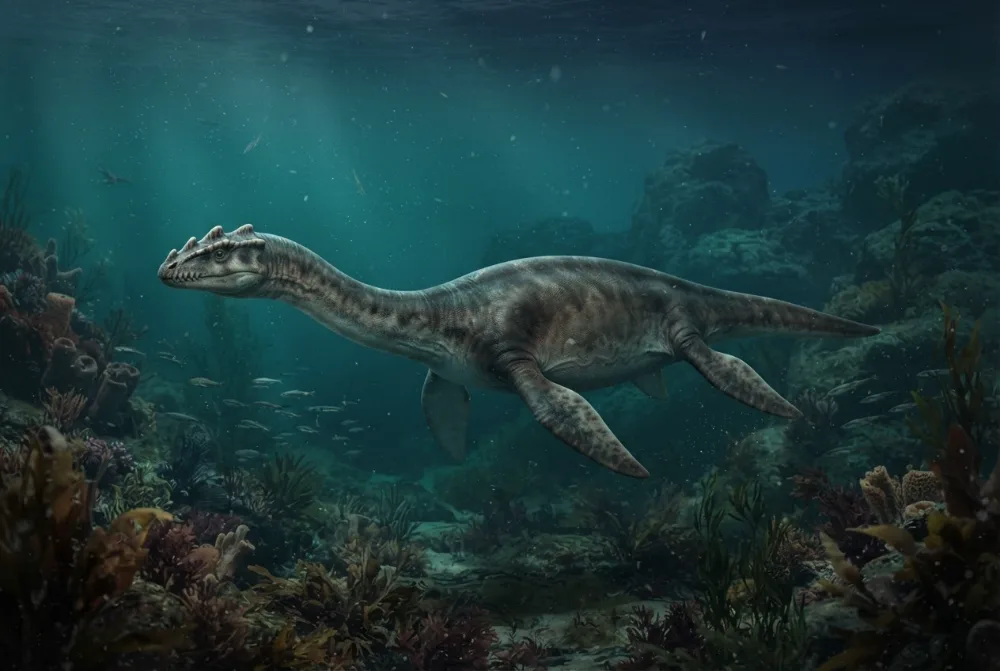
Umoonasaurus was a small, crested marine reptile that swam in cold seas near Antarctica about 115 million years ago. It had three bony crests on its head, like a tiny underwater dinosaur, but it was actually a plesiosaur, not a dinosaur. Its fossils are famous because they are preserved in beautiful blue opal.12
Kañ la dundoon?
Naka la réyoon?
Naka la guddoon?
 gudd ni 2,5 xaj, bakkan ba geen🍌gudd ni 14 banaana yu ñu topp-toppale🏊mënoon na féey guddaayu pisin bu mag (50 m) ci 6,9 segond
Naka la Umoonasaurus réyoon, bu ñu ko méngalee ak YAW?
Ay kalkil rekk ci sa navigatëer. Dara du ñu denc, dara du ñu yónne fenn.
Naka la gaawoon?


Xibaar yu neex
Umoonasaurus is known from several partial skeletons, and one of them is the most complete opalized vertebrate fossil ever found.1
It had three thin, blade-like crests on its skull: one along the top of its snout and a pair above its eyes. These crests may have been used for display, like a peacock's tail.1
Umoonasaurus lived in a cold, high-latitude inland sea near the South Pole, where water temperatures were near freezing.12
It was a small plesiosaur, only about 2.5 metres (8 feet) long as an adult. A juvenile specimen was less than 1 metre long.1
Umoonasaurus is the most primitive and also the last surviving member of its group, the rhomaleosaurids. It lived about 115 million years ago.12
Its tail ended in a 'pygostyle-like' structure made of fused vertebrae, similar to the tail tip of some modern birds.1
Laaj yi ñu gën a laaj ci Umoonasaurus
?What did Umoonasaurus eat?
Umoonasaurus ate small fish. Preserved gut contents show it ate small teleost fish.1
?Why did Umoonasaurus have crests?
Scientists think the three crests on its skull were used for display, like a peacock's tail, to help recognise each other or attract mates. They were too fragile for fighting.1
Ngir ñi xam dino lool
- Turu xam-xam
- Umoonasaurus
- Ku ko tudde
- Kear et al. 20065
- Kurél
- Plesiyosoor yi
- Njaboot / klad
- Leptocleididae5
- Klasifikasiyoŋ
- Plesiosauria > Sauropterygia5
- Màggaayu doj yi
- 121 ba 100 milyoŋ at (Aptian / Albian)5
- Formasiyoŋi doj
- Bulldog Shale5
- Réew yi
- Ostarali5
- Fosil yu ñu gis
- 4 ci The Paleobiology Database5
- Gisees
- Umoonasaurus was named in 2006 by Benjamin Kear and colleagues. The holotype skeleton, nicknamed 'Eric', was bought by public donations and is preserved in opal from the Zorba Extension Opal Field near Coober Pedy, Australia.1
- Ñu ngi koy werante ba tey
- Scientists are not sure what the three crests on its head were used for. They were too fragile for fighting, so they might have been for display or recognizing other Umoonasaurus.1
Fa xibaar yi jóge
- An archaic crested plesiosaur in opal from the Lower Cretaceous high-latitude deposits of Australia (pmc.ncbi.nlm.nih.gov)
- An archaic crested plesiosaur in opal from the Lower Cretaceous high-latitude deposits of Australia (royalsocietypublishing.org)
- Umoonasaurus (en.wikipedia.org)
- Umoonasaurus demoscyllus - The Australian Museum (australian.museum)
- Umoonasaurus in The Paleobiology Database (CC BY 4.0): at, béréb yi, formasiyoŋi doj, klasifikasiyoŋ.
Bépp xibaar ci xët wii am na lim bu wone fa mu jóge. Su nu juumee, baal nu, nun ñu bëgg dino lanu, du ab sërnaalu xam-xam. Wax nu ko ci [email protected] nu defar ko.
 Rex xiif na! Dino Wiki, mbiru ab baay la ngir doomam ju góor ju bëgg dinosoor, ci neen te amul kaamuñaate, amul tracker. Mag ñi mën nañu jox Rex tuuti ñam ngir dimbali ko mu des ci internet.Dundal Rex
 Elasmosaurus
 Pliosaurus
 Plesiosaurus
 Cimoliasaurus
 Colymbosaurus
 Trinacromerum
 Stegosaurus
 Iguanodon
 Archaeopteryx
 Giganotosaurus
 Microraptor
 Deinonychus