 Ban dino nga? Kiis
 Xeexu dino
 Rawante dino
 Fo yu ndaw yu dino
 Albomu sitikeer
 Limu TOP yu dino
 Bett ma!
Vallibonavenatrix
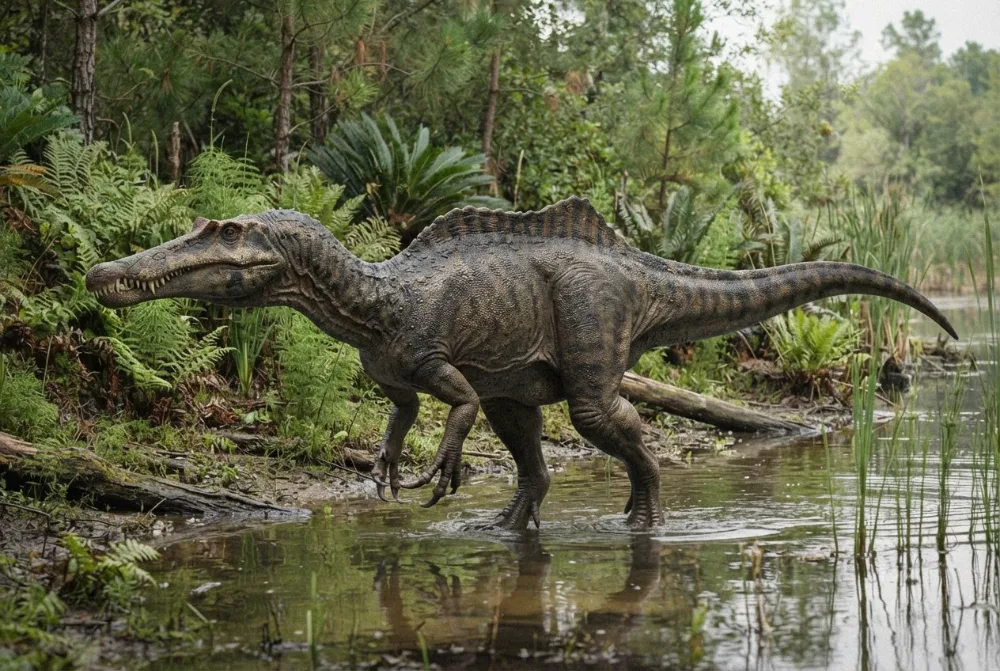
Vallibonavenatrix was a medium-sized spinosaurid dinosaur that lived in what is now Spain during the Early Cretaceous. It had a long, crocodile-like snout and probably ate fish, just like its bigger cousin Spinosaurus. This dinosaur is the most complete spinosaur ever found in the Iberian Peninsula.1
Kañ la dundoon?
Naka la réyoon?
Naka la guddoon?
Naka la kawewoon?
Naka la diisoon?
 gudd ni 7 xaj, bakkan ba geen🍌gudd ni 39 banaana yu ñu topp-toppale🍉diis ni 200 xaal🧸diis ni 53 xale yu maternel🎒diis ni 31 xale yu lekkool🐻❄️diis ni 2 uurs yu weex🏃mënoon na daw 100 meetar ci 12 segond (nit ki gën a gaaw dafay soxla 9,6)
Naka la Vallibonavenatrix réyoon, bu ñu ko méngalee ak YAW?
Ay kalkil rekk ci sa navigatëer. Dara du ñu denc, dara du ñu yónne fenn.
Naka la gaawoon?


Xibaar yu neex
Vallibonavenatrix had a sail on its back made of tall, fan-shaped spines, similar to the dinosaur Ichthyovenator.1
Its bones were full of air pockets, making its skeleton lighter. This is called being pneumatic.1
The first fossils were found by amateur fossil collector Juan Cano Forner in the 1980s and 1990s.1
Vallibonavenatrix lived about 129 to 125 million years ago, during the Barremian stage of the Early Cretaceous.1
It shared its home with other dinosaurs like Iguanodon and the spinosaurid Protathlitis.1
Laaj yi ñu gën a laaj ci Vallibonavenatrix
?How big was Vallibonavenatrix?
It was a medium-sized spinosaurid, but scientists do not know its exact length or weight because only a partial skeleton has been found.1
?What did Vallibonavenatrix eat?
It probably ate fish, just like its bigger cousin Spinosaurus, because it had a long, crocodile-like snout.1
?Did Vallibonavenatrix have a sail?
Yes, it likely had a sail on its back made of tall, fan-shaped spines, similar to the dinosaur Ichthyovenator.1
?When did Vallibonavenatrix live?
It lived about 129 to 125 million years ago, during the Barremian stage of the Early Cretaceous.1
?Where was Vallibonavenatrix found?
Its fossils were found in the Arcillas de Morella Formation near Vallibona, Castellón, Spain.12
?Is Vallibonavenatrix a dinosaur?
Yes, it is a spinosaurid dinosaur, a type of theropod dinosaur.1
Ku tas léeb yu dul dëgg
Léeb: Vallibonavenatrix was a close relative of Baryonyx from Europe.
Dëgg: Scientists disagree. Some studies place it closer to spinosaurines from Africa and South America, like Spinosaurus and Irritator.1
Ngir ñi xam dino lool
- Turu xam-xam
- Vallibonavenatrix
- Ku ko tudde
- Malafaia et al. 20192
- Kurél
- Spinosoor yi
- Njaboot / klad
- Spinosauridae2
- Klasifikasiyoŋ
- Theropoda > Spinosauridae2
- Màggaayu doj yi
- 126 ba 121 milyoŋ at (Barremian)2
- Formasiyoŋi doj
- Arcillas de Morella2
- Réew yi
- Españ2
- Fosil yu ñu gis
- 1 ci The Paleobiology Database2
- Gisees
- Vallibonavenatrix was named in 2019 by Elisabete Malafaia and colleagues. The species name cani honors Juan Cano Forner, who discovered the fossils.1
- Ñu ngi koy werante ba tey
- Scientists are not sure whether Vallibonavenatrix belongs to the Spinosaurinae or Baryonychinae group, or if it is a more primitive spinosaurid.1
Fa xibaar yi jóge
- Vallibonavenatrix (en.wikipedia.org)
- Vallibonavenatrix in The Paleobiology Database (CC BY 4.0): at, béréb yi, formasiyoŋi doj, klasifikasiyoŋ.
Bépp xibaar ci xët wii am na lim bu wone fa mu jóge. Su nu juumee, baal nu, nun ñu bëgg dino lanu, du ab sërnaalu xam-xam. Wax nu ko ci [email protected] nu defar ko.
 Rex xiif na! Dino Wiki, mbiru ab baay la ngir doomam ju góor ju bëgg dinosoor, ci neen te amul kaamuñaate, amul tracker. Mag ñi mën nañu jox Rex tuuti ñam ngir dimbali ko mu des ci internet.Dundal Rex
 Spinosaurus
 Baryonyx
 Suchomimus
 Angaturama
 Camarillasaurus
 Ceratosuchops
 Stegosaurus
 Iguanodon
 Archaeopteryx
 Giganotosaurus
 Microraptor
 Deinonychus