 Ban dino nga? Kiis
 Xeexu dino
 Rawante dino
 Fo yu ndaw yu dino
 Albomu sitikeer
 Limu TOP yu dino
 Bett ma!
Kañ la dundoon?

Naka la réyoon?
Naka la guddoon?
Naka la kawewoon?
jortu
Naka la diisoon?
 gudd ni 3 xaj, bakkan ba geen🍌gudd ni 17 banaana yu ñu topp-toppale
 diis ni 12 muusu kër🍉diis ni 10 xaal🧸diis ni 2,5 xale yu maternel🎒diis ni 1,5 xale yu lekkool🏃mënoon na daw 100 meetar ci 7,2 segond (nit ki gën a gaaw dafay soxla 9,6)
Naka la Velocipes réyoon, bu ñu ko méngalee ak YAW?
Ay kalkil rekk ci sa navigatëer. Dara du ñu denc, dara du ñu yónne fenn.
Naka la gaawoon?


Xibaar yu neex
Velocipes is known from only one fossil: the top part of a leg bone called a fibula, which is 16.4 cm long.1
The bone was first discovered around 1884 by Georg Gürich, but it was not named until 1932 by Friedrich von Huene.1
The original fossil was damaged during World War II and was thought to be lost, but it was rediscovered in 2012.1
Scientists once thought Velocipes might not be a dinosaur at all, but newer studies confirm it was a theropod, a group of meat-eating dinosaurs.1
Velocipes lived alongside other Triassic animals like the aetosaur Kocurypelta and an early turtle called Proterochersis.1
The full fibula of Velocipes was probably about 30 to 35 cm long, which helps scientists guess its size.1
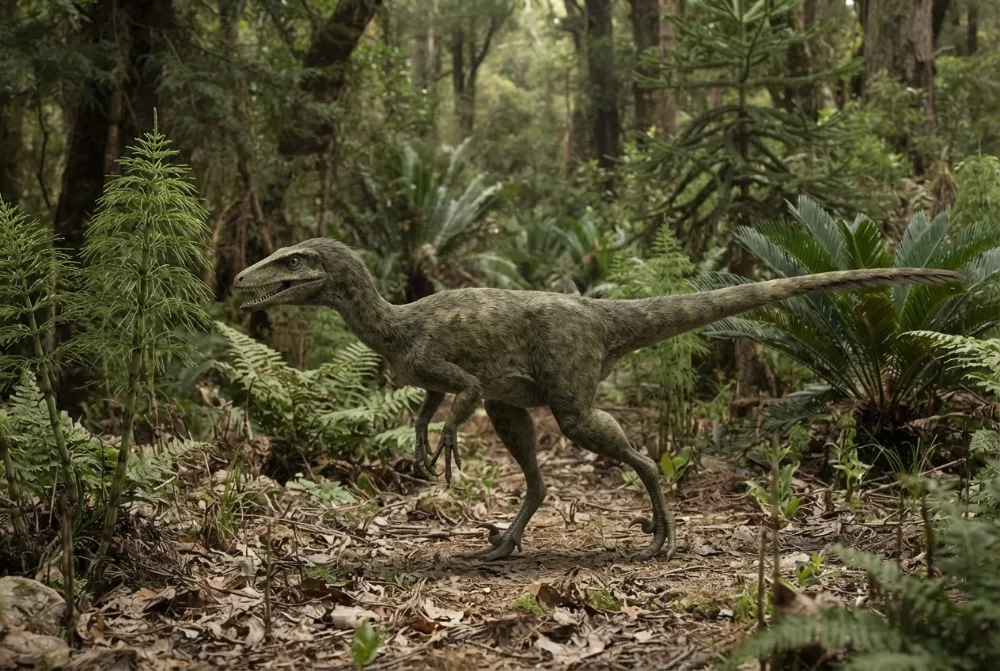
Laaj yi ñu gën a laaj ci Velocipes
?How big was Velocipes?
Velocipes may have reached up to 3 metres long and weighed around 50 kilograms, but this is only a guess because only one leg bone is known.1
?What did Velocipes eat?
Velocipes was a meat-eating dinosaur, so it likely hunted smaller animals. Its name means 'quick foot', and it was probably a fast runner.1
?When did Velocipes live?
Velocipes lived during the Late Triassic period, about 227 to 205 million years ago, in what is now southern Poland.1
?Is Velocipes a dinosaur?
Yes, Velocipes is a dinosaur. Scientists once thought it might not be, but newer studies confirm it was a theropod, a group of meat-eating dinosaurs.1
Ku tas léeb yu dul dëgg
Léeb: Velocipes is a nomen dubium (doubtful name) and not a real dinosaur.
Dëgg: Some scientists once considered Velocipes a doubtful name because the fossil is so incomplete, but more recent research in 2017 confirmed it is a valid theropod dinosaur.1
Ngir ñi xam dino lool
- Turu xam-xam
- Velocipes
- Ku ko tudde
- Huene 19322
- Kurél
- Dino yuy lekk yàpp
- Njaboot / klad
- Neotheropoda2
- Klasifikasiyoŋ
- Theropoda2
- Màggaayu doj yi
- 227 ba 206 milyoŋ at (Norian)2
- Formasiyoŋi doj
- Lissauer Breccia2
- Réew yi
- Poloñ2
- Fosil yu ñu gis
- 1 ci The Paleobiology Database2
- Gisees
- The first fossil of Velocipes was found by Georg Gürich around 1884 in Kocury, Poland. It was named Velocipes guerichi by Friedrich von Huene in 1932.1
- Ñu ngi koy werante ba tey
- Scientists are still unsure exactly how big Velocipes grew, because only one leg bone has been found.1
Fa xibaar yi jóge
- Velocipes (en.wikipedia.org)
- Velocipes in The Paleobiology Database (CC BY 4.0): at, béréb yi, formasiyoŋi doj, klasifikasiyoŋ.
Bépp xibaar ci xët wii am na lim bu wone fa mu jóge. Su nu juumee, baal nu, nun ñu bëgg dino lanu, du ab sërnaalu xam-xam. Wax nu ko ci [email protected] nu defar ko.
 Rex xiif na! Dino Wiki, mbiru ab baay la ngir doomam ju góor ju bëgg dinosoor, ci neen te amul kaamuñaate, amul tracker. Mag ñi mën nañu jox Rex tuuti ñam ngir dimbali ko mu des ci internet.Dundal Rex
 Allosaurus
 Carnotaurus
 Dilophosaurus
 Giganotosaurus
 Compsognathus
 Paronychodon
 Nothosaurus
 Massospondylus
 Plateosaurus
 Simosaurus
 Thecodontosaurus
 Eudimorphodon