 Uyiyiphi idayinaso? Ikwizi
 Idabi leedayinaso
 Ugqatso lweedayinaso
 Imidlalo emincinci yeedayinaso
 I-albhamu yezitikha
 Iilisti ze-TOP zeedayinaso
 Ndothuse!
Afrotapejara
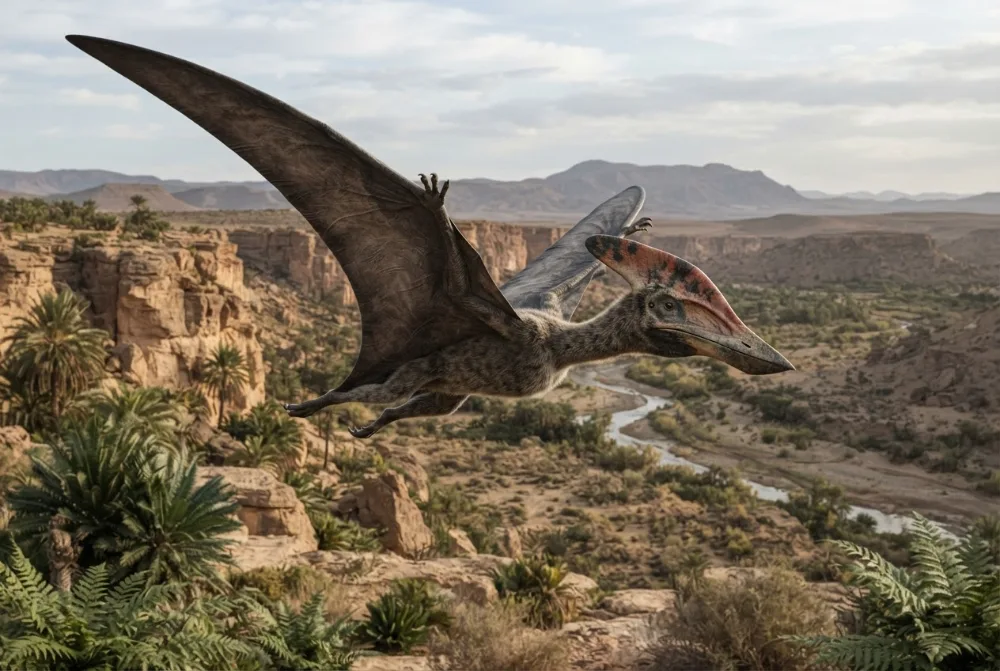
Afrotapejara was a flying reptile that lived in what is now Morocco. It had a downturned beak and no teeth, just like a modern bird. Scientists think it might have eaten fruit.14
Yaphila nini?
Yayikhawuleza kangakanani?


Iinyani ezimnandi
Its name means 'African Tapejara', because it comes from Africa and looks like the Brazilian pterosaur Tapejara.1
Afrotapejara had a downturned beak and no teeth, which is unusual for pterosaurs.1
It lived during the mid-Cretaceous period, about 106 to 94 million years ago.4
Only a partial jaw bone (the front part of the upper beak) has been found so far.1
The Kem Kem beds in Morocco, where Afrotapejara was found, are famous for many other pterosaurs and dinosaurs.1
Eyona mibuzo ibuzwa kakhulu: Afrotapejara
?What did Afrotapejara eat?
Scientists think it might have eaten fruit, but no one knows for sure. It had no teeth, like a bird, and its beak shape is similar to animals that eat fruit.1
?Was Afrotapejara a dinosaur?
No, Afrotapejara was a pterosaur, a flying reptile that lived at the same time as dinosaurs. Pterosaurs are not dinosaurs.3
?How big was Afrotapejara?
Nobody knows for sure, because only a partial jaw bone has been found so far. Scientists can't tell its size from just that piece.3
?When did Afrotapejara live?
It lived during the mid-Cretaceous period, about 106 to 94 million years ago, in what is now Morocco.3
Kwiingcali zeedayinaso
- Igama lenzululwazi
- Afrotapejara
- Inikwe igama ngu:
- Martill et al. 20204
- Iqela
- Izirhubuluzi ezibhabhayo
- Usapho / iclade
- Tapejaridae4
- Ukuhlelwa
- Pterosauria > Pterodactyloidea4
- Ubudala bamatye
- 106 ukuya ku-94 izigidi zeminyaka (Albian / Cenomanian)4
- Amazwe
- iMorocco4
- Iirekhodi zeefosili
- 2 kwi-Paleobiology Database4
- Ukufunyanwa
- Afrotapejara was named in 2020 by David Martill and colleagues. The fossil was bought from a fossil trader in Erfoud, Morocco, and came from the Kem Kem beds near Takmout.12
- Kusaxoxwa ngayo
- Scientists are not sure what Afrotapejara's crest looked like, because only the front of its beak has been found.1
Apho iinyani zivela khona
- A new tapejarid (Pterosauria, Azhdarchoidea) from the mid (pure.port.ac.uk)
- A new tapejarid (Pterosauria, Azhdarchoidea) from the mid-Cretaceous Kem Kem beds of Takmout, southern Morocco (sciencedirect.com)
- Afrotapejara (en.wikipedia.org)
- Afrotapejara in The Paleobiology Database (CC BY 4.0): ubudala, iindawo, izakhiwo zamatye, ukuhlelwa.
Yonke inyani ekweli phepha inenombolo ebonisa umthombo wayo. Ukuba siphosisile, uxolo, sithanda iidayinaso, asiyojenali yenzululwazi. Sixelele apha: [email protected], siya kuyilungisa.
 URex ulambile! I-Dino Wiki yiprojekthi katata ukwenzela unyana wakhe othanda iidayinaso, isimahla, ayinazintengiso, ayinazilandeli. Abantu abadala banokuphakela uRex isidlwana ukuze incede ihlale kwi-intanethi.Phakela uRex
 Pteranodon
 Quetzalcoatlus
 Dorygnathus
 Rhamphorhynchus
 Anhanguera
 Pterodactylus
 Tyrannosaurus
 Triceratops
 Velociraptor
 Spinosaurus
 Ankylosaurus
 Parasaurolophus