 Uyiyiphi idayinaso? Ikwizi
 Idabi leedayinaso
 Ugqatso lweedayinaso
 Imidlalo emincinci yeedayinaso
 I-albhamu yezitikha
 Iilisti ze-TOP zeedayinaso
 Ndothuse!
Rhamphorhynchus
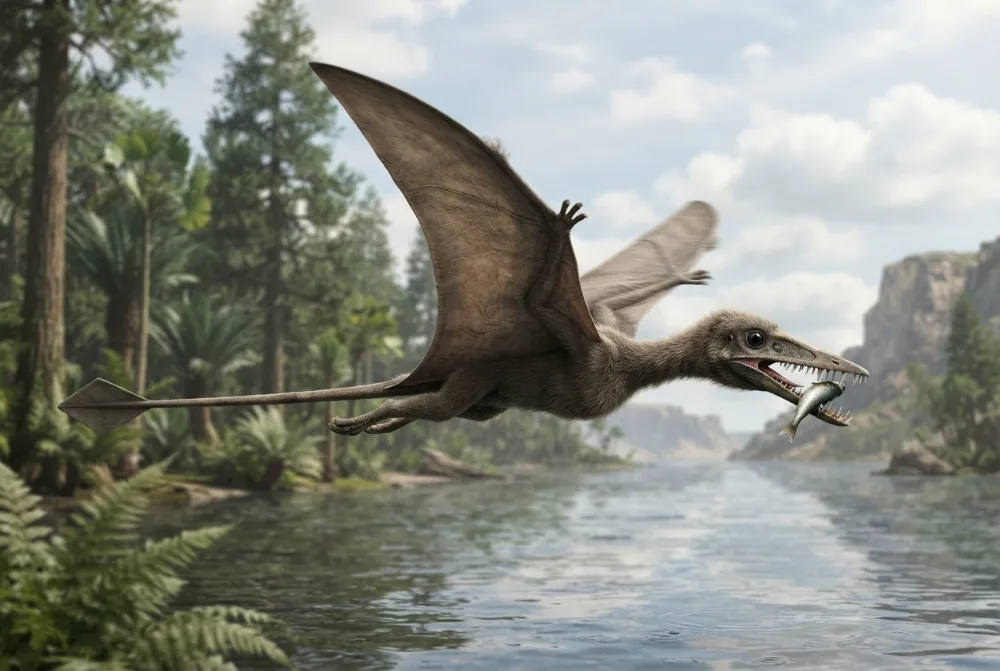
Rhamphorhynchus was a flying reptile that lived in the Late Jurassic. It had a very long tail with a diamond-shaped flap at the tip. It used its needle-like teeth to catch slippery fish.12
Yaphila nini?
Yayinkulu kangakanani?
Yayinde kangakanani?
Yayinzima kangakanani?
 malunga nobunzima bekati yasekhaya🍌inzima njengeebhanana ezingama-17🧱inde njengezitena zokudlala ezingama-16 zilandelelana⚽ibinokubhabha inqumle ibala lebhola ekhatywayo lonke ngemizuzwana engama-6.8
Rhamphorhynchus wayemkhulu kangakanani xa ethelekiswa NAWE?
Yimathematika nje kwibhrawuza yakho. Akukho nto igcinwayo okanye ithunyelwe naphi na.
Yayikhawuleza kangakanani?


Iinyani ezimnandi
Its tail was stiffened with ligaments and ended in a diamond-shaped rudder, which may have helped it steer while flying.12
Rhamphorhynchus had no teeth at the very tip of its beak, but the rest of its beak held many forward-angled teeth that interlocked to trap fish.1
Fossils of Rhamphorhynchus often show impressions of soft parts, including wing membranes and fuzz-like pycnofibers.1
It probably swam and launched from the water like modern birds, not just flew over the waves.1
Rhamphorhynchus lived about 150 to 148 million years ago, during the late Jurassic Period.1
Eyona mibuzo ibuzwa kakhulu: Rhamphorhynchus
?How big was Rhamphorhynchus?
Most adults had a wingspan of about 1 metre (3.3 feet), but the largest known specimen reached about 1.8 metres (5.9 feet) across. A huge fragmentary fossil may have had a wingspan of over 3 metres (10 feet).15
?What did Rhamphorhynchus eat?
It mainly ate fish and squid-like animals called cephalopods. Fossil stomach contents and droppings often contain fish and cephalopod remains.12
?Could Rhamphorhynchus swim?
Yes, it probably swam and launched from the water like modern birds. Its broad feet and body shape suggest it was good at swimming.1
?When did Rhamphorhynchus live?
It lived during the Late Jurassic Period, about 150 to 148 million years ago.12
?Was Rhamphorhynchus a dinosaur?
No, it was a pterosaur, a flying reptile that is not a dinosaur. Pterosaurs are close cousins of dinosaurs.12
?Why did Rhamphorhynchus have a long tail?
The long tail ended in a diamond-shaped flap that may have helped it steer while flying. The tail was stiffened with ligaments to keep it straight.12
?Did Rhamphorhynchus have feathers?
It did not have feathers, but it had a fuzzy coat called pycnofibers, which are like simple hairs. These are different from feathers.1
?Where have Rhamphorhynchus fossils been found?
The best fossils come from the Solnhofen limestone in Bavaria, Germany. Fragmentary remains have also been found in England, Tanzania, Spain, and Portugal.1
Inyaniso ngeentsomi
Intsomi: Some people think Rhamphorhynchus was a dinosaur.
Inyaniso: Rhamphorhynchus was a pterosaur, a flying reptile, not a dinosaur.1
Kwiingcali zeedayinaso
- Igama lenzululwazi
- Rhamphorhynchus
- Inikwe igama ngu:
- Meyer 18476
- Iqela
- Izirhubuluzi ezibhabhayo
- Usapho / iclade
- Rhamphorhynchidae6
- Ukuhlelwa
- Pterosauria > Rhamphorhynchidae6
- Ubudala bamatye
- 159 ukuya ku-143 izigidi zeminyaka (Oxfordian / Tithonian)6
- Izakhiwo zamatye
- Solnhofen, Solnhofener Plattenkalk, Painten6
- Amazwe
- iJamani, iPortugal, iTanzania, iUnited Kingdom6
- Iirekhodi zeefosili
- 30 kwi-Paleobiology Database6
- Ukufunyanwa
- The first specimen was brought to scientist Samuel Thomas von Sömmerring in 1825. It was later named Ornithocephalus muensteri by Goldfuss in 1831, and then renamed Rhamphorhynchus by Hermann von Meyer in 1847.13
- Kusaxoxwa ngayo
- Scientists still debate exactly how many species of Rhamphorhynchus there were, because many similar fossils have been given different names.1
Apho iinyani zivela khona
- Rhamphorhynchus (en.wikipedia.org)
- Rhamphorhynchus | Pterosaur, Jurassic & Flying Reptile | Britannica (britannica.com)
- PBDB Taxon (paleobiodb.org)
- Life History of Rhamphorhynchus Inferred from Bone Histology and the Diversity of Pterosaurian Growth Strategies (pmc.ncbi.nlm.nih.gov)
- A giant specimen of Rhamphorhynchus muensteri and comments on the ontogeny of rhamphorhynchines (pmc.ncbi.nlm.nih.gov)
- Rhamphorhynchus in The Paleobiology Database (CC BY 4.0): ubudala, iindawo, izakhiwo zamatye, ukuhlelwa.
Yonke inyani ekweli phepha inenombolo ebonisa umthombo wayo. Ukuba siphosisile, uxolo, sithanda iidayinaso, asiyojenali yenzululwazi. Sixelele apha: [email protected], siya kuyilungisa.
 URex ulambile! I-Dino Wiki yiprojekthi katata ukwenzela unyana wakhe othanda iidayinaso, isimahla, ayinazintengiso, ayinazilandeli. Abantu abadala banokuphakela uRex isidlwana ukuze incede ihlale kwi-intanethi.Phakela uRex
 Pteranodon
 Quetzalcoatlus
 Dorygnathus
 Anhanguera
 Pterodactylus
 Eudimorphodon
 Brachiosaurus
 Diplodocus
 Allosaurus
 Brontosaurus
 Compsognathus
 Camarasaurus