 Uyiyiphi idayinaso? Ikwizi
 Idabi leedayinaso
 Ugqatso lweedayinaso
 Imidlalo emincinci yeedayinaso
 I-albhamu yezitikha
 Iilisti ze-TOP zeedayinaso
 Ndothuse!
Alanqa
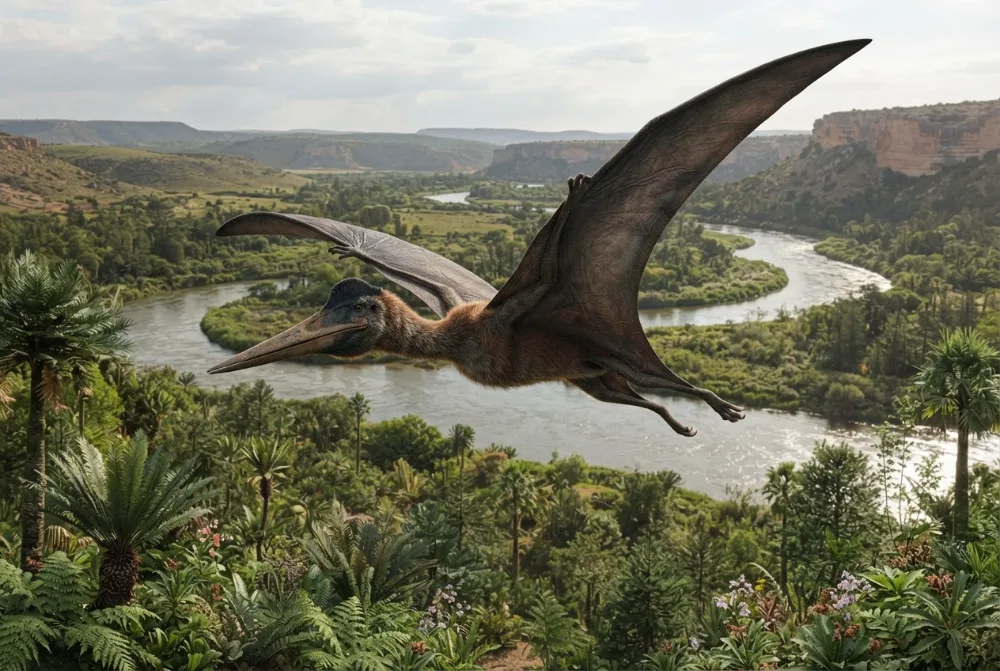
Alanqa was a giant flying reptile that soared over ancient rivers in what is now Morocco. It had a long, straight, pointed beak with no teeth, perfect for scooping up fish and other small animals.2
Yaphila nini?
Yayinkulu kangakanani?
Amaphiko ayo ayebanzi kangakanani?
Yayinzima kangakanani?

 amaphiko abanzi njengeebhayisikile ezingama-3 zilandelelana🍉inzima njengamavatala angama-7⚽ibinokubhabha inqumle ibala lebhola ekhatywayo lonke ngemizuzwana engama-5.1
Alanqa wayemkhulu kangakanani xa ethelekiswa NAWE?
Yimathematika nje kwibhrawuza yakho. Akukho nto igcinwayo okanye ithunyelwe naphi na.
Yayikhawuleza kangakanani?


Iinyani ezimnandi
Alanqa is known from only five jaw fragments and possibly one neck vertebra, so scientists have not found a full skeleton yet.1
Its beak was straight and pointed, like a spear, and it had a raised bump on the top of its lower jaw near the back.2
The largest Alanqa individuals may have had a wingspan as wide as a small airplane, about 6 meters (20 feet).21
Alanqa lived alongside huge meat-eating dinosaurs like Spinosaurus and Carcharodontosaurus, which might have hunted it.1
The Kem Kem Beds where Alanqa was found were once a freshwater delta, full of rivers and swamps.1
Two of the jaw fragments were first described in 1999 but were not named until 2010, when scientists realized they belonged to a new species.1
Eyona mibuzo ibuzwa kakhulu: Alanqa
?How big was Alanqa?
Most Alanqa individuals had a wingspan of about 4 meters (13 feet), but a larger neck vertebra suggests some reached 6 meters (20 feet). An individual of that size would have weighed 16 to 37 kilograms (35 to 82 pounds).1
?What did Alanqa eat?
Alanqa probably ate small animals like crustaceans, mollusks, amphibians, small reptiles, and even small or juvenile dinosaurs. Grooves in its jaw suggest it also crushed hard foods like mollusks and seeds.1
?Is Alanqa a dinosaur?
No, Alanqa is a pterosaur, a flying reptile that is not a dinosaur.1
?Where was Alanqa found?
Alanqa was found in the Kem Kem Group of southeastern Morocco, in a place called Aferdou N'Chaft near the village of Begaa.1
?When did Alanqa live?
Alanqa lived during the Late Cretaceous period, specifically the Cenomanian stage, about 100 to 93 million years ago.1
?Did Alanqa have teeth?
No, Alanqa had no teeth. Its jaws were straight and pointed, like a spear, perfect for scooping up food.1
Kwiingcali zeedayinaso
- Igama lenzululwazi
- Alanqa
- Inikwe igama ngu:
- Ibrahim et al. 20104
- Iqela
- Izirhubuluzi ezibhabhayo
- Usapho / iclade
- Azhdarchidae4
- Ukuhlelwa
- Pterosauria > Pterodactyloidea > Azhdarchidae4
- Ubudala bamatye
- 100 ukuya ku-94 izigidi zeminyaka (Cenomanian)4
- Izakhiwo zamatye
- Ifezouane4
- Amazwe
- iMorocco4
- Iirekhodi zeefosili
- 4 kwi-Paleobiology Database4
- Ukufunyanwa
- Alanqa was named in 2010 by Ibrahim and colleagues based on a nearly complete lower jaw found at Aferdou N'Chaft, Morocco, in 2008.21
- Kusaxoxwa ngayo
- Scientists are not sure if the large neck vertebra really belongs to Alanqa or to a different, even bigger pterosaur.21
Apho iinyani zivela khona
- Alanqa (en.wikipedia.org)
- A New Pterosaur (Pterodactyloidea: Azhdarchidae) from the Upper Cretaceous of Morocco - PMC (pmc.ncbi.nlm.nih.gov)
- PBDB Taxon (paleobiodb.org)
- Alanqa in The Paleobiology Database (CC BY 4.0): ubudala, iindawo, izakhiwo zamatye, ukuhlelwa.
Yonke inyani ekweli phepha inenombolo ebonisa umthombo wayo. Ukuba siphosisile, uxolo, sithanda iidayinaso, asiyojenali yenzululwazi. Sixelele apha: [email protected], siya kuyilungisa.
 URex ulambile! I-Dino Wiki yiprojekthi katata ukwenzela unyana wakhe othanda iidayinaso, isimahla, ayinazintengiso, ayinazilandeli. Abantu abadala banokuphakela uRex isidlwana ukuze incede ihlale kwi-intanethi.Phakela uRex
 Pteranodon
 Quetzalcoatlus
 Dorygnathus
 Rhamphorhynchus
 Anhanguera
 Pterodactylus
 Tyrannosaurus
 Triceratops
 Velociraptor
 Spinosaurus
 Ankylosaurus
 Parasaurolophus