 Uyiyiphi idayinaso? Ikwizi
 Idabi leedayinaso
 Ugqatso lweedayinaso
 Imidlalo emincinci yeedayinaso
 I-albhamu yezitikha
 Iilisti ze-TOP zeedayinaso
 Ndothuse!
Yaphila nini?

Yayinkulu kangakanani?
Yayinde kangakanani?
Yayiphakame kangakanani?
Yayinzima kangakanani?
 inde njengeemoto ezingama-2 zipakwe zilandelelana🍌inde njengeebhanana ezingama-56 zilandelelana
 malunga nobunzima bendlovu🍉inzima njengamavatala angama-1100🎒inzima njengamagumbi okufundela apheleleyo abantwana angama-7🐻❄️inzima njengeebhere ezimhlophe ezingama-12🏃ibinokubaleka iimitha ezili-100 ngemizuzwana engama-20 (oyena mntu ukhawulezayo udinga i-9,6)
Antetonitrus wayemkhulu kangakanani xa ethelekiswa NAWE?
Yimathematika nje kwibhrawuza yakho. Akukho nto igcinwayo okanye ithunyelwe naphi na.
Yayikhawuleza kangakanani?


Iinyani ezimnandi
Antetonitrus lived about 201 to 193 million years ago, during the Early Jurassic.2
Its name means 'before thunder' because it lived before the famous sauropod Brontosaurus, whose name means 'thunder lizard'.1
Unlike later sauropods, Antetonitrus had a flexible thumb that could grasp, not just support weight.1
Its fossils were first found in 1981 and were originally thought to belong to another dinosaur called Euskelosaurus.1
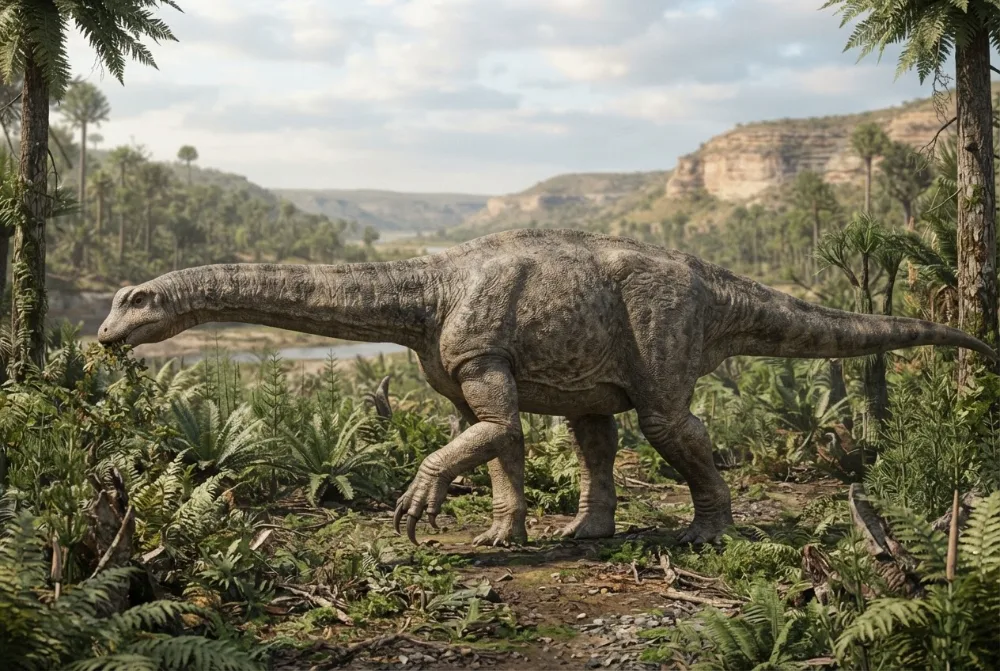
Antetonitrus was about 8 to 10 metres long and weighed as much as a large elephant.1
Its thigh bone was slightly S-shaped when viewed from the side, unlike the straight thigh bones of later sauropods.1
Antetonitrus is one of the oldest known sauropods, tied with other early sauropods from the same formation in South Africa.1
Eyona mibuzo ibuzwa kakhulu: Antetonitrus
?How big was Antetonitrus?
Antetonitrus was about 8 to 10 metres (26 to 33 feet) long, stood 1.5 to 2 metres (5 to 6.5 feet) tall at the hip, and weighed around 5.6 metric tons (6.2 short tons). It may not have been fully grown yet.34
?Could Antetonitrus grab things with its hands?
Yes. Unlike later sauropods, Antetonitrus had a flexible thumb that could grasp, not just support weight. Its wrist bones were not locked into a permanent weight-supporting position.35
Kwiingcali zeedayinaso
- Igama lenzululwazi
- Antetonitrus
- Inikwe igama ngu:
- Yates and Kitching 20036
- Iqela
- Iintamo-nde
- Usapho / iclade
- Lessemsauridae6
- Ukuhlelwa
- Sauropodomorpha > Sauropoda6
- Ubudala bamatye
- 201 ukuya ku-193 izigidi zeminyaka (Hettangian / Sinemurian)6
- Izakhiwo zamatye
- Elliot6
- Amazwe
- uMzantsi Afrika6
- Iirekhodi zeefosili
- 2 kwi-Paleobiology Database6
- Ukufunyanwa
- Antetonitrus was named in 2003 by Adam Yates and James Kitching. The fossils were discovered by Kitching in 1981 in the Free State of South Africa and were stored as Euskelosaurus until Yates recognized them as a new dinosaur.1
- Kusaxoxwa ngayo
- Scientists are not sure if Antetonitrus was a true sauropod or a very close relative, because it had both primitive and advanced features.1
Apho iinyani zivela khona
- Antetonitrus (en.wikipedia.org)
- PBDB Taxon (paleobiodb.org)
- Antetonitrus (en.wikipedia.org)
- A Giant Dinosaur from the Earliest Jurassic of South Africa and the Transition to Quadrupedality in Early Sauropodomorphs: Current Biology (cell.com)
- The earliest known sauropod dinosaur and the first steps towards sauropod locomotion (royalsocietypublishing.org)
- Antetonitrus in The Paleobiology Database (CC BY 4.0): ubudala, iindawo, izakhiwo zamatye, ukuhlelwa.
Yonke inyani ekweli phepha inenombolo ebonisa umthombo wayo. Ukuba siphosisile, uxolo, sithanda iidayinaso, asiyojenali yenzululwazi. Sixelele apha: [email protected], siya kuyilungisa.
 URex ulambile! I-Dino Wiki yiprojekthi katata ukwenzela unyana wakhe othanda iidayinaso, isimahla, ayinazintengiso, ayinazilandeli. Abantu abadala banokuphakela uRex isidlwana ukuze incede ihlale kwi-intanethi.Phakela uRex
 Brachiosaurus
 Diplodocus
 Brontosaurus
 Argentinosaurus
 Camarasaurus
 Morosaurus
 Dilophosaurus
 Stenopterygius
 Dorygnathus
 Scutellosaurus
 Sinosaurus
 Temnodontosaurus