 Uyiyiphi idayinaso? Ikwizi
 Idabi leedayinaso
 Ugqatso lweedayinaso
 Imidlalo emincinci yeedayinaso
 I-albhamu yezitikha
 Iilisti ze-TOP zeedayinaso
 Ndothuse!
Arthropleura
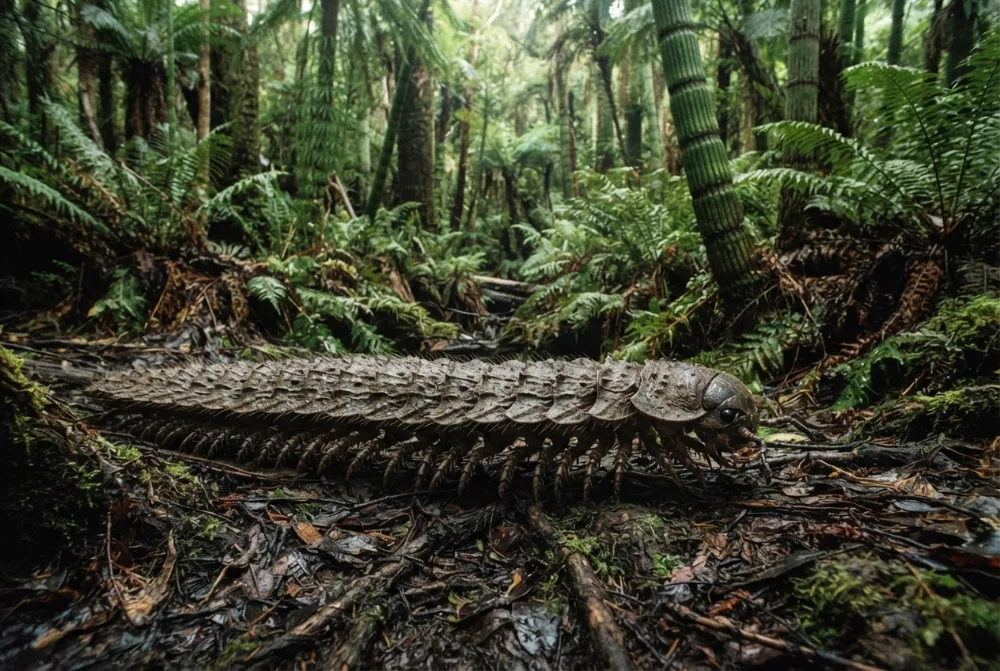
Arthropleura was a giant millipede that lived long before the dinosaurs. It could grow as long as a car, making it the biggest land bug ever! It crawled through ancient forests near water.1
Yaphila nini?
Yayinkulu kangakanani?
Yayinde kangakanani?
Yayinzima kangakanani?
 inde njengezinja ezingama-2.5, impumlo ukuya emsileni🍌inde njengeebhanana ezingama-14 zilandelelana
 inzima njengeekati zasekhaya ezingama-12🍉inzima njengamavatala angama-10🧸inzima njengabantwana basenkulisa abangama-2.5🎒inzima njengabantwana besikolo abangama-1.5🏃ibinokubaleka iimitha ezili-100 ngemizuzwana engama-90 (oyena mntu ukhawulezayo udinga i-9,6)
Arthropleura wayemkhulu kangakanani xa ethelekiswa NAWE?
Yimathematika nje kwibhrawuza yakho. Akukho nto igcinwayo okanye ithunyelwe naphi na.
Yayikhawuleza kangakanani?


Iinyani ezimnandi
Arthropleura is the largest known land arthropod of all time, reaching at least 2 metres (6.5 feet) long.1
It left giant trackways up to 50 centimetres (20 inches) wide, which are fossilized footprints of its many legs.1
Its head had features of both millipedes and centipedes, showing it was a mix of both groups.2
Arthropleura lived in open, sparsely wooded areas near water and may have been able to go on land and in water.1
It was a slow mover, not a fast runner like centipedes, based on its short legs and trackways.2
Some Arthropleura fossils are so well preserved that scientists can see the details of its head and mouthparts using special scanners.2
Eyona mibuzo ibuzwa kakhulu: Arthropleura
?How big was Arthropleura?
About 2 metres (6.5 feet) long, possibly up to 2.63 metres (8.6 feet). That makes it the largest known land arthropod of all time.12
?What did Arthropleura eat?
It probably ate dead plants and other detritus, like modern millipedes. It did not have venom fangs or legs for catching prey.5
?Was Arthropleura a dinosaur?
No, it was a giant millipede, not a dinosaur. It lived long before the dinosaurs, from about 344 to 292 million years ago.1
?Could Arthropleura swim?
It may have been amphibious, meaning it could live both on land and in water. It lived in open, sparsely wooded areas near water.1
?How fast could Arthropleura move?
Probably only about 4 km/h (2 mph), a slow walking pace. This is a guess: it was a giant millipede with short legs, and its trackways show it did not hurry.5
?Did Arthropleura have a head?
Yes, and scientists recently used special scanners to see its head in detail. It had antennae, mandibles, and two pairs of maxillae.2
?When did Arthropleura go extinct?
It died out around 292 million years ago, during the early Permian period.1
?Where did Arthropleura live?
It lived in what is now Europe and North America, in open, sparsely wooded forests near water.1
?Is Arthropleura related to centipedes?
It is a millipede, but its head has features of both millipedes and centipedes, showing it was a mix of both groups.5
?How much did Arthropleura weigh?
One large fossil suggests it weighed about 50 kilograms (110 pounds), as heavy as a small human.1
Inyaniso ngeentsomi
Intsomi: Arthropleura was a giant centipede that hunted other animals.
Inyaniso: Arthropleura was actually a millipede, and it was likely a slow plant-eater, not a predator.2
Kwiingcali zeedayinaso
- Igama lenzululwazi
- Arthropleura
- Inikwe igama ngu:
- (Jordan 1854)6
- Iqela
- Amagorha amandulo
- Usapho / iclade
- Arthropleuridae6
- Ukuhlelwa
- Myriapoda > Arthropleurida > Arthropleuridae6
- Ubudala bamatye
- 347 ukuya ku-290 izigidi zeminyaka (Visean / Sakmarian)6
- Izakhiwo zamatye
- Saarbrucker layers, Farrington6
- Amazwe
- iJamani, iFransi, iBhelgiyam, iUnited Kingdom, iSpeyin, iUSA6
- Iirekhodi zeefosili
- 61 kwi-Paleobiology Database6
- Ukufunyanwa
- Arthropleura was first named by Jordan in 1854, based on fossils found in Europe.3
- Kusaxoxwa ngayo
- Scientists still debate whether Arthropleura was a true millipede or a more primitive relative, and they are not sure exactly what it ate.2
Apho iinyani zivela khona
- Arthropleura (en.wikipedia.org)
- Head anatomy and phylogenomics show the Carboniferous giant Arthropleura belonged to a millipede-centipede group (science.org)
- PBDB Taxon (paleobiodb.org)
- Millipedes ‘as big as cars’ once roamed England | University of Cambridge (cam.ac.uk)
- Largest ever millipede’s head revealed by 300-million-year-old fossils | Natural History Museum (nhm.ac.uk)
- Arthropleura in The Paleobiology Database (CC BY 4.0): ubudala, iindawo, izakhiwo zamatye, ukuhlelwa.
Yonke inyani ekweli phepha inenombolo ebonisa umthombo wayo. Ukuba siphosisile, uxolo, sithanda iidayinaso, asiyojenali yenzululwazi. Sixelele apha: [email protected], siya kuyilungisa.
 URex ulambile! I-Dino Wiki yiprojekthi katata ukwenzela unyana wakhe othanda iidayinaso, isimahla, ayinazintengiso, ayinazilandeli. Abantu abadala banokuphakela uRex isidlwana ukuze incede ihlale kwi-intanethi.Phakela uRex
 Megalodon
 Sabre-toothed cat
 Dimetrodon
 Woolly mammoth
 Helicoprion
 Deinosuchus