 Uyiyiphi idayinaso? Ikwizi
 Idabi leedayinaso
 Ugqatso lweedayinaso
 Imidlalo emincinci yeedayinaso
 I-albhamu yezitikha
 Iilisti ze-TOP zeedayinaso
 Ndothuse!
Helicoprion
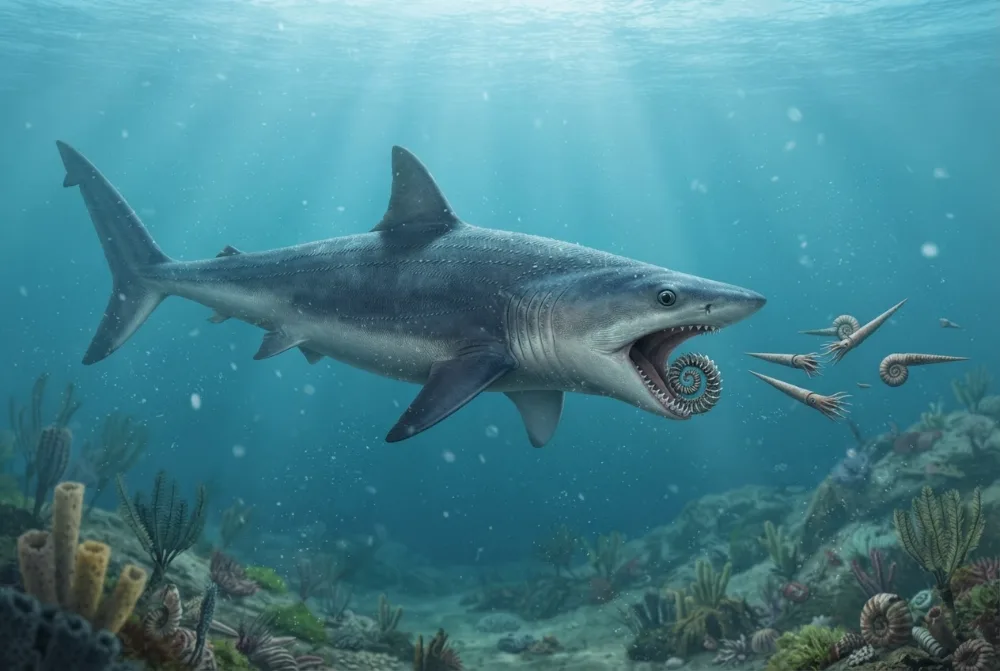
Helicoprion was a shark-like fish that lived in the Permian seas. It had a strange, spiral-shaped tooth whorl in its lower jaw that looked like a buzz-saw. This helped it catch and eat soft prey like squid and other cephalopods.12
Yaphila nini?
Yayinkulu kangakanani?
Yayinde kangakanani?
 inde njengeemoto ezingama-2.5 zipakwe zilandelelana🍌inde njengeebhanana ezingama-67 zilandelelana🏊ibinokuqubha ubude bechibi elikhulu lokuqubha (50 m) ngemizuzwana engama-6
Helicoprion wayemkhulu kangakanani xa ethelekiswa NAWE?
Yimathematika nje kwibhrawuza yakho. Akukho nto igcinwayo okanye ithunyelwe naphi na.
Yayikhawuleza kangakanani?


Iinyani ezimnandi
Helicoprion is known mostly from its spiral tooth whorls, because its skeleton was made of cartilage and did not fossilize easily.12
The tooth whorl sat in the lower jaw, and each tooth had a different job: front teeth hooked prey, middle teeth pierced and cut, and back teeth pushed food into the throat.12
Helicoprion lived during the Permian Period, about 290 to 270 million years ago, which is before the dinosaurs.1
Scientists think Helicoprion was an apex predator in its environment, and it may have gathered in deep inland seas like the Phosphoria Sea (now Idaho) to breed or hunt.1
The name Helicoprion comes from Greek words meaning 'spiral saw', because of its coiled tooth whorl.1
Helicoprion could grow up to 12 metres (39 feet) long, about as long as a school bus.1
Eyona mibuzo ibuzwa kakhulu: Helicoprion
?Was Helicoprion a dinosaur?
No, Helicoprion was a shark-like cartilaginous fish, not a dinosaur. It lived in the Permian seas long before the first dinosaurs appeared.1
?How big was Helicoprion?
Helicoprion is estimated to have reached lengths between 5 and 12 metres, about as long as a school bus.1
?What did Helicoprion eat?
Helicoprion ate soft-bodied prey like squid, belemnoids, and other cephalopods. It may also have eaten hard-shelled ammonoids and nautiloids by pulling the body out of the shell.12
?When did Helicoprion live?
Helicoprion lived from the Early to the Middle Permian, about 290 to 270 million years ago. That is before the dinosaurs.1
?Where was Helicoprion found?
Helicoprion fossils have been found all over the world, including in the United States (especially Idaho), Russia, Australia, China, and Japan. It lived in many seas.12
?How did Helicoprion use its tooth whorl?
The tooth whorl sat in the lower jaw and worked like a saw. Front teeth hooked prey, middle teeth pierced and cut, and back teeth pushed food into the throat.12
?Why did Helicoprion have a spiral tooth?
The spiral tooth whorl helped Helicoprion catch and eat soft prey like squid. It could also help shell hard-shelled animals by pulling the body out of the shell.12
?Is Helicoprion still alive?
No, Helicoprion went extinct about 270 million years ago, at the end of the Middle Permian. It is only known from fossils.1
?How fast could Helicoprion swim?
Maybe up to about 30 km/h (19 mph). This is a guess: nobody knows for sure. Its body was probably shaped like a tuna or mackerel shark, so it was likely a fast swimmer.1
?What would happen if Helicoprion was alive today?
If Helicoprion were alive today, it would be a large, fast-swimming predator that ate squid and fish. But it lived in the Permian and is extinct, so we can only imagine.1
Kwiingcali zeedayinaso
- Igama lenzululwazi
- Helicoprion
- Inikwe igama ngu:
- Karpinsky 18993
- Iqela
- Amagorha amandulo
- Usapho / iclade
- Helicoprionidae3
- Ukuhlelwa
- Chondrichthyes > Eugeneodontiformes > Helicoprionidae3
- Ubudala bamatye
- 299 ukuya ku-254 izigidi zeminyaka (Asselian / Wuchiapingian)3
- Izakhiwo zamatye
- Phosphoria, Assistance, Bone Spring3
- Amazwe
- iUSA, iKhanada, iJapan, iMexico, i-Ostreliya, iKazakhstan3
- Iirekhodi zeefosili
- 35 kwi-Paleobiology Database3
- Ukufunyanwa
- Helicoprion was first named in 1899 by Russian geologist Alexander Karpinsky, based on fossils found in Russia and Australia. The type species is Helicoprion bessonowi.13
- Kusaxoxwa ngayo
- Scientists are still unsure about the exact shape of Helicoprion's body, because almost no skeleton has been found, only tooth whorls.12
Apho iinyani zivela khona
- Helicoprion (en.wikipedia.org)
- Helicoprion - The Australian Museum (australian.museum)
- Helicoprion in The Paleobiology Database (CC BY 4.0): ubudala, iindawo, izakhiwo zamatye, ukuhlelwa.
Yonke inyani ekweli phepha inenombolo ebonisa umthombo wayo. Ukuba siphosisile, uxolo, sithanda iidayinaso, asiyojenali yenzululwazi. Sixelele apha: [email protected], siya kuyilungisa.
 URex ulambile! I-Dino Wiki yiprojekthi katata ukwenzela unyana wakhe othanda iidayinaso, isimahla, ayinazintengiso, ayinazilandeli. Abantu abadala banokuphakela uRex isidlwana ukuze incede ihlale kwi-intanethi.Phakela uRex
 Megalodon
 Sabre-toothed cat
 Dimetrodon
 Woolly mammoth
 Arthropleura
 Deinosuchus