 Uyiyiphi idayinaso? Ikwizi
 Idabi leedayinaso
 Ugqatso lweedayinaso
 Imidlalo emincinci yeedayinaso
 I-albhamu yezitikha
 Iilisti ze-TOP zeedayinaso
 Ndothuse!
Austriadactylus
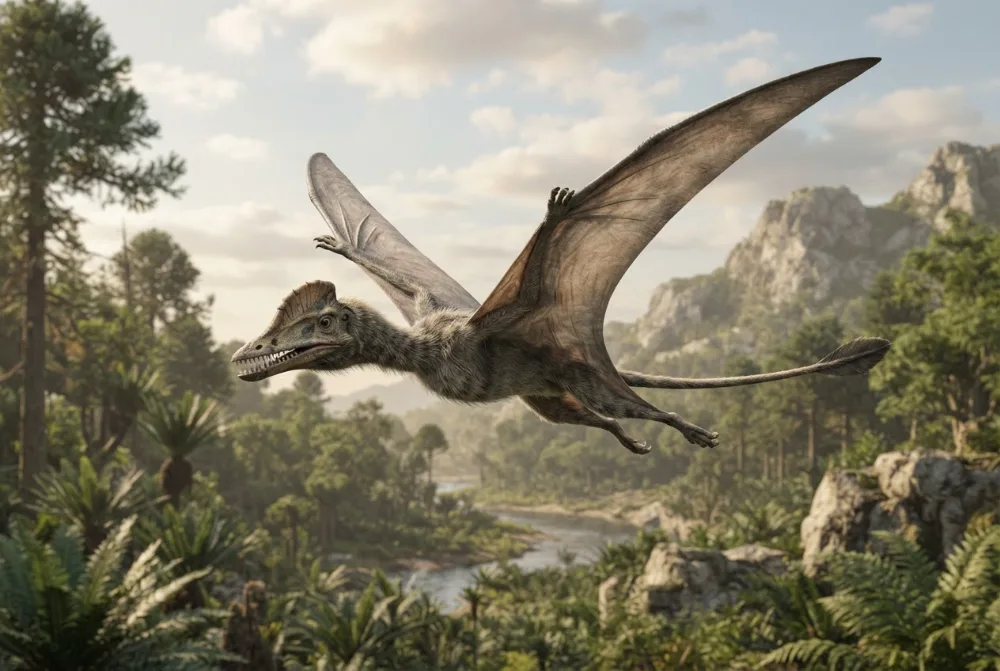
Austriadactylus was an early flying reptile with a long tail and a crest on its head. It lived about 215 million years ago in what is now Austria and Italy. This pterosaur had many different kinds of teeth, perfect for crunching hard-shelled bugs.12
Yaphila nini?
Yayinkulu kangakanani?
Amaphiko ayo ayebanzi kangakanani?
 inde njengeekati zasekhaya ezingama-2.5, impumlo ukuya emsileni⚽ibinokubhabha inqumle ibala lebhola ekhatywayo lonke ngemizuzwana engama-9.7
Austriadactylus wayemkhulu kangakanani xa ethelekiswa NAWE?
Yimathematika nje kwibhrawuza yakho. Akukho nto igcinwayo okanye ithunyelwe naphi na.
Yayikhawuleza kangakanani?


Iinyani ezimnandi
Austriadactylus had a bony crest on its head that started at the tip of its snout and went back to above its eye. The crest was about 2 cm tall.21
Its teeth were very different from each other. It had tall, pointed teeth at the front, blade-like teeth with tiny serrations in the middle, and triangular teeth with up to 12 small points at the back.2
Unlike many other long-tailed pterosaurs, Austriadactylus had a flexible tail without stiff rods made of bone.21
The only known fossil of Austriadactylus was found in an abandoned mine near Ankerschlag in Tyrol, Austria.21
Austriadactylus lived during the Late Triassic period, about 215 million years ago, in a shallow sea environment with islands.12
The name Austriadactylus cristatus means 'crested Austrian finger', referring to the wing finger and the crest on its head.1
Eyona mibuzo ibuzwa kakhulu: Austriadactylus
?What did Austriadactylus eat?
It mostly ate hard-shelled bugs. Scientists can tell from the tiny scratches on its teeth that it crunched hard invertebrates.1
?How big was Austriadactylus?
Its wingspan was about 120 cm (47 inches), and its skull was 11 cm long. It was about the size of a crow.1
?Did Austriadactylus have a crest?
Yes, it had a bony crest on its head that started at the tip of its snout and went back to above its eye. The crest was about 2 cm tall.1
?Is Austriadactylus a dinosaur?
No, it is a pterosaur, which is a flying reptile that lived at the same time as dinosaurs but is not a dinosaur.1
Kwiingcali zeedayinaso
- Igama lenzululwazi
- Austriadactylus
- Inikwe igama ngu:
- Dalla Vecchia et al. 20023
- Iqela
- Izirhubuluzi ezibhabhayo
- Usapho / iclade
- Pterosauria3
- Ukuhlelwa
- Pterosauria3
- Ubudala bamatye
- 215 ukuya ku-206 izigidi zeminyaka (Norian)3
- Izakhiwo zamatye
- Seefelder Schichten, Dolomia di Forni3
- Amazwe
- i-Ostriya, i-Itali3
- Iirekhodi zeefosili
- 2 kwi-Paleobiology Database3
- Ukufunyanwa
- Austriadactylus was named in 2002 by Fabio Marco Dalla Vecchia and colleagues. The fossil was found in an abandoned mine in Tyrol, Austria, and is stored at the State Museum of Natural History in Stuttgart, Germany.31
- Kusaxoxwa ngayo
- Scientists are not sure if Austriadactylus is a close relative of Eudimorphodon or if it belongs to a different group. Some think it might even be the same animal as Eudimorphodon.1
Apho iinyani zivela khona
- Austriadactylus (en.wikipedia.org)
- vrpa_22_124.196_199.tp (doc.rero.ch)
- Austriadactylus in The Paleobiology Database (CC BY 4.0): ubudala, iindawo, izakhiwo zamatye, ukuhlelwa.
Yonke inyani ekweli phepha inenombolo ebonisa umthombo wayo. Ukuba siphosisile, uxolo, sithanda iidayinaso, asiyojenali yenzululwazi. Sixelele apha: [email protected], siya kuyilungisa.
 URex ulambile! I-Dino Wiki yiprojekthi katata ukwenzela unyana wakhe othanda iidayinaso, isimahla, ayinazintengiso, ayinazilandeli. Abantu abadala banokuphakela uRex isidlwana ukuze incede ihlale kwi-intanethi.Phakela uRex
 Pteranodon
 Quetzalcoatlus
 Dorygnathus
 Rhamphorhynchus
 Anhanguera
 Pterodactylus
 Nothosaurus
 Massospondylus
 Plateosaurus
 Coelophysis
 Podokesaurus
 Simosaurus