 Uyiyiphi idayinaso? Ikwizi
 Idabi leedayinaso
 Ugqatso lweedayinaso
 Imidlalo emincinci yeedayinaso
 I-albhamu yezitikha
 Iilisti ze-TOP zeedayinaso
 Ndothuse!
Yaphila nini?

Yayinkulu kangakanani?
Yayinde kangakanani?
Yayiphakame kangakanani?
Yayinzima kangakanani?
 inde njengeemoto ezingama-2 zipakwe zilandelelana🍌inde njengeebhanana ezingama-56 zilandelelana
 inzima njengezinja ezingama-190🍉inzima njengamavatala angama-760🎒inzima njengamagumbi okufundela apheleleyo abantwana angama-5🐻❄️inzima njengeebhere ezimhlophe ezingama-8🏃ibinokubaleka iimitha ezili-100 ngemizuzwana engama-18 (oyena mntu ukhawulezayo udinga i-9,6)
Camelotia wayemkhulu kangakanani xa ethelekiswa NAWE?
Yimathematika nje kwibhrawuza yakho. Akukho nto igcinwayo okanye ithunyelwe naphi na.
Yayikhawuleza kangakanani?


Iinyani ezimnandi
Camelotia lived about 205 to 201 million years ago, during the Rhaetian stage of the Late Triassic.3
Its thigh bone (femur) is about 1 metre (3.3 feet) long, which helped scientists guess its size.1
Camelotia is named after Camelot, the legendary castle of King Arthur, because its fossils were found in Somerset, near where the stories take place.1
It was one of the largest sauropodomorphs from the Triassic, weighing about 3.8 tonnes (8,400 pounds).1
Scientists think Camelotia walked on all four legs, like later sauropods, because its relatives were becoming more quadrupedal.1
The first fossils of Camelotia were discovered in 1894 in a quarry in Wedmore, but they were not named until 1985.1
Some large dinosaur footprints found in Wales might have been made by Camelotia, but scientists are not sure.1
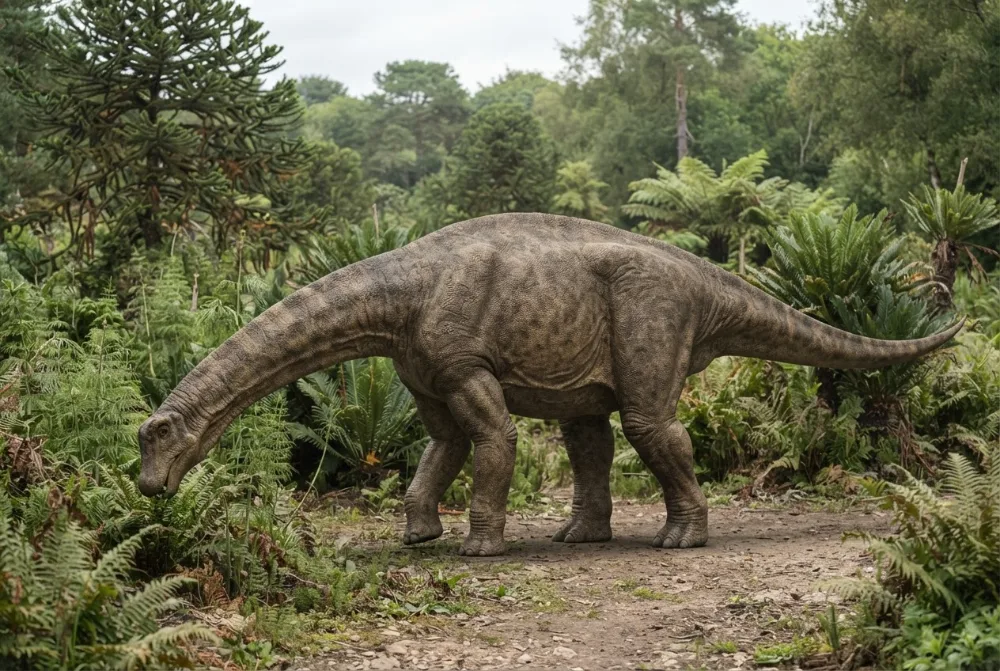
Eyona mibuzo ibuzwa kakhulu: Camelotia
?How big was Camelotia?
Camelotia was about 8 to 10 metres long and weighed around 3.8 tonnes. That is about as long as a school bus.1
?What did Camelotia eat?
Camelotia was a plant-eater. Its teeth were leaf-shaped and serrated, perfect for eating plants.1
?Did Camelotia walk on two legs or four?
Scientists think Camelotia walked on all four legs, like later sauropods. Its relatives were becoming more quadrupedal.1
?Where was Camelotia found?
Camelotia's fossils were found in a quarry in Wedmore, Somerset, England. That is near the legendary castle of King Arthur, Camelot.1
Inyaniso ngeentsomi
Intsomi: Camelotia was a meat-eater because its teeth were found near its bones.
Inyaniso: The teeth found with Camelotia actually belong to a different dinosaur, a theropod called Newtonsaurus. Camelotia itself was a plant-eater.1
Kwiingcali zeedayinaso
- Igama lenzululwazi
- Camelotia
- Inikwe igama ngu:
- Galton 19853
- Iqela
- Iintamo-nde
- Usapho / iclade
- Sauropodiformes3
- Ukuhlelwa
- Sauropodomorpha3
- Ubudala bamatye
- 206 ukuya ku-201 izigidi zeminyaka (Rhaetian)3
- Izakhiwo zamatye
- Westbury3
- Amazwe
- iUnited Kingdom3
- Iirekhodi zeefosili
- 2 kwi-Paleobiology Database3
- Ukufunyanwa
- The first fossils were found in 1894 in a quarry near Wedmore, England. They were named Camelotia borealis by Peter M. Galton in 1985.1
- Kusaxoxwa ngayo
- Scientists are not sure exactly where Camelotia fits on the dinosaur family tree. Some think it is a close relative of Melanorosaurus, while others think it is a very early sauropod.1
Apho iinyani zivela khona
- Camelotia (en.wikipedia.org)
- Camelotia - Justapedia (justapedia.org)
- Camelotia in The Paleobiology Database (CC BY 4.0): ubudala, iindawo, izakhiwo zamatye, ukuhlelwa.
Yonke inyani ekweli phepha inenombolo ebonisa umthombo wayo. Ukuba siphosisile, uxolo, sithanda iidayinaso, asiyojenali yenzululwazi. Sixelele apha: [email protected], siya kuyilungisa.
 URex ulambile! I-Dino Wiki yiprojekthi katata ukwenzela unyana wakhe othanda iidayinaso, isimahla, ayinazintengiso, ayinazilandeli. Abantu abadala banokuphakela uRex isidlwana ukuze incede ihlale kwi-intanethi.Phakela uRex
 Brachiosaurus
 Diplodocus
 Brontosaurus
 Argentinosaurus
 Camarasaurus
 Morosaurus
 Nothosaurus
 Coelophysis
 Podokesaurus
 Simosaurus
 Eudimorphodon
 Herrerasaurus