 Uyiyiphi idayinaso? Ikwizi
 Idabi leedayinaso
 Ugqatso lweedayinaso
 Imidlalo emincinci yeedayinaso
 I-albhamu yezitikha
 Iilisti ze-TOP zeedayinaso
 Ndothuse!
Yaphila nini?

Yayinkulu kangakanani?
Yayinde kangakanani?
Yayiphakame kangakanani?
uqikelelo
Yayinzima kangakanani?
 inde njengezinja ezingama-6, impumlo ukuya emsileni🍌inde njengeebhanana ezingama-33 zilandelelana🍉inzima njengamavatala angama-80🧸inzima njengabantwana basenkulisa abangama-21🎒inzima njengabantwana besikolo abangama-12🏃ibinokubaleka iimitha ezili-100 ngemizuzwana engama-8 (oyena mntu ukhawulezayo udinga i-9,6)
Concavenator wayemkhulu kangakanani xa ethelekiswa NAWE?
Yimathematika nje kwibhrawuza yakho. Akukho nto igcinwayo okanye ithunyelwe naphi na.
Yayikhawuleza kangakanani?


Iinyani ezimnandi
Concavenator had a hump on its back made from two tall bones in its spine.1
Scientists found small bumps on its arm bone that might be quill knobs, places where feathers attach.12
It lived about 130 to 125 million years ago during the Early Cretaceous Period.1
Its fossils were found at Las Hoyas in Spain, which was once an inland lake.1
Concavenator belongs to the carcharodontosaur group, which means 'shark-toothed lizards'.1
The hump on Concavenator's back might have been used for display or to store fat, but scientists are not sure.2
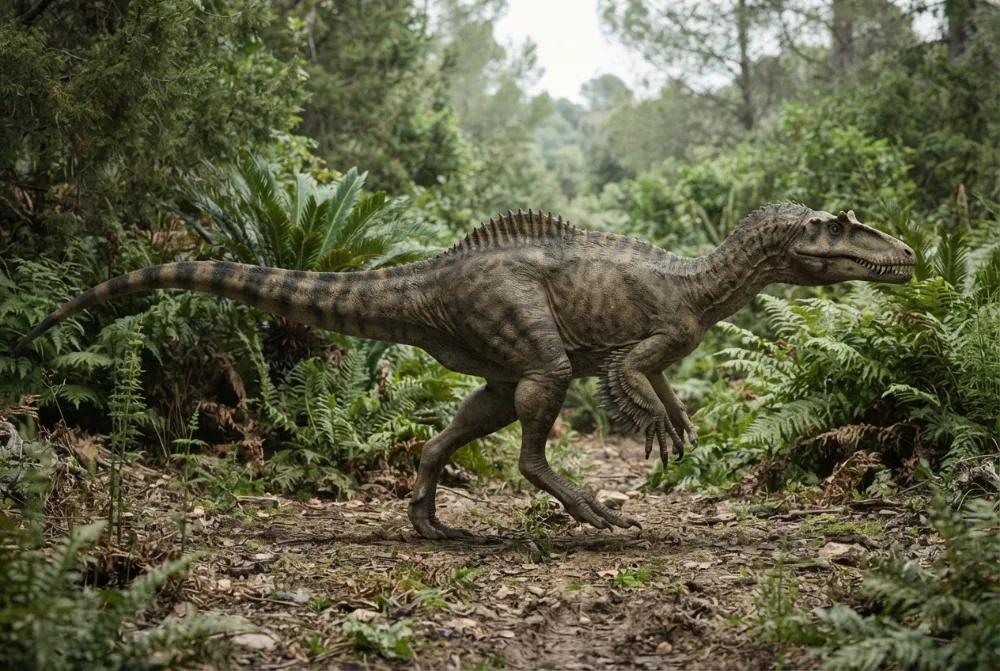
Eyona mibuzo ibuzwa kakhulu: Concavenator
?How big was Concavenator?
Concavenator was a medium sized dinosaur, about 5 to 6 metres long and weighed around 320 to 400 kilograms.31
?What did Concavenator eat?
Concavenator was a carnivore, meaning it ate meat. It likely hunted other animals that lived in its environment.1
?Did Concavenator have feathers?
Scientists disagree. Some think small bumps on its arm bone were quill knobs where feathers attached, but others think they were muscle scars. Scaly skin was found on its feet and tail.132
?Why did Concavenator have a hump?
Nobody knows for sure. It might have been used for display to recognise each other, or for temperature control like a camel's hump.13
?When did Concavenator live?
Concavenator lived about 130 to 125 million years ago, during the Early Cretaceous Period.13
?Where was Concavenator found?
Its fossils were found at the Las Hoyas site in Cuenca, Spain. That area was once an inland lake.13
?Was Concavenator a dinosaur?
Yes, Concavenator was a theropod dinosaur. It belongs to the carcharodontosaur group, which means 'shark-toothed lizards'.13
?Is Concavenator related to Spinosaurus?
No, Concavenator is not a spinosaur. It is a carcharodontosaur, a different group of meat-eating dinosaurs.1
Inyaniso ngeentsomi
Intsomi: Some people think Concavenator was a spinosaur because of its hump.
Inyaniso: Concavenator was not a spinosaur. It was a carcharodontosaur, a different group of meat-eating dinosaurs.1
Kwiingcali zeedayinaso
- Igama lenzululwazi
- Concavenator
- Inikwe igama ngu:
- Ortega et al. 20104
- Iqela
- Iidayinaso ezitya inyama
- Usapho / iclade
- Carcharodontosauridae4
- Ukuhlelwa
- Theropoda > Allosauroidea > Carcharodontosauridae4
- Ubudala bamatye
- 126 ukuya ku-121 izigidi zeminyaka (Barremian)4
- Izakhiwo zamatye
- La Huérguina4
- Amazwe
- iSpeyin4
- Iirekhodi zeefosili
- 1 kwi-Paleobiology Database4
- Ukufunyanwa
- Concavenator was named by Ortega, Escaso and Sanz in 2010. The type specimen is MCCM-LH 6666, a nearly complete skeleton found at Las Hoyas, Spain.14
- Kusaxoxwa ngayo
- Scientists still debate whether the bumps on Concavenator's arm bone are really quill knobs for feathers or something else.2
Apho iinyani zivela khona
- Concavenator | Natural History Museum (nhm.ac.uk)
- A bizarre, humped Carcharodontosauria (Theropoda) from the Lower Cretaceous of Spain | Nature (nature.com)
- Concavenator (en.wikipedia.org)
- Concavenator in The Paleobiology Database (CC BY 4.0): ubudala, iindawo, izakhiwo zamatye, ukuhlelwa.
Yonke inyani ekweli phepha inenombolo ebonisa umthombo wayo. Ukuba siphosisile, uxolo, sithanda iidayinaso, asiyojenali yenzululwazi. Sixelele apha: [email protected], siya kuyilungisa.
 URex ulambile! I-Dino Wiki yiprojekthi katata ukwenzela unyana wakhe othanda iidayinaso, isimahla, ayinazintengiso, ayinazilandeli. Abantu abadala banokuphakela uRex isidlwana ukuze incede ihlale kwi-intanethi.Phakela uRex
 Allosaurus
 Carnotaurus
 Dilophosaurus
 Giganotosaurus
 Compsognathus
 Paronychodon
 Stegosaurus
 Iguanodon
 Archaeopteryx
 Microraptor
 Deinonychus
 Baryonyx