 Uyiyiphi idayinaso? Ikwizi
 Idabi leedayinaso
 Ugqatso lweedayinaso
 Imidlalo emincinci yeedayinaso
 I-albhamu yezitikha
 Iilisti ze-TOP zeedayinaso
 Ndothuse!
Cruxicheiros
Cruxicheiros was a big meat-eating dinosaur that lived about 170 million years ago in what is now England. It was a fierce hunter that walked on two legs and had sharp teeth and claws. Its bones were found in a quarry in Warwickshire, and scientists think it was a close relative of the famous Megalosaurus.51
Yaphila nini?
Yayinkulu kangakanani?
Yayinde kangakanani?
Yayiphakame kangakanani?
uqikelelo
Yayinzima kangakanani?

 inde njengeemoto ezingama-2 zipakwe zilandelelana🍌inde njengeebhanana ezingama-50 zilandelelana🍉inzima njengamavatala angama-100🧸inzima njengabantwana basenkulisa abangama-26🎒inzima njengabantwana besikolo abangama-16🏃ibinokubaleka iimitha ezili-100 ngemizuzwana engama-8.6 (oyena mntu ukhawulezayo udinga i-9,6)
Cruxicheiros wayemkhulu kangakanani xa ethelekiswa NAWE?
Yimathematika nje kwibhrawuza yakho. Akukho nto igcinwayo okanye ithunyelwe naphi na.
Yayikhawuleza kangakanani?


Iinyani ezimnandi
Cruxicheiros was named in 2010, making it a relatively new dinosaur discovery.5
Its name means 'cross hand' in Latin and Greek, after the Cross Hands Quarry where its bones were found.1
The dinosaur's bones were discovered in the 1960s but were not identified as a new species until decades later.1
Cruxicheiros lived during the Middle Jurassic period, about 168 to 165 million years ago.5
The fossils include parts of the leg bones, vertebrae, and pelvis, but the skeleton is incomplete.12
Scientists are not sure exactly where Cruxicheiros fits in the dinosaur family tree, but it was a type of tetanuran theropod.2
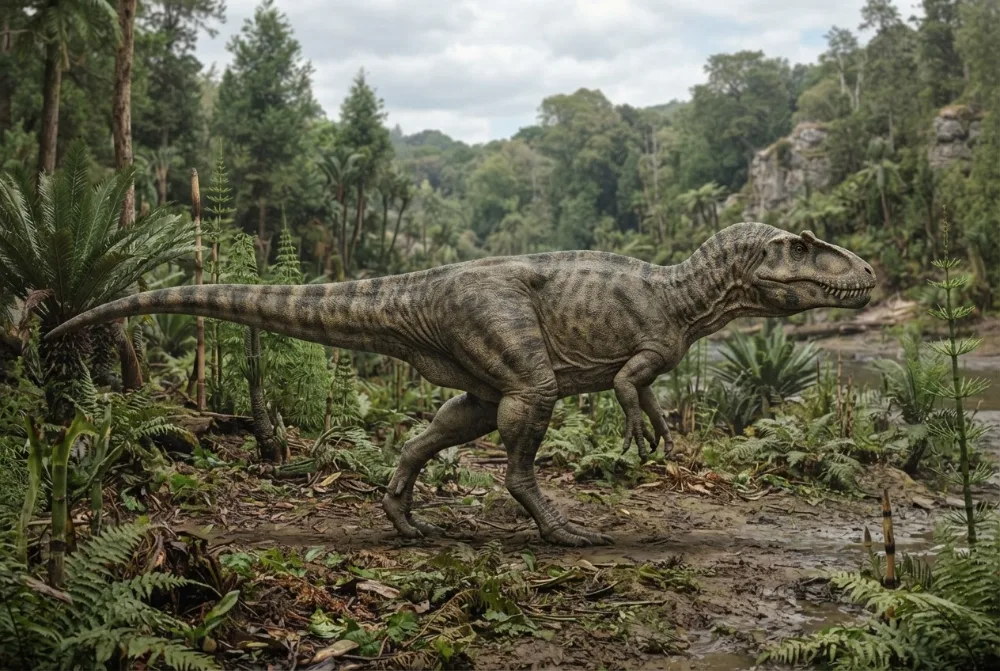
Eyona mibuzo ibuzwa kakhulu: Cruxicheiros
?How big was Cruxicheiros?
About 9 metres (29.5 feet) long, according to an estimate by Thomas Holtz in 2012.3
?Who discovered Cruxicheiros?
It was described by scientists Roger Benson and Jonathan Radley in 2010.3
?Where are Cruxicheiros fossils kept?
They are stored at the Warwickshire Museum Service in England, after being moved from the Birmingham Museum and Art Gallery in 2008.3
?How was Cruxicheiros different from Megalosaurus?
Cruxicheiros had lower and broader spines along its back, and differences in its leg and hip bones compared to Megalosaurus.3
Kwiingcali zeedayinaso
- Igama lenzululwazi
- Cruxicheiros
- Inikwe igama ngu:
- Benson and Radley 20105
- Iqela
- Iidayinaso ezitya inyama
- Usapho / iclade
- Tetanurae5
- Ukuhlelwa
- Theropoda5
- Ubudala bamatye
- 168 ukuya ku-165 izigidi zeminyaka (Bathonian)5
- Izakhiwo zamatye
- Chipping Norton Limestone5
- Amazwe
- iUnited Kingdom5
- Iirekhodi zeefosili
- 1 kwi-Paleobiology Database5
- Ukufunyanwa
- Cruxicheiros was named by scientists Benson and Radley in 2010. The bones were found in the 1960s at Cross Hands Quarry in Warwickshire, England, and were later studied and identified as a new species.51
- Kusaxoxwa ngayo
- Scientists are still debating exactly how Cruxicheiros is related to other theropod dinosaurs. Some think it was a very early tetanuran, while others place it closer to Megalosaurus.2
Apho iinyani zivela khona
- Warwickshire's 'New' Dinosaur (ourwarwickshire.org.uk)
- A new large-bodied theropod dinosaur from the middle jurassic of Warwickshire, United Kingdom - ORA - Oxford University Research Archive (ora.ox.ac.uk)
- Cruxicheiros (en.wikipedia.org)
- Cruxicheiros newmanorum | Dinosaur Database by DinoAnimals.com (dinoanimals.com)
- Cruxicheiros in The Paleobiology Database (CC BY 4.0): ubudala, iindawo, izakhiwo zamatye, ukuhlelwa.
Yonke inyani ekweli phepha inenombolo ebonisa umthombo wayo. Ukuba siphosisile, uxolo, sithanda iidayinaso, asiyojenali yenzululwazi. Sixelele apha: [email protected], siya kuyilungisa.
 URex ulambile! I-Dino Wiki yiprojekthi katata ukwenzela unyana wakhe othanda iidayinaso, isimahla, ayinazintengiso, ayinazilandeli. Abantu abadala banokuphakela uRex isidlwana ukuze incede ihlale kwi-intanethi.Phakela uRex
 Allosaurus
 Carnotaurus
 Dilophosaurus
 Giganotosaurus
 Compsognathus
 Paronychodon
 Ichthyosaurus
 Khudiakovia
 Ophthalmosaurus
 Pterodactylus
 Peloneustes
 Rhamphocephalus