 Uyiyiphi idayinaso? Ikwizi
 Idabi leedayinaso
 Ugqatso lweedayinaso
 Imidlalo emincinci yeedayinaso
 I-albhamu yezitikha
 Iilisti ze-TOP zeedayinaso
 Ndothuse!
Yaphila nini?

Yayikhawuleza kangakanani?


Iinyani ezimnandi
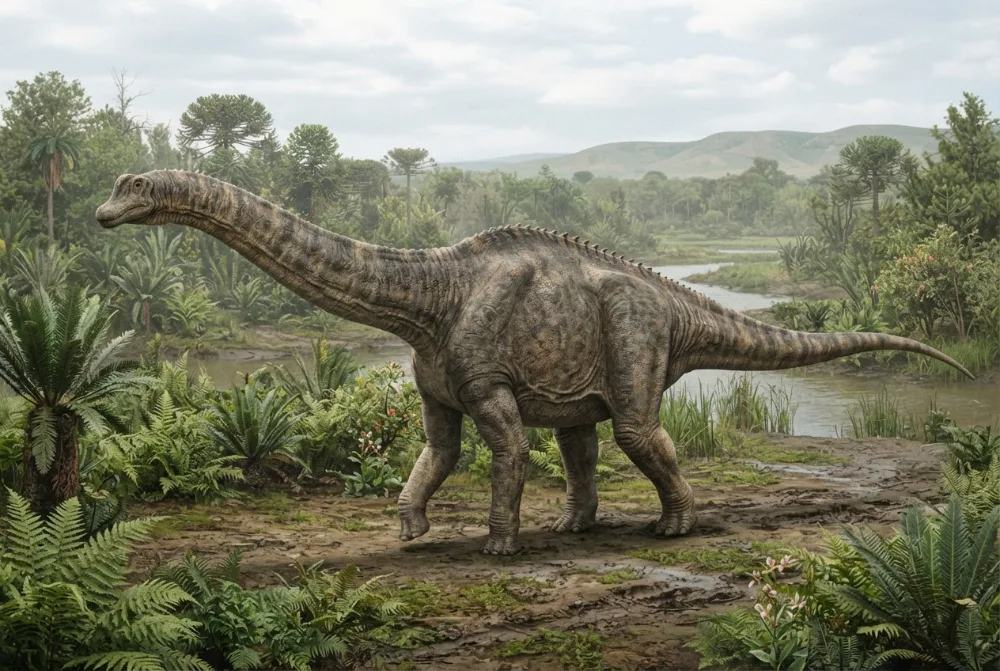
Dzharatitanis is the first rebbachisaurid dinosaur ever found in Asia. All other rebbachisaurids were known only from Africa, Europe, and South America.2
Scientists know Dzharatitanis from just one tail vertebra, which is about 10 centimetres (4 inches) long. The bone has complex air pockets, making it lightweight.2
Dzharatitanis lived about 92 to 90 million years ago, during the Turonian stage of the Late Cretaceous.1
The tail bone of Dzharatitanis has wing-like projections on the sides, which are features of rebbachisaurid dinosaurs.2
The species name kingi honors Dr. Christopher King, a geologist who studied the Cretaceous rocks of Central Asia.2
Eyona mibuzo ibuzwa kakhulu: Dzharatitanis
?How big was Dzharatitanis?
Nobody knows for sure, because scientists have only found one tail bone. That bone is about 10 centimetres (4 inches) long, so Dzharatitanis was probably a large sauropod, but its exact size is unknown.12
?Is Dzharatitanis a dinosaur?
Yes, it is a dinosaur. It is a sauropod, a long-necked plant-eating dinosaur.1
?What did Dzharatitanis eat?
It was a plant-eater. As a sauropod, it ate plants like leaves and ferns.1
Inyaniso ngeentsomi
Intsomi: Some people think Dzharatitanis was a titanosaur, like many other sauropods from the same area.
Inyaniso: When first described, Dzharatitanis was thought to be a rebbachisaurid, but later research suggests it might actually be a titanosaur. Scientists are still debating.13
Kwiingcali zeedayinaso
- Igama lenzululwazi
- Dzharatitanis
- Inikwe igama ngu:
- Averianov and Sues 20213
- Iqela
- Iintamo-nde
- Usapho / iclade
- Somphospondyli3
- Ukuhlelwa
- Sauropodomorpha > Sauropoda > Macronaria3
- Ubudala bamatye
- 94 ukuya ku-90 izigidi zeminyaka (Turonian)3
- Izakhiwo zamatye
- Bissekty3
- Amazwe
- iUzbekistan3
- Iirekhodi zeefosili
- 1 kwi-Paleobiology Database3
- Ukufunyanwa
- The only known bone of Dzharatitanis was found in 1997 by David J. Ward and Hans-Dieter Sues during an expedition in Uzbekistan. It was named and described in 2021.2
- Kusaxoxwa ngayo
- Scientists are not sure whether Dzharatitanis was a rebbachisaurid or a titanosaur. Different studies place it in different groups.13
Apho iinyani zivela khona
- Dzharatitanis (en.wikipedia.org)
- First rebbachisaurid sauropod dinosaur from Asia (pmc.ncbi.nlm.nih.gov)
- Dzharatitanis in The Paleobiology Database (CC BY 4.0): ubudala, iindawo, izakhiwo zamatye, ukuhlelwa.
Yonke inyani ekweli phepha inenombolo ebonisa umthombo wayo. Ukuba siphosisile, uxolo, sithanda iidayinaso, asiyojenali yenzululwazi. Sixelele apha: [email protected], siya kuyilungisa.
 URex ulambile! I-Dino Wiki yiprojekthi katata ukwenzela unyana wakhe othanda iidayinaso, isimahla, ayinazintengiso, ayinazilandeli. Abantu abadala banokuphakela uRex isidlwana ukuze incede ihlale kwi-intanethi.Phakela uRex
 Brachiosaurus
 Diplodocus
 Brontosaurus
 Argentinosaurus
 Camarasaurus
 Morosaurus
 Tyrannosaurus
 Triceratops
 Velociraptor
 Spinosaurus
 Ankylosaurus
 Parasaurolophus