 Uyiyiphi idayinaso? Ikwizi
 Idabi leedayinaso
 Ugqatso lweedayinaso
 Imidlalo emincinci yeedayinaso
 I-albhamu yezitikha
 Iilisti ze-TOP zeedayinaso
 Ndothuse!
Elaphrosaurus
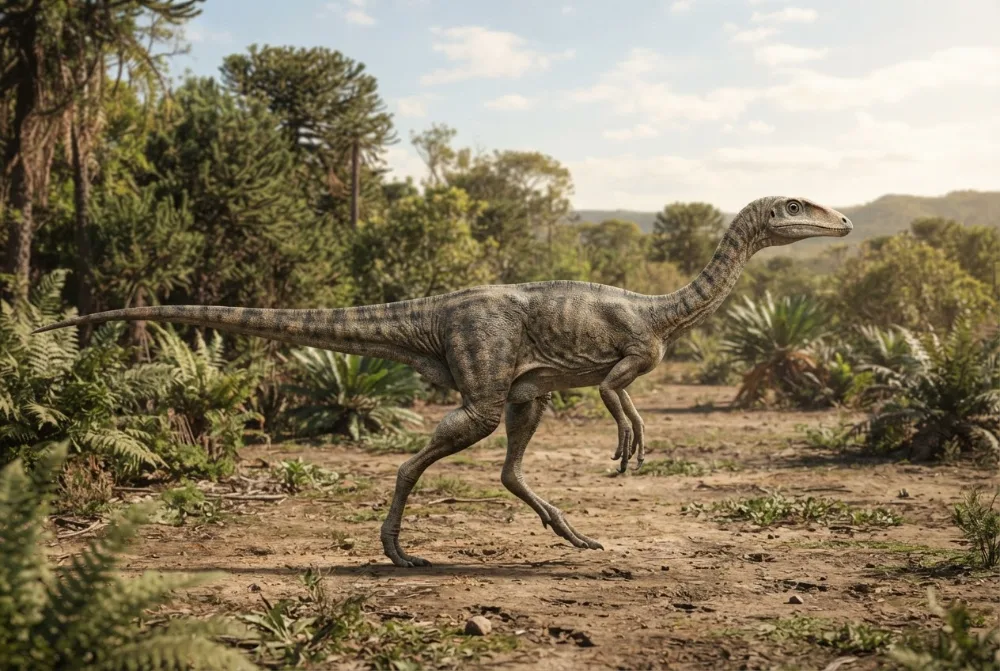
Elaphrosaurus was a long, slender dinosaur that ran fast on short legs. It lived in what is now Africa during the Late Jurassic Period, about 155 to 145 million years ago. Scientists think it might have eaten plants or small animals, not big prey.1
Yaphila nini?
Yayinkulu kangakanani?
Yayinde kangakanani?
Yayiphakame kangakanani?
Yayinzima kangakanani?
 inde njengezinja ezingama-6, impumlo ukuya emsileni🍌inde njengeebhanana ezingama-34 zilandelelana🍉inzima njengamavatala angama-42🧸inzima njengabantwana basenkulisa abangama-11🎒inzima njengabantwana besikolo abangama-7🏃ibinokubaleka iimitha ezili-100 ngemizuzwana engama-7.5 (oyena mntu ukhawulezayo udinga i-9,6)
Elaphrosaurus wayemkhulu kangakanani xa ethelekiswa NAWE?
Yimathematika nje kwibhrawuza yakho. Akukho nto igcinwayo okanye ithunyelwe naphi na.
Yayikhawuleza kangakanani?


Iinyani ezimnandi
Elaphrosaurus had very short legs for its body length, which is unusual for a meat-eating dinosaur.1
Its shin bone was longer than its thigh bone, which helped it run fast.1
No skull of Elaphrosaurus has ever been found, so scientists are not sure what its head looked like.1
Elaphrosaurus had a long tail that bent downward at the tip, a rare feature among theropods.1
It was once thought to be an ornithomimid (ostrich dinosaur), but now scientists place it in the group Ceratosauria.1
Elaphrosaurus was about 6.2 metres (20 feet) long but only weighed around 200 kilograms (440 pounds), making it lightly built.1
Fossils of Elaphrosaurus have also been found in the Morrison Formation of the United States, but those are fragmentary.1
Eyona mibuzo ibuzwa kakhulu: Elaphrosaurus
?How big was Elaphrosaurus?
About 6.2 metres (20 feet) long and 1.46 metres (4.8 feet) tall at the hip. It weighed around 200 to 210 kilograms (440 to 460 pounds).1
?What did Elaphrosaurus eat?
Scientists are not sure. It may have eaten plants or small animals, because its neck was not flexible enough to catch large prey.1
?Did Elaphrosaurus have feathers?
No fossil feathers have been found with Elaphrosaurus, so scientists do not know for sure. Many theropod dinosaurs are thought to have had feathers, but no direct evidence exists for this species.1
?How fast could Elaphrosaurus run?
Its long shin bone and light build suggest it was a fast runner, but no exact speed is known.1
?Where was Elaphrosaurus found?
Its fossils were discovered in Tanzania, Africa, in the Tendaguru Formation.1
Inyaniso ngeentsomi
Intsomi: Elaphrosaurus was a fast predator that hunted large dinosaurs.
Inyaniso: Its short legs and inflexible neck suggest it could not catch big prey. It may have eaten small animals or plants instead.1
Kwiingcali zeedayinaso
- Igama lenzululwazi
- Elaphrosaurus
- Inikwe igama ngu:
- Janensch 19203
- Iqela
- Iidayinaso ezitya inyama
- Usapho / iclade
- Noasauridae3
- Ukuhlelwa
- Theropoda > Ceratosauria3
- Ubudala bamatye
- 155 ukuya ku-94 izigidi zeminyaka (Kimmeridgian / Cenomanian)3
- Izakhiwo zamatye
- Tendaguru, Morrison3
- Amazwe
- iTanzania, iUSA, iMorocco3
- Iirekhodi zeefosili
- 4 kwi-Paleobiology Database3
- Ukufunyanwa
- Elaphrosaurus was named by German paleontologist Werner Janensch in 1920. The first nearly complete skeleton was found in 1910 in Tanzania during an expedition to the Tendaguru Formation.1
- Kusaxoxwa ngayo
- Scientists are still debating whether Elaphrosaurus was a carnivore, herbivore, or omnivore, because its skull is unknown and its neck was not built for hunting.1
Apho iinyani zivela khona
- Elaphrosaurus (en.wikipedia.org)
- Elaphrosaurus | Natural History Museum (nhm.ac.uk)
- Elaphrosaurus in The Paleobiology Database (CC BY 4.0): ubudala, iindawo, izakhiwo zamatye, ukuhlelwa.
Yonke inyani ekweli phepha inenombolo ebonisa umthombo wayo. Ukuba siphosisile, uxolo, sithanda iidayinaso, asiyojenali yenzululwazi. Sixelele apha: [email protected], siya kuyilungisa.
 URex ulambile! I-Dino Wiki yiprojekthi katata ukwenzela unyana wakhe othanda iidayinaso, isimahla, ayinazintengiso, ayinazilandeli. Abantu abadala banokuphakela uRex isidlwana ukuze incede ihlale kwi-intanethi.Phakela uRex
 Allosaurus
 Carnotaurus
 Dilophosaurus
 Giganotosaurus
 Compsognathus
 Paronychodon
 Stegosaurus
 Iguanodon
 Archaeopteryx
 Microraptor
 Deinonychus
 Baryonyx