 Uyiyiphi idayinaso? Ikwizi
 Idabi leedayinaso
 Ugqatso lweedayinaso
 Imidlalo emincinci yeedayinaso
 I-albhamu yezitikha
 Iilisti ze-TOP zeedayinaso
 Ndothuse!
Gondwanatitan
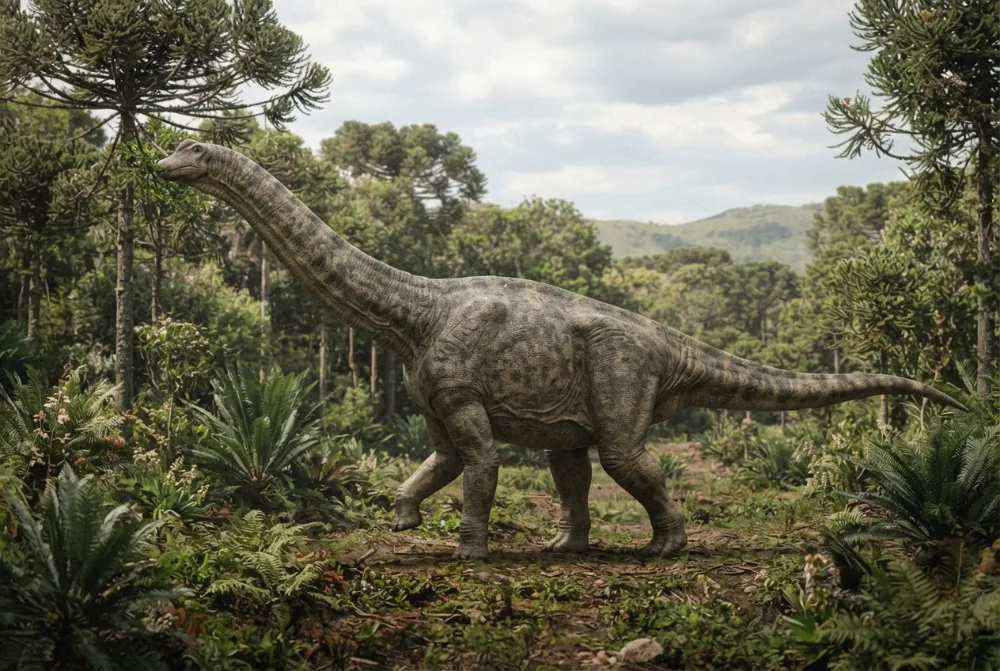
Gondwanatitan was a long-necked plant-eater that stomped around Brazil near the end of the Age of Dinosaurs. It was small for a sauropod, about as long as a school bus, and probably used its tall neck to munch leaves from high trees.1
Yaphila nini?
Yayinkulu kangakanani?
Yayinde kangakanani?
Yayiphakame kangakanani?
uqikelelo
Yayinzima kangakanani?
 inde njengezinja ezingama-7, impumlo ukuya emsileni🍌inde njengeebhanana ezingama-39 zilandelelana🍉inzima njengamavatala angama-200🧸inzima njengabantwana basenkulisa abangama-53🎒inzima njengabantwana besikolo abangama-31🐻❄️inzima njengeebhere ezimhlophe ezingama-2🏃ibinokubaleka iimitha ezili-100 ngemizuzwana engama-12 (oyena mntu ukhawulezayo udinga i-9,6)
Gondwanatitan wayemkhulu kangakanani xa ethelekiswa NAWE?
Yimathematika nje kwibhrawuza yakho. Akukho nto igcinwayo okanye ithunyelwe naphi na.
Yayikhawuleza kangakanani?


Iinyani ezimnandi
Gondwanatitan's middle tail bones are shaped like hearts, which helps scientists tell it apart from its close relative Aeolosaurus.1
Its limb bones were slender and graceful, not as heavy as those of many other sauropods.1
The shallow depressions on its vertebrae are similar to those seen in Saltasaurus, Alamosaurus, and Malawisaurus.1
The neural spines on its middle tail vertebrae point forward, a feature also seen in Cedarosaurus and Venenosaurus.1
In 2001, some scientists thought Gondwanatitan was the same as Aeolosaurus, but most now treat it as a separate genus.1
The type specimen was found on a farm in 1983, but it took until 1997 before scientists started preparing the bones.1
Eyona mibuzo ibuzwa kakhulu: Gondwanatitan
?How big was Gondwanatitan?
It was about 7 to 8 metres long and weighed around 1 tonne. That is small for a sauropod, about as long as a school bus.12
?What did Gondwanatitan eat?
It was a herbivore, eating tough shoots and leaves from the tops of trees. Its tall neck helped it reach high branches.13
?When did Gondwanatitan live?
It lived during the Late Cretaceous Period, about 70 million years ago.1
Inyaniso ngeentsomi
Intsomi: Gondwanatitan was a giant like other sauropods.
Inyaniso: Actually, Gondwanatitan was a fairly small sauropod, only about 7 meters long and weighing about 1 tonne.1
Kwiingcali zeedayinaso
- Igama lenzululwazi
- Gondwanatitan
- Inikwe igama ngu:
- Kellner and Azevedo 19993
- Iqela
- Iintamo-nde
- Usapho / iclade
- Aeolosaurini3
- Ukuhlelwa
- Sauropodomorpha > Sauropoda > Titanosauria > Macronaria3
- Ubudala bamatye
- 84 ukuya ku-66 izigidi zeminyaka (Campanian / Maastrichtian)3
- Izakhiwo zamatye
- Adamantina, Cambambe3
- Amazwe
- iBrazil3
- Iirekhodi zeefosili
- 2 kwi-Paleobiology Database3
- Ukufunyanwa
- The type specimen was discovered in 1983 on a farm in São Paulo, Brazil, and was formally named Gondwanatitan faustoi by Kellner and de Azevedo in 1999.13
- Kusaxoxwa ngayo
- Scientists still debate whether Gondwanatitan is really a separate genus from Aeolosaurus, since some bones look very similar.1
Apho iinyani zivela khona
- Gondwanatitan (en.wikipedia.org)
- Gondwanatitan (prehistoric-wildlife.com)
- Gondwanatitan in The Paleobiology Database (CC BY 4.0): ubudala, iindawo, izakhiwo zamatye, ukuhlelwa.
Yonke inyani ekweli phepha inenombolo ebonisa umthombo wayo. Ukuba siphosisile, uxolo, sithanda iidayinaso, asiyojenali yenzululwazi. Sixelele apha: [email protected], siya kuyilungisa.
 URex ulambile! I-Dino Wiki yiprojekthi katata ukwenzela unyana wakhe othanda iidayinaso, isimahla, ayinazintengiso, ayinazilandeli. Abantu abadala banokuphakela uRex isidlwana ukuze incede ihlale kwi-intanethi.Phakela uRex
 Brachiosaurus
 Diplodocus
 Brontosaurus
 Argentinosaurus
 Camarasaurus
 Morosaurus
 Tyrannosaurus
 Triceratops
 Velociraptor
 Spinosaurus
 Ankylosaurus
 Parasaurolophus