 Uyiyiphi idayinaso? Ikwizi
 Idabi leedayinaso
 Ugqatso lweedayinaso
 Imidlalo emincinci yeedayinaso
 I-albhamu yezitikha
 Iilisti ze-TOP zeedayinaso
 Ndothuse!
Henodus
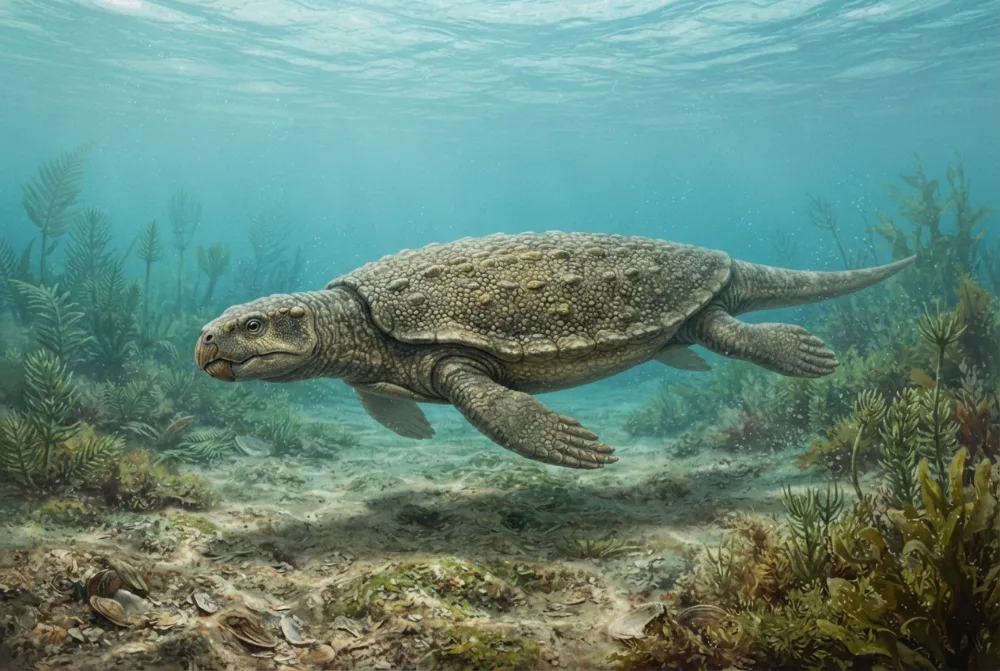
Henodus was a strange reptile that looked a bit like a turtle, but it wasn't one. It lived in shallow, salty lagoons during the Late Triassic, about 237 to 227 million years ago. It had a flat shell and a beak, and it probably used its special jaws to filter food from the water.13
Yaphila nini?
Yayinkulu kangakanani?
Yayinde kangakanani?
 inde njengeekati zasekhaya ezingama-2, impumlo ukuya emsileni🍌inde njengeebhanana ezingama-6 zilandelelana🏊ibinokuqubha ubude bechibi elikhulu lokuqubha (50 m) ngemizuzwana engama-30
Henodus wayemkhulu kangakanani xa ethelekiswa NAWE?
Yimathematika nje kwibhrawuza yakho. Akukho nto igcinwayo okanye ithunyelwe naphi na.
Yayikhawuleza kangakanani?


Iinyani ezimnandi
Henodus is the only placodont found in rocks that were not from the open sea, so it probably lived in brackish or freshwater lagoons.1
Its shell was made of many small bony plates that formed a mosaic pattern, unlike a turtle's shell.1
Henodus had only one tooth on each side of its mouth, and the rest of its jaws were a beak.1
It had baleen-like denticles along its jaws, similar to some whales, which helped it filter small food from the water.1
Its weak limbs suggest it spent little or no time on land.1
Scientists think Henodus could close its jaws very quickly, which helped it catch small prey.1
Small snail shells were found near the skulls of Henodus, so it might have eaten those tiny snails.2
Eyona mibuzo ibuzwa kakhulu: Henodus
?How big was Henodus?
About 1 metre (3.3 feet) long.1
?What did Henodus eat?
It probably ate tiny snails, small crustaceans, and maybe plants. It had a beak and baleen-like denticles to filter food from the water.12
?Was Henodus a dinosaur?
No, it was a marine reptile called a placodont, not a dinosaur.1
?Could Henodus walk on land?
Probably not much. Its weak limbs suggest it spent little or no time on land.1
?When did Henodus live?
It lived during the Late Triassic period, about 237 to 227 million years ago.1
?Why did Henodus have a shell?
Its shell was made of many small bony plates that formed a mosaic pattern, and it probably protected Henodus from predators.1
Inyaniso ngeentsomi
Intsomi: Henodus was a turtle.
Inyaniso: Henodus looked like a turtle, but it was a different kind of reptile called a placodont. Its shell was made of many more bones, and its limbs were not inside its ribcage like a turtle's.1
Kwiingcali zeedayinaso
- Igama lenzululwazi
- Henodus
- Inikwe igama ngu:
- Huene 19363
- Iqela
- Izirhubuluzi zaselwandle
- Usapho / iclade
- Henodontidae3
- Ukuhlelwa
- Placodontia > Sauropterygia3
- Ubudala bamatye
- 237 ukuya ku-227 izigidi zeminyaka (Carnian)3
- Izakhiwo zamatye
- Grabfeld3
- Amazwe
- iJamani3
- Iirekhodi zeefosili
- 1 kwi-Paleobiology Database3
- Ukufunyanwa
- Henodus was named by Friedrich von Huene in 1936. The first fossils were found in the Grabfeld Formation near Tübingen, Germany.31
- Kusaxoxwa ngayo
- Scientists are not sure exactly what Henodus ate. Some think it was a filter feeder, others think it ate plants, and some think it ate small animals. It might have done all of these.2
Apho iinyani zivela khona
- Henodus (en.wikipedia.org)
- Dentition and feeding in Placodontia: tooth replacement in Henodus chelyops | BMC Ecology and Evolution | Springer Nature Link (link.springer.com)
- Henodus in The Paleobiology Database (CC BY 4.0): ubudala, iindawo, izakhiwo zamatye, ukuhlelwa.
Yonke inyani ekweli phepha inenombolo ebonisa umthombo wayo. Ukuba siphosisile, uxolo, sithanda iidayinaso, asiyojenali yenzululwazi. Sixelele apha: [email protected], siya kuyilungisa.
 URex ulambile! I-Dino Wiki yiprojekthi katata ukwenzela unyana wakhe othanda iidayinaso, isimahla, ayinazintengiso, ayinazilandeli. Abantu abadala banokuphakela uRex isidlwana ukuze incede ihlale kwi-intanethi.Phakela uRex
 Nothosaurus
 Placodus
 Lariosaurus
 Cyamodus
 Cymatosaurus
 Proneusticosaurus
 Massospondylus
 Plateosaurus
 Coelophysis
 Podokesaurus
 Thecodontosaurus
 Eudimorphodon