 Uyiyiphi idayinaso? Ikwizi
 Idabi leedayinaso
 Ugqatso lweedayinaso
 Imidlalo emincinci yeedayinaso
 I-albhamu yezitikha
 Iilisti ze-TOP zeedayinaso
 Ndothuse!
Yaphila nini?

Yayinkulu kangakanani?
Yayinde kangakanani?
Juravenator wayemkhulu kangakanani xa ethelekiswa NAWE?
Yimathematika nje kwibhrawuza yakho. Akukho nto igcinwayo okanye ithunyelwe naphi na.
Yayikhawuleza kangakanani?


Iinyani ezimnandi
Juravenator is known from a single, nearly complete skeleton of a juvenile, making it one of the best-preserved predatory dinosaurs from Europe.21
Unlike many other small theropods from the same time, Juravenator did not have feathers or feather-like structures on its tail.21
Scientists think Juravenator may have been nocturnal, based on the shape of its eye bones.1
In 2020, researchers found tiny round structures on the sides of Juravenator's tail that might have been sensory organs, like those on crocodile scales.1
The only known Juravenator fossil was found in a lagoon deposit, suggesting it may have drowned after being washed into the water.1
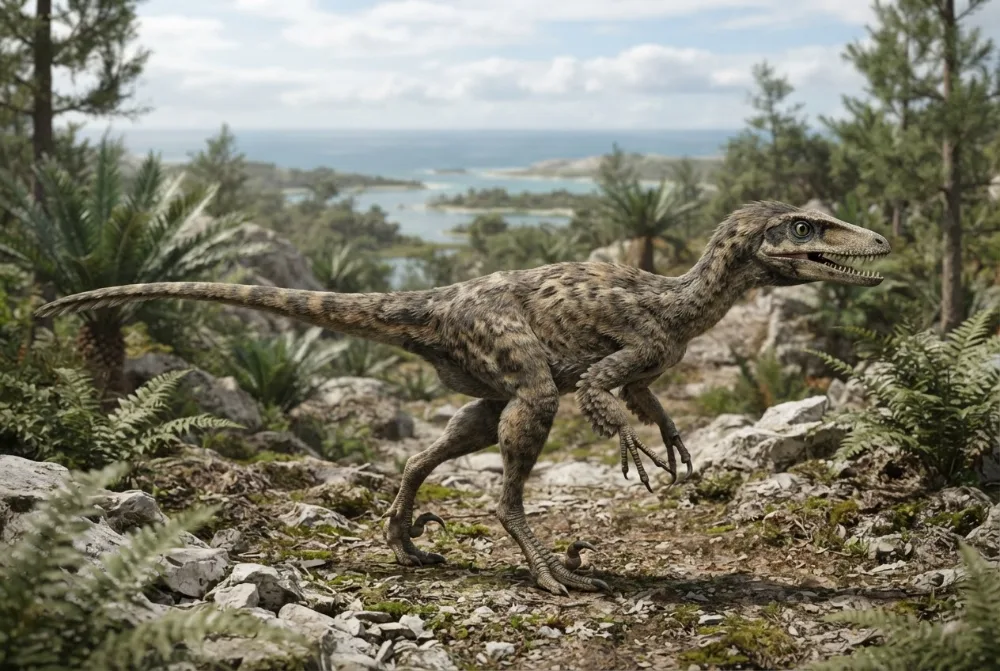
Eyona mibuzo ibuzwa kakhulu: Juravenator
?How big was Juravenator?
About 75 centimetres (2.46 feet) long, which is roughly the size of a small dog.1
?Did Juravenator have feathers?
It had mostly scales on its tail and legs, but some faint impressions of possible simple feathers have been found on the top of the tail and hips.1
?What did Juravenator eat?
It was a small meat-eater that may have hunted fish and other small prey in shallow water.4
?Could Juravenator swim?
It may have waded in water to hunt, but it probably did not swim well. The only known fossil was found in a lagoon, possibly after drowning.1
?Was Juravenator nocturnal?
Yes, scientists think it may have been nocturnal based on the shape of its eye bones.1
?Where was Juravenator found?
In Germany, in the Franconian Jura region, from rocks that are about 151 to 152 million years old.1
Kwiingcali zeedayinaso
- Igama lenzululwazi
- Juravenator
- Inikwe igama ngu:
- Göhlich and Chiappe 20065
- Iqela
- Iidayinaso ezitya inyama
- Usapho / iclade
- Coelurosauria5
- Ukuhlelwa
- Theropoda5
- Ubudala bamatye
- 152 ukuya ku-149 izigidi zeminyaka (Kimmeridgian)5
- Izakhiwo zamatye
- Painten5
- Amazwe
- iJamani5
- Iirekhodi zeefosili
- 1 kwi-Paleobiology Database5
- Ukufunyanwa
- Juravenator was discovered in 1998 by volunteers Klaus-Dieter Weiß and Hans-Joachim Weiß in a quarry near Schamhaupten, Germany. It was named and described by Ursula Göhlich and Luis Chiappe in 2006.12
- Kusaxoxwa ngayo
- Scientists are not sure if Juravenator was fully grown when it died, because the only known skeleton is from a juvenile.1
Apho iinyani zivela khona
- Juravenator (en.wikipedia.org)
- A new carnivorous dinosaur from the Late Jurassic Solnhofen archipelago | Nature (nature.com)
- PBDB Taxon (paleobiodb.org)
- This small dinosaur had a marvelous sense of touch, detailed fossils reveal | National Geographic (nationalgeographic.com)
- Juravenator in The Paleobiology Database (CC BY 4.0): ubudala, iindawo, izakhiwo zamatye, ukuhlelwa.
Yonke inyani ekweli phepha inenombolo ebonisa umthombo wayo. Ukuba siphosisile, uxolo, sithanda iidayinaso, asiyojenali yenzululwazi. Sixelele apha: [email protected], siya kuyilungisa.
 URex ulambile! I-Dino Wiki yiprojekthi katata ukwenzela unyana wakhe othanda iidayinaso, isimahla, ayinazintengiso, ayinazilandeli. Abantu abadala banokuphakela uRex isidlwana ukuze incede ihlale kwi-intanethi.Phakela uRex
 Allosaurus
 Carnotaurus
 Dilophosaurus
 Giganotosaurus
 Compsognathus
 Paronychodon
 Brachiosaurus
 Diplodocus
 Brontosaurus
 Camarasaurus
 Morosaurus
 Apatosaurus