 Uyiyiphi idayinaso? Ikwizi
 Idabi leedayinaso
 Ugqatso lweedayinaso
 Imidlalo emincinci yeedayinaso
 I-albhamu yezitikha
 Iilisti ze-TOP zeedayinaso
 Ndothuse!
Kaijutitan
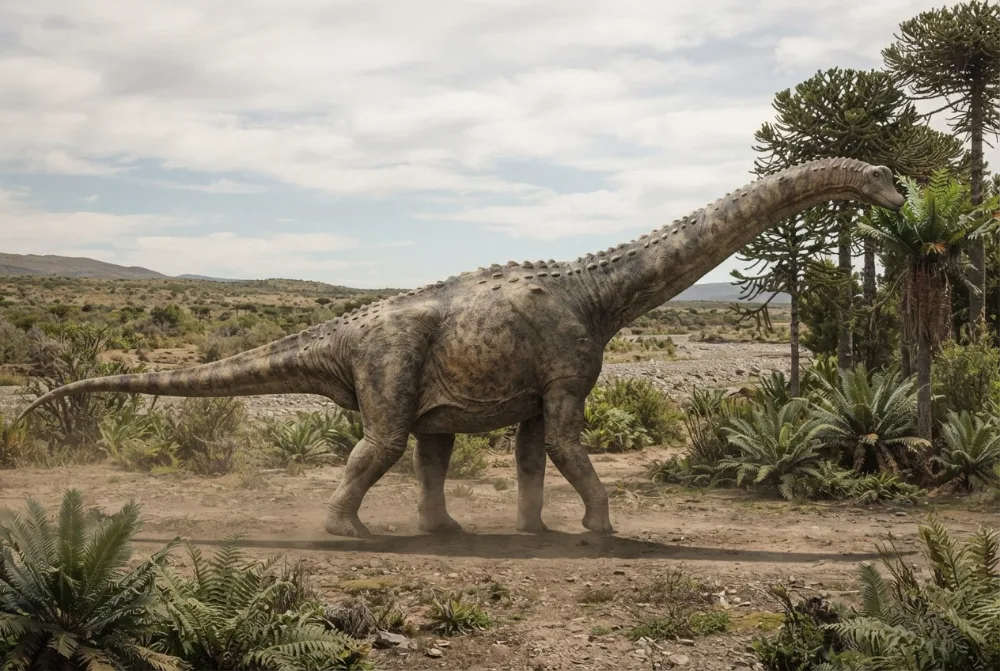
Kaijutitan was a giant, long-necked plant-eater that lived in what is now Argentina. It is one of the earliest known titanosaurs, a group that includes the biggest dinosaurs ever. Its neck bones had a strange split shape, like a fork.42
Yaphila nini?
Yayinkulu kangakanani?
Yayinzima kangakanani?

Kaijutitan wayemkhulu kangakanani xa ethelekiswa NAWE?
Yimathematika nje kwibhrawuza yakho. Akukho nto igcinwayo okanye ithunyelwe naphi na.
Yayikhawuleza kangakanani?


Iinyani ezimnandi
Kaijutitan is the latest known basal titanosaur, meaning it lived near the end of the time when early titanosaurs existed.2
Its neck vertebrae had bifid (split) neural spines, a feature that evolved several times among sauropods but is rare in titanosaurs.2
The fossil includes part of the skull, which is very unusual for large titanosaurs because their skulls are rarely preserved.2
Kaijutitan lived about 89 to 86 million years ago, during the Coniacian stage of the Late Cretaceous.4
Its bones were found scattered in an area of about 20 square metres, suggesting the carcass fell apart before being buried.2
The species name maui honors the Museo Municipal Argentino Urquiza (MAU), where the fossil is stored.1
Eyona mibuzo ibuzwa kakhulu: Kaijutitan
?How big was Kaijutitan?
Scientists don't know its exact size yet, but it was a huge sauropod, one of the giant titanosaurs. Its bones show it was an adult of huge body size.31
?What did Kaijutitan eat?
Kaijutitan was a plant-eater, like all sauropods. It used its long neck to reach leaves from tall trees.1
Kwiingcali zeedayinaso
- Igama lenzululwazi
- Kaijutitan
- Inikwe igama ngu:
- Filippi et al. 20194
- Iqela
- Iintamo-nde
- Usapho / iclade
- Lithostrotia4
- Ukuhlelwa
- Sauropodomorpha > Sauropoda > Titanosauria > Macronaria4
- Ubudala bamatye
- 90 ukuya ku-86 izigidi zeminyaka (Coniacian)4
- Izakhiwo zamatye
- Sierra Barrosa4
- Amazwe
- i-Argentina4
- Iirekhodi zeefosili
- 1 kwi-Paleobiology Database4
- Ukufunyanwa
- Kaijutitan was named in 2019 by paleontologists Leonardo Filippi, Leonardo Salgado, and Alberto Garrido. The skeleton was found by a team from the Museo Municipal Argentino Urquiza and the Museo Provincial de Ciencias Naturales in Argentina.42
- Kusaxoxwa ngayo
- Scientists are not sure exactly how big Kaijutitan was, because only a partial skeleton has been found.2
Apho iinyani zivela khona
- Kaijutitan (en.wikipedia.org)
- A new giant basal titanosaur sauropod in the Upper Cretaceous (Coniacian) of the NeuquEn Basin, Argentina (rid.unrn.edu.ar)
- KAIJUTITAN MAUI, A SAUROPOD TITANOSAUR FROM THE UPPER CRETACEOUS (SIERRA BARROSA FORMATION, NEUQUÉN BASIN) OF NORTHERN PATAGONIA ARGENTINA: HISTOLOGICAL AND TAPHONOMIC CONSIDERATIONS | Publicación Electrónica de la Asociación Paleontológica Argentina (peapaleontologica.org.ar)
- Kaijutitan in The Paleobiology Database (CC BY 4.0): ubudala, iindawo, izakhiwo zamatye, ukuhlelwa.
Yonke inyani ekweli phepha inenombolo ebonisa umthombo wayo. Ukuba siphosisile, uxolo, sithanda iidayinaso, asiyojenali yenzululwazi. Sixelele apha: [email protected], siya kuyilungisa.
 URex ulambile! I-Dino Wiki yiprojekthi katata ukwenzela unyana wakhe othanda iidayinaso, isimahla, ayinazintengiso, ayinazilandeli. Abantu abadala banokuphakela uRex isidlwana ukuze incede ihlale kwi-intanethi.Phakela uRex
 Brachiosaurus
 Diplodocus
 Brontosaurus
 Argentinosaurus
 Camarasaurus
 Morosaurus
 Tyrannosaurus
 Triceratops
 Velociraptor
 Spinosaurus
 Ankylosaurus
 Parasaurolophus