 Uyiyiphi idayinaso? Ikwizi
 Idabi leedayinaso
 Ugqatso lweedayinaso
 Imidlalo emincinci yeedayinaso
 I-albhamu yezitikha
 Iilisti ze-TOP zeedayinaso
 Ndothuse!
Leivanectes
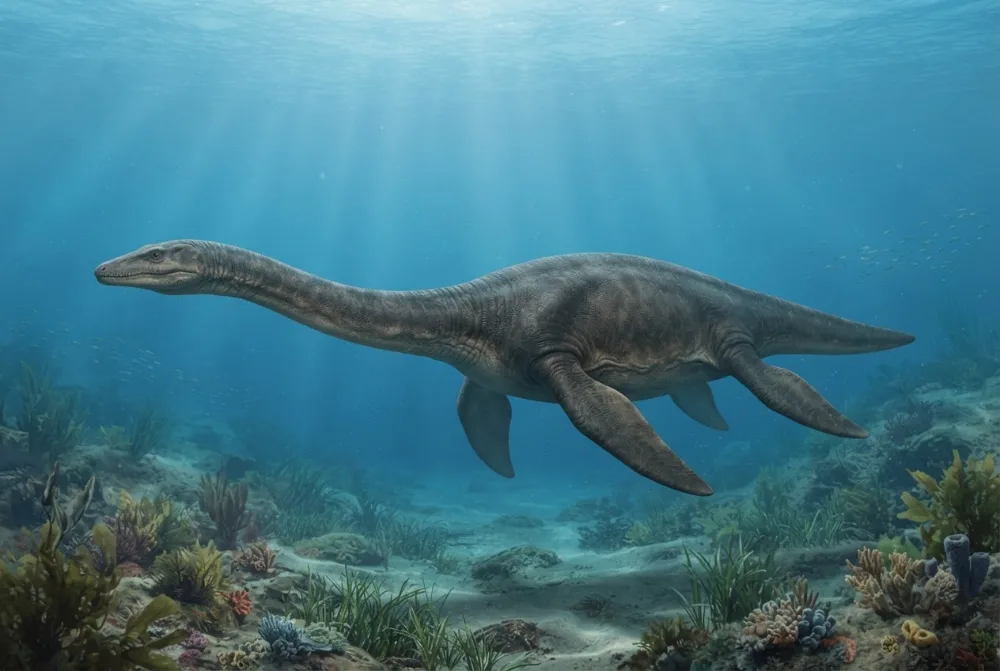
Leivanectes was a long-necked marine reptile that swam in the warm seas of Colombia about 115 million years ago. It was a plesiosaur, not a dinosaur, and it used its strong flippers to paddle through the water. This ocean hunter had a special short jaw with big teeth for catching large fish.12
Yaphila nini?
Yayikhawuleza kangakanani?


Iinyani ezimnandi
Leivanectes had fewer and larger teeth than any other known elasmosaurid plesiosaur. It only had 3 teeth in the front of its lower jaw, while a similar plesiosaur called Callawayasaurus had 5.2
This plesiosaur lived during the Aptian stage of the Early Cretaceous, between about 119 and 113 million years ago.1
Leivanectes was named in 2019 by a team of scientists from Argentina and Colombia, including María Páramo-Fonseca and José O'Gorman.12
Its short jaw and big teeth suggest Leivanectes ate larger prey than other long-necked elasmosaurids, which usually ate small fish.2
Leivanectes is only known from a partial skull and lower jaw, so scientists are not sure how big its body was.2
Kwiingcali zeedayinaso
- Igama lenzululwazi
- Leivanectes
- Inikwe igama ngu:
- Páramo-Fonseca et al. 20193
- Iqela
- Iiplesiosauri
- Usapho / iclade
- Elasmosauridae3
- Ukuhlelwa
- Plesiosauria > Elasmosauridae > Sauropterygia3
- Ubudala bamatye
- 120 ukuya ku-113 izigidi zeminyaka (Aptian)3
- Izakhiwo zamatye
- Paja3
- Amazwe
- iColombia3
- Iirekhodi zeefosili
- 1 kwi-Paleobiology Database3
- Ukufunyanwa
- Leivanectes was discovered in the Paja Formation of Villa de Leiva, Colombia, and named in 2019 by Páramo-Fonseca and colleagues. The species name bernardoi honors a local person named Bernardo.12
- Kusaxoxwa ngayo
- Scientists are not sure how long Leivanectes' neck was, because only its skull has been found. It might have had a shorter neck than other elasmosaurids.2
Apho iinyani zivela khona
- PBDB Taxon (paleobiodb.org)
- A new late Aptian elasmosaurid from the Paja Formation, Villa de Leiva, Colombia (explore.openaire.eu)
- Leivanectes in The Paleobiology Database (CC BY 4.0): ubudala, iindawo, izakhiwo zamatye, ukuhlelwa.
Yonke inyani ekweli phepha inenombolo ebonisa umthombo wayo. Ukuba siphosisile, uxolo, sithanda iidayinaso, asiyojenali yenzululwazi. Sixelele apha: [email protected], siya kuyilungisa.
 URex ulambile! I-Dino Wiki yiprojekthi katata ukwenzela unyana wakhe othanda iidayinaso, isimahla, ayinazintengiso, ayinazilandeli. Abantu abadala banokuphakela uRex isidlwana ukuze incede ihlale kwi-intanethi.Phakela uRex
 Elasmosaurus
 Pliosaurus
 Plesiosaurus
 Cimoliasaurus
 Colymbosaurus
 Trinacromerum
 Stegosaurus
 Iguanodon
 Archaeopteryx
 Giganotosaurus
 Microraptor
 Deinonychus